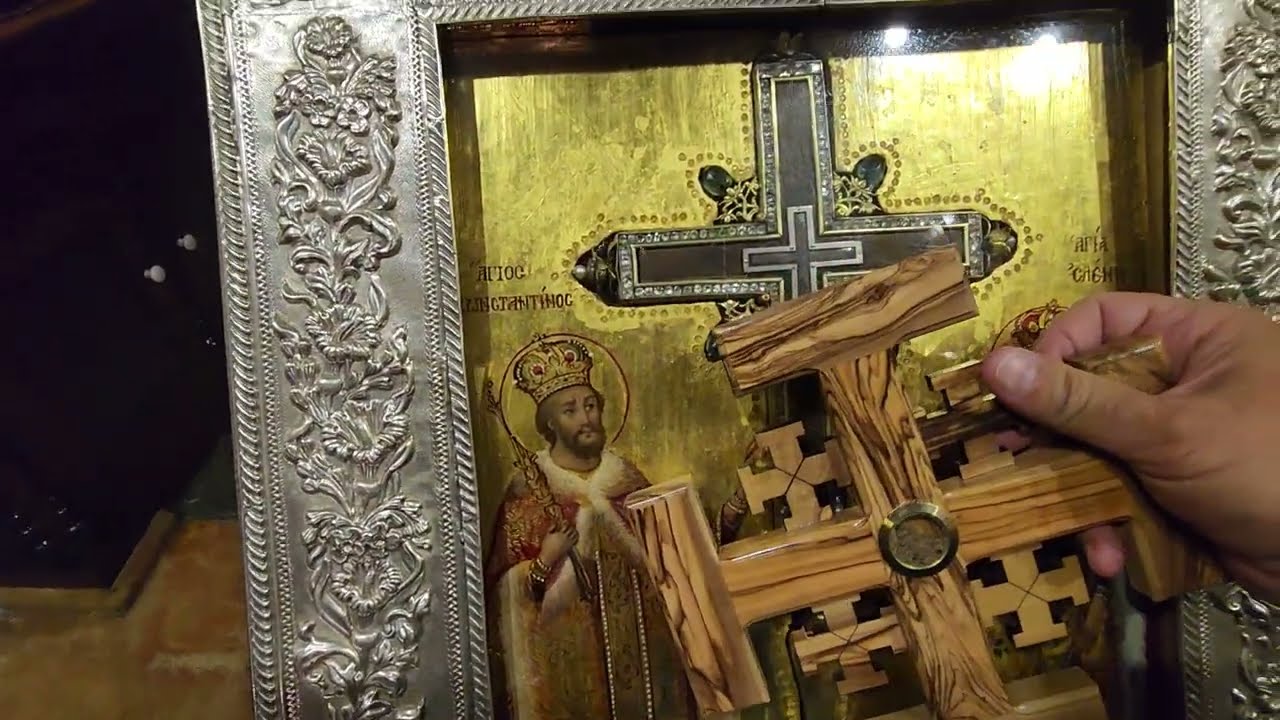

## Relic of the True Cross (Jerusalem) The venerated Relic of the True Cross in Jerusalem holds a profound place in Christian history, tracing its origins to the momentous discovery by Saint Helena, mother of Emperor Constantine, in the early 4th century. According to tradition, during her pilgrimage to the Holy Land around 326 AD, Helena embarked on a mission to locate sites associated with the life of Christ. Guided by local Christians, she is said to have unearthed three crosses on Golgotha, the site of Christ's crucifixion. To discern the True Cross from those of the two thieves, a miraculous healing of a sick woman or the resurrection of a deceased person was attributed to its touch. A significant portion of this True Cross was then enshrined in the newly constructed Church of the Holy Sepulchre, while other fragments were sent to Constantinople and Rome. Within Catholic tradition, the Relic of the True Cross is considered one of the most sacred and powerful relics, representing the very instrument of Christ's sacrifice and redemption. It serves as a tangible link to the Passion of Jesus, inviting profound contemplation on His suffering, death, and resurrection. The veneration of the True Cross, particularly during Holy Week and on the Feast of the Exaltation of the Holy Cross (September 14th), is a cornerstone of Catholic piety, fostering a deeper understanding of the Paschal Mystery. It symbolizes God's immense love for humanity and the victory of life over death, inspiring countless pilgrims throughout history to seek spiritual solace and grace through its presence. Today, a significant fragment of the Relic of the True Cross is preserved and venerated within the Greek Orthodox Treasury of the Church of the Holy Sepulchre in Jerusalem. While the original large piece discovered by St. Helena has been subdivided over centuries due to historical events, pilfering, and the distribution of fragments to various churches worldwide, the portion held in Jerusalem is considered to be a direct descendant of the original discovery. It is typically displayed for veneration on special occasions, particularly during the Orthodox Holy Week, allowing pilgrims and the faithful to approach and reverence this sacred artifact, connecting them to nearly two millennia of Christian devotion and the central mystery of their faith.

Historical details are being researched.
Seeing the relic of Relic of the True Cross (Jerusalem) in Jerusalem was an experience I will carry with me always. The church housing it has such a rich history. I was struck by how many people still come to venerate this relic after so many centuries.
October 16, 2024