Biography
Blessed Helen Enselmini, a luminous figure in the early history of the Poor Clares, was born into a noble family in Padua, Italy, around the turn of the 13th century. From her earliest years, Helen displayed a profound piety and a deep longing for God, a spiritual inclination that set her apart from many of her peers. The vibrant spiritual renewal sweeping through Italy, ignited by the nascent Franciscan movement, deeply resonated with her young heart. It was in this fervent atmosphere that she encountered the revolutionary ideals of St. Francis of Assisi and St. Clare, who championed a life of radical poverty, prayer, and service to God. Despite her privileged background, Helen felt an irresistible call to embrace this austere way of life, forsaking worldly comforts for the spiritual riches of Christ.
At the tender age of twelve, Blessed Helen, with an unwavering spirit, entered the monastery of the Poor Clares in Padua, becoming one of the very first women in Italy to join this burgeoning order. Her life within the cloister was a testament to profound humility, rigorous penance, and unceasing prayer. She quickly became a model for her sisters, known for her extraordinary devotion to the Blessed Sacrament and her deep contemplative spirit. Though her life was largely hidden within the monastery walls, her sanctity radiated outwards, inspiring those who knew her. She bore her physical ailments with remarkable patience, offering her sufferings as a sacrifice to God, and her spiritual wisdom, though she was young in years, was sought by many, including St. Anthony of Padua, who reportedly visited her for spiritual counsel.
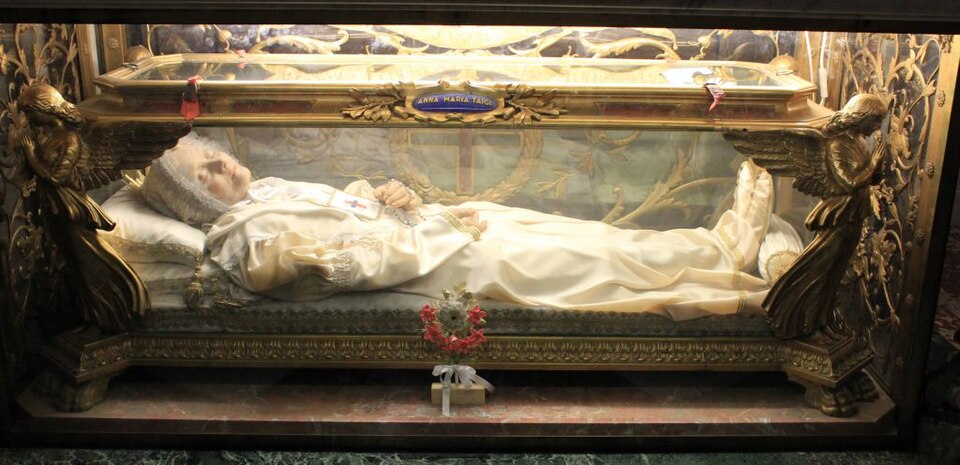
Blessed Helen Enselmini departed this earthly life in 1242, at the young age of twenty-three, leaving behind a legacy of fervent devotion. Her death, though premature by human standards, was met with a profound sense of her sanctity. Miraculously, her body remained incorrupt, a testament to her purity and closeness to God, defying the natural processes of decay. Her perfectly preserved remains are enshrined in the Basilica of Saint Anthony in Padua, Italy, where they continue to be venerated by the faithful. The discovery of her incorrupt body served as a powerful affirmation of her holiness and the grace of God at work within her.
The enduring legacy of Blessed Helen Enselmini lies not only in the miraculous preservation of her body but also in her embodiment of the Franciscan ideal for women. She stands as a powerful example of youthful sanctity, radical obedience, and unwavering faith. Her life, though brief, illuminated the path of spiritual perfection for countless others, particularly within the Poor Clare Order. Today, pilgrims to the Basilica of Saint Anthony can witness the profound miracle of her incorrupt body, a tangible link to a saint who, through her simple yet profound life, continues to inspire a deep love for God and a commitment to the Gospel message. Her beatification by the Church further solidified her place among the blessed, offering her as a model of holiness for all generations.
Discovery
The remarkable story of Blessed Helen Enselmini's incorruption begins not long after her death in 1242. While the initial burial was in the common manner of the time, within the convent grounds, the first formal discovery of her incorrupt state occurred in 1295, a mere 53 years after her passing. This exhumation was not a casual affair but a deliberate act, prompted by the growing veneration of Helen among the Poor Clares and the local populace. Accounts from the period describe a solemn procession of nuns, led by their abbess, accompanied by ecclesiastical authorities and local dignitaries, to the grave site. As the earth was carefully removed and the simple wooden coffin opened, a collective gasp reportedly rippled through the onlookers. Instead of the skeletal remains expected after half a century, Helen's body was found to be remarkably preserved. Her skin retained its natural color, her limbs were supple, and a sweet, unearthly fragrance, often described as that of roses and lilies, emanated from her. This miraculous state was immediately recognized as a sign of divine favor, further cementing her reputation for sanctity. The discovery was meticulously documented by the attending clergy, who noted the absence of any signs of decay, despite the damp conditions of the grave.
Over the centuries, the incorrupt body of Blessed Helen Enselmini has undergone several examinations and translations, each confirming her extraordinary state. One significant re-examination took place in 1500, nearly 250 years after her death. During this inspection, conducted by a panel of physicians and theologians, her body was still found to be intact, though some natural desiccation had occurred. Her skin, while still present, had taken on a more parchment-like quality, and her features were more pronounced. Yet, the flexibility of her joints remained, and the faint, sweet aroma was still perceptible to those in close proximity. Another notable event occurred in 1700, when her body was once again examined and found to be in a similar state of preservation. It was during this period that protective measures began to be more seriously considered. The consistent reports across these centuries of her uncorrupted state, defying the natural laws of decomposition, served as a powerful testament to her holiness and fueled the ongoing devotion to her. These repeated inspections, often involving the opening of her reliquary, provided invaluable historical documentation of her physical condition over time.
The journey of Blessed Helen's preservation and display reflects the evolving practices of the Church in venerating its saints. Following her initial discovery, her body was initially placed in a simple wooden casket within the convent chapel, accessible to the nuns. As her cult grew and more pilgrims sought her intercession, a more prominent display became necessary. In the 16th century, she was enshrined in a more elaborate reliquary, often adorned with precious metals and jewels, reflecting the artistic sensibilities of the Renaissance. By the 18th century, with advancements in glassmaking, her body was placed in a crystal or glass casket, allowing for public veneration while offering protection. This transparent display, a common practice for incorrupt saints, allowed the faithful to directly view her preserved remains. Today, Blessed Helen Enselmini rests in a glass-sided casket, clad in the habit of the Poor Clares, within the Convent of the Poor Clares in Padua, Italy. The casket is housed in a specially constructed chapel, designed to maintain stable environmental conditions and protect the relic from deterioration. This careful stewardship ensures that future generations can continue to witness this enduring miracle.
Beyond the remarkable physical preservation, several unusual phenomena have been consistently associated with Blessed Helen Enselmini's incorrupt body. The most frequently cited is the sweet fragrance, often described as a blend of roses, lilies, and other heavenly scents, which has been reported by numerous witnesses over the centuries, even when the body was enclosed. This phenomenon, known as the odor of sanctity, is a recurring theme in the lives of many incorruptible saints. While the body has naturally undergone some dehydration over the centuries, it has never exhibited the putrefaction or skeletal decomposition expected of a body interred for so long. There are also accounts, though less frequently documented in recent times, of a subtle flexibility in her limbs, even centuries after her death, defying the rigor mortis and subsequent stiffening that typically occurs. These extraordinary details, attested to by various ecclesiastical authorities and lay witnesses throughout history, further underscore the miraculous nature of her incorruption and continue to inspire awe and devotion among those who come to venerate her.
Spiritual Significance
The remarkable phenomenon of incorruption, as exemplified by Blessed Helen Enselmini, stands as a profound theological signpost within Catholic tradition, offering a tangible witness to the Church's understanding of the human body and its ultimate destiny. Far from being a mere biological anomaly, the preservation of Helen's earthly remains speaks directly to the doctrine of the body as a temple of the Holy Spirit, as articulated in 1 Corinthians 6:19. This sacred dwelling, consecrated by baptism and graced by divine indwelling, is deemed worthy of special divine care, even beyond death. The incorrupt state of a saint's body, therefore, is interpreted not as a defiance of natural decay, but as a supernatural affirmation of God's power over creation and a foretaste of the resurrection of the body, a central tenet of Christian faith. It underscores the belief that the entire person – body and soul – is destined for glory. For Blessed Helen, whose life was marked by an extraordinary devotion to Christ, her incorruption serves as a visible testament to the sanctity that permeated her being, a sanctity so profound that it touched even her physical form. The Church, in acknowledging such instances, invites the faithful to contemplate the profound mystery of God's transformative grace and the ultimate triumph over death promised to those who live in Christ.
Blessed Helen Enselmini's life was a vibrant testament to the Franciscan charism, deeply rooted in a radical embrace of poverty, prayer, and humility. Her unique spiritual gift lay in her profound contemplative spirit, a mystical inclination that drew her ever closer to God amidst the nascent Poor Clare movement. Forsaking the comforts of her noble birth, Helen exemplified heroic virtue through her unwavering commitment to the austere life championed by St. Clare. Her humility was evident in her willingness to abandon worldly status for the simplicity of the cloister, while her profound charity manifested in her selfless devotion to God and her sisters in community. Obedience, a cornerstone of Franciscan spirituality, guided her every action, reflecting a deep trust in divine providence and the wisdom of her superiors. Her mysticism was not an escape from reality, but a deeper engagement with it, seeing God's presence in all things and striving for an intimate union with Him. Helen's life, therefore, contributed significantly to the spiritual legacy of the Poor Clares, demonstrating that true spiritual wealth lies not in material possessions but in an unreserved surrender to God's will, a profound lesson she lived out daily with unwavering conviction and grace.
Devotion to Blessed Helen Enselmini has blossomed over the centuries, drawing countless pilgrims to her resting place in the Convent of the Poor Clares in Padua, Italy. Her incorrupt body, a powerful visual reminder of her sanctity, has been a focal point for veneration, inspiring awe and profound spiritual reflection. While not officially designated a patron saint for a specific cause, her life of radical poverty and contemplative prayer has naturally made her a source of inspiration for those seeking deeper spiritual commitment and detachment from worldly concerns. Pilgrims often bring their petitions and prayers to her shrine, seeking her intercession for spiritual guidance, strength in adversity, and a renewed sense of purpose. Though no specific novenas or elaborate feast day traditions are widely known outside of her order, the simple act of visiting her remains and offering prayers is a deeply cherished practice. The experience of encountering her incorrupt body is often described as profoundly moving, a tangible bridge to the spiritual realm that transcends time and space. Visitors speak of a palpable sense of peace and the profound realization of the enduring power of holiness, fostering a deeper connection to the communion of saints and the eternal life they represent.
The spiritual power emanating from Blessed Helen Enselmini's incorrupt body has been a source of profound consolation and a conduit for numerous miracles throughout the ages. While the Church meticulously investigates such claims, documented healings, conversions, and answered prayers have been attributed to her intercession, testifying to her continued presence and efficacy in the communion of saints. These miracles, whether physical cures from illness, spiritual transformations leading to a deeper faith, or unexpected solutions to seemingly insurmountable problems, serve as powerful affirmations of God's grace working through His chosen servants. The very presence of her incorrupt body, defying the natural laws of decay, is itself considered a perpetual miracle, a constant reminder of divine power and the promise of resurrection. For the faithful, this tangible sign of God's favor offers immense spiritual comfort, reinforcing their belief in the intercessory power of saints and the ultimate triumph of life over death. It fosters a sense of hope and encourages a deeper trust in God's loving providence, demonstrating that even in our earthly struggles, we are not alone, but surrounded by a cloud of witnesses who continue to pray for us.
Blessed Helen Enselmini's enduring message for contemporary Catholics and seekers resonates with profound relevance in an increasingly materialistic and secularized world. Her radical embrace of poverty and her unwavering commitment to a life centered on God offer a powerful counter-narrative to the prevailing pursuit of wealth, status, and fleeting pleasures. In an age often characterized by spiritual emptiness and a disconnection from the sacred, Helen's life challenges us to re-evaluate our priorities, reminding us that true fulfillment lies not in what we accumulate, but in our relationship with the divine. Her incorruption serves as a tangible bridge between the visible and invisible worlds, a physical manifestation of spiritual truth that defies purely scientific explanation. It invites us to look beyond the superficial and to contemplate the deeper realities of faith, grace, and eternal life. From her example, modern believers can learn the transformative power of humility, the profound peace found in detachment, and the enduring joy that comes from a life wholly dedicated to God. Her legacy continues to inspire a deeper commitment to prayer, a renewed appreciation for simplicity, and a courageous pursuit of holiness, offering a timeless beacon of hope and spiritual guidance for all who seek a more meaningful existence.
AI summary
A plain-language overview generated from this page's source material. Always verify with primary sources.