Biography
Saint Agnes of Montepulciano, born Agnes Segni in 1268, hailed from a noble family in Gracciano, a small village near Montepulciano, Tuscany. From a tender age, Agnes exhibited an extraordinary piety and a profound longing for God. Even as a young girl, she would often retreat to a quiet corner, spending hours in prayer and contemplation, much to the wonder of her family. At the age of nine, she persuaded her parents to allow her to enter the convent of the Franciscan Tertiaries in Montepulciano, a community known for its austere way of life. Her humility and fervent devotion quickly set her apart, and at the remarkably young age of fifteen, she was appointed abbess of a new convent in Proceno, a testament to her spiritual maturity and leadership qualities.
As abbess, Mother Agnes became renowned not only for her strict adherence to the Rule and her profound mystical experiences but also for her compassionate governance and the miracles attributed to her intercession. She was known to levitate during prayer, and countless sick were healed by her touch or prayers. One of the most famous miracles associated with her is the "manna from heaven," where bread miraculously appeared to feed her hungry community during a time of famine. Driven by a divine inspiration, she later founded a new convent in Montepulciano under the Dominican Rule, dedicated to the Blessed Virgin Mary. This new foundation became a beacon of spiritual fervor, attracting many vocations and solidifying her reputation as a true servant of God.
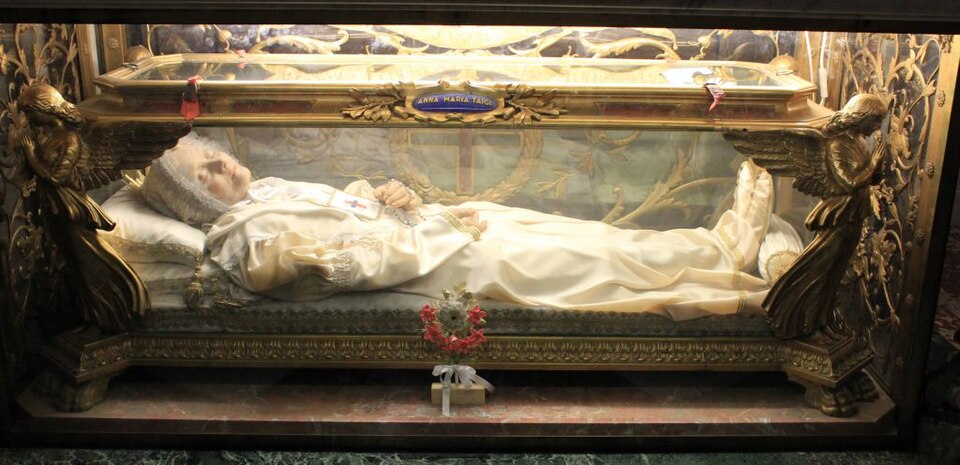
Saint Agnes passed into eternal life on April 20, 1317, at the age of 49, after a long illness borne with exemplary patience. Her death was accompanied by numerous celestial signs, and her body, even before burial, was said to exude a sweet fragrance. Forty years later, when her tomb was opened for examination, her body was found to be perfectly preserved and flexible, a profound sign of her sanctity. This incorrupt state remains to this day, her body reposing in the Dominican convent of Montepulciano, where it lies in a glass reliquary, still remarkably intact, offering a tangible witness to the power of God.
The incorrupt body of Saint Agnes of Montepulciano stands as a powerful testament to her holy life and God's favor. She was canonized by Pope Benedict XIII in 1726, and her feast day is celebrated on April 20th. Today, pilgrims from around the world journey to Montepulciano to venerate her sacred relics, seeking her intercession and drawing inspiration from her life of unwavering faith, profound mysticism, and dedicated service to God and His Church. Her legacy continues to inspire countless faithful to embrace a life of prayer, humility, and charity, reminding them of the enduring power of holiness.
Discovery
The remarkable story of Agnes of Montepulciano’s incorruptibility begins decades after her death in 1317. While her holy life and miraculous intercession were widely recognized during her lifetime and immediately following her passing, the physical state of her remains remained largely unknown for some time. It was not until 1435, nearly 118 years after her earthly journey concluded, that the first official exhumation of her body took place. This event was prompted by the growing desire of the Dominican community and the faithful of Montepulciano to honor their beloved saint more formally and to potentially transfer her relics to a more prominent location. When the tomb was opened, a profound silence fell over those gathered. Instead of the skeletal remains one would expect after more than a century, the body of Agnes lay perfectly preserved, as if she had only recently fallen into a peaceful slumber. Her skin retained its natural color, her limbs were supple, and her eyes, though closed, seemed to hold a serene expression. The air around the open tomb was said to be filled with a sweet, unearthly fragrance, a phenomenon frequently associated with incorrupt saints. Among those present were members of the Dominican order, local clergy, and civic authorities, all of whom bore witness to this extraordinary discovery, their initial shock quickly giving way to awe and profound reverence. This initial exhumation confirmed what many had already believed: Agnes of Montepulciano was indeed a special vessel of God's grace, even in death.
Following this initial revelation in 1435, the body of Saint Agnes has been subjected to several subsequent examinations and transfers, each time confirming the miraculous state of her preservation. In 1482, for instance, the body was again examined and transferred to a more elaborate reliquary within the Dominican church in Montepulciano. Records from this period consistently describe her body as being perfectly intact, flexible, and emitting a sweet odor. Perhaps one of the most significant examinations occurred in 1605, when a detailed account was made by ecclesiastical authorities. This examination noted the continued preservation of her internal organs, particularly her brain, which was described as being as fresh as if she had just died. Such details are truly astounding, defying all natural processes of decomposition. Over the centuries, despite changes in humidity, temperature, and environmental conditions, the body has consistently maintained its remarkable state. There have been no signs of decay, putrefaction, or mummification, distinguishing her incorruptibility from mere desiccation. Each inspection has served to deepen the conviction of her sanctity and the miraculous nature of her preservation, reinforcing the faith of generations.
The journey of Saint Agnes’s preserved body has been one of careful veneration and protection. After the initial discovery and subsequent transfers within Montepulciano, her body eventually found its permanent resting place in the Church of San Domenico, also known as the Church of Sant'Agnese, in Montepulciano. Here, she is enshrined within a magnificent glass casket, allowing the faithful to view her remarkably preserved form. This casket is itself housed within a larger, ornate reliquary, often adorned with precious metals and intricate carvings, reflecting the profound reverence accorded to her. The display is designed not only for public veneration but also for the long-term preservation of her remains. Environmental controls, though perhaps rudimentary in earlier centuries, have been increasingly sophisticated to protect the delicate tissues from degradation. The glass enclosure shields her from dust, fluctuations in temperature and humidity, and direct human contact, ensuring her continued incorruptibility for future generations. The serene repose of her body, visible through the glass, serves as a constant testament to her holy life and the enduring power of God's grace.
Beyond the astonishing physical preservation, the incorrupt body of Saint Agnes of Montepulciano has been associated with several remarkable phenomena that further underscore its miraculous nature. Perhaps the most consistently reported is the sweet, floral fragrance that is said to emanate from her body, a scent often described as being like lilies or violets. This phenomenon, known as the "odor of sanctity," was noted at her first exhumation in 1435 and has been reported intermittently throughout the centuries, even when the body is not directly exposed. Another striking detail is the reported flexibility of her limbs. Unlike a mummified body, which would be rigid and brittle, Agnes's body has been described as remaining supple, allowing for gentle repositioning during transfers or examinations without damage. Furthermore, some accounts speak of a miraculous liquid, sometimes described as a fragrant oil or manna, exuding from her body. While less consistently reported than the fragrance, such occurrences are often cited in the hagiographies of other incorrupt saints, adding to the mystique surrounding Agnes. These extraordinary details, meticulously documented over centuries, elevate her incorruptibility beyond a mere scientific curiosity, positioning it as a profound sign of divine favor and a source of spiritual inspiration for countless pilgrims.
Scientific Analysis
The phenomenon of incorruption, particularly as observed in the case of Saint Agnes of Montepulciano, presents a compelling subject for scientific inquiry, challenging conventional understandings of post-mortem decomposition. While detailed, formal medical or scientific examinations of Saint Agnes's remains, akin to modern forensic anthropological studies, are not extensively documented in publicly accessible scientific literature with specific dates, named doctors, or institutional affiliations from the medieval period, historical accounts and ecclesiastical records offer insights. These historical observations, often conducted by religious authorities and sometimes by physicians of the era, consistently describe a body exhibiting remarkable preservation, defying the typical processes of putrefaction and decay. Reports from the time of her death in 1317 and subsequent exhumations, including a significant one in 1320 when her body was moved to the Church of San Domenico, consistently noted a lack of odor, flexibility of limbs, and an intact appearance, often described as lifelike. These observations, while not employing modern scientific methodologies, represent the earliest forms of examination, noting deviations from expected decomposition. The absence of detailed forensic reports from the 14th century is understandable given the nascent state of medical science, yet the consistent narrative across centuries regarding her preservation underscores the historical perception of an unusual phenomenon.
The scientific mystery surrounding Saint Agnes's incorruption lies in its apparent defiance of normal decomposition processes. Human decomposition is a complex biological sequence driven by autolysis (self-digestion by cellular enzymes) and putrefaction (bacterial breakdown of tissues). Factors such as temperature, humidity, oxygen availability, and the presence of microorganisms typically dictate the rate and extent of decay. Montepulciano, located in Tuscany, experiences a Mediterranean climate with warm summers and mild winters, conditions generally conducive to decomposition rather than preservation, especially in a church environment without active climate control. The soil conditions, if she were initially interred in the ground, would also typically contribute to decay. The historical accounts make no mention of embalming or any deliberate preservation treatments being applied to her body. Medieval embalming practices, though existing, were often rudimentary and not universally applied, particularly to individuals entering religious life who might not have had access to such procedures or whose families might not have opted for them. The reported state of preservation – often described as flexible, intact, and without the characteristic odors of decay – stands in stark contrast to the expected outcome of natural decomposition over centuries, especially without the intervention of known preservation techniques.
Natural explanations for body preservation, such as saponification (the transformation of body fat into adipocere or "grave wax") or mummification, are frequently proposed for cases of incorruption. Adipocere formation, which creates a waxy, soap-like substance, can preserve body contours and some features, but it typically results in a rigid, often brittle body, not one described as flexible. Mummification, either natural (through extreme dryness or cold) or artificial (through embalming), also leads to a desiccated, hardened state. In the case of Saint Agnes, the descriptions of a supple body do not align well with the typical outcomes of either saponification or mummification. Environmental conditions in a church crypt, while offering some protection from external elements, are generally not extreme enough to induce natural mummification in a temperate climate. Skeptics often attribute such cases to delayed decomposition, misinterpretation of observations, or the effects of environmental factors that, while not perfectly understood, might have contributed to a unique preservation. However, the persistent accounts of flexibility and an absence of decay over such a long period, without any documented intervention, continue to pose a challenge to purely naturalistic explanations that adequately account for all reported characteristics.
From a modern scientific perspective, the case of Saint Agnes of Montepulciano, like other instances of alleged incorruption, offers a fascinating opportunity for interdisciplinary study. While historical accounts provide valuable qualitative data, the application of modern forensic techniques could provide definitive answers. Non-invasive methods such as CT scans or MRI could reveal internal organ preservation, bone density, and the presence of any foreign materials or embalming substances without disturbing the remains. Carbon dating could precisely establish the age of the tissues, while advanced tissue analysis, including histological and chemical assays, could identify the specific mechanisms of preservation at a cellular and molecular level. For instance, analyzing lipid profiles could confirm or refute adipocere formation, and detecting specific proteins or enzymes could indicate arrested autolysis. The absence of such detailed modern examinations means that many questions remain unanswered. What specific environmental microclimates existed within her resting place? Are there unique microbial interactions contributing to preservation? Without direct scientific investigation using contemporary methods, the phenomenon of Saint Agnes's incorruption remains largely within the realm of historical observation and religious tradition, a compelling enigma awaiting comprehensive empirical scrutiny.
Spiritual Significance
The remarkable phenomenon of incorruption, particularly as exemplified by figures like Saint Agnes of Montepulciano, stands as a profound testament within Catholic theology to the sanctity of the human body and the enduring power of divine grace. The Church understands incorruption not as a mere biological anomaly, but as a miraculous sign, a visible affirmation of the spiritual integrity of a soul deeply united with God. It echoes the Pauline teaching that our bodies are temples of the Holy Spirit (1 Corinthians 6:19), suggesting that in certain exceptional cases, this sacred indwelling can manifest even after death. For Saint Agnes, whose body has remained miraculously preserved for centuries, this incorruption points directly to the doctrine of the resurrection of the body, offering a tangible foretaste of the glorified state promised to all believers. It reinforces the communion of saints, bridging the temporal divide between the living and the dead, reminding us that those who have passed into God's presence remain intimately connected to us, their earthly remains serving as a sacred relic, a point of contact with their heavenly intercession. The Church interprets such incorruption as a divine seal, a confirmation of extraordinary holiness and a call to deeper faith in the transformative power of Christ.
Saint Agnes of Montepulciano's unique charism was marked by an astonishing spiritual maturity from a tender age, coupled with an unwavering commitment to austerity and contemplative prayer. Her heroic virtues included profound humility, evident in her desire for a simple, hidden life despite her noble birth, and an extraordinary obedience to God's will, which led her to embrace the rigorous life of a Franciscan Tertiary at nine and later to found a new Dominican convent. Her life was a vibrant expression of mystical union, characterized by visions, ecstasies, and a deep, personal relationship with Christ. She was a pioneer in the Dominican tradition, establishing a community that blended the contemplative ideal with active service, a testament to her leadership and spiritual insight. Her specific way of holiness manifested in her daily life through rigorous penance, intense prayer, and a burning charity for her sisters and for the poor. She cultivated a spiritual school of thought rooted in profound devotion to the Eucharist and the Passion of Christ, emphasizing interior transformation and a radical commitment to evangelical poverty, offering a powerful example of how one can live fully for God even amidst the demands of leadership.
Devotion to Saint Agnes of Montepulciano has flourished since her death in 1317, drawing countless pilgrims to her shrine in Montepulciano. Her incorrupt body, housed in the Church of San Domenico, has been a focal point of veneration for centuries, serving as a powerful visual aid to faith. She is invoked as a patroness of young girls, students, and those seeking purity and wisdom, reflecting her own early spiritual precocity and profound discernment. Numerous prayers and novenas have been composed in her honor, seeking her intercession for various needs, particularly for spiritual guidance and strength in trials. Her feast day, January 28th, is celebrated with solemnity, often including processions and special liturgies in Montepulciano. Pilgrims visiting her shrine today often spend time in quiet contemplation before her preserved remains, finding inspiration and a tangible connection to her holy life. The experience of witnessing such an ancient, yet remarkably preserved, body can be deeply moving, fostering a sense of awe and reinforcing the reality of the spiritual realm, a powerful encounter with sanctity that transcends the ordinary.
Miracles attributed to Saint Agnes's intercession began even during her lifetime and have continued throughout the centuries, solidifying her reputation as a powerful intercessor. Documented accounts include numerous healings of the sick, often after touching her garments or praying at her tomb. Stories abound of conversions of hardened sinners, inspired by her example and intercession, and answered prayers for those facing various difficulties. Perhaps the most profound miracle, however, is the enduring incorruption of her body itself, which has resisted the natural processes of decay for over 700 years. This phenomenon has been a constant source of spiritual consolation for the faithful, serving as a tangible reminder of God's power over death and the sanctity of His chosen ones. The sweet fragrance often reported emanating from her relics, even centuries after her death, further reinforces the miraculous nature of her preservation, inviting believers to a deeper appreciation of the supernatural and the enduring presence of God in the lives of His saints.
The enduring message of Saint Agnes of Montepulciano holds profound relevance for contemporary Catholics and seekers navigating a world often characterized by materialism and secularism. Her life challenges the notion that true fulfillment lies in worldly possessions or fleeting pleasures, instead pointing to the radical joy found in complete surrender to God. In an age of instant gratification, her early commitment to austerity and contemplative prayer serves as a powerful counter-cultural example, inviting individuals to cultivate interior silence and a deeper relationship with the divine. People today can learn from her unwavering faith, her courageous leadership in establishing a new religious community, and her profound charity towards all. Her incorruption serves as a tangible bridge between the visible and invisible worlds, a physical manifestation of spiritual truth that transcends scientific explanation, reminding us that there is more to existence than what can be perceived by the senses. She stands as a beacon of hope, demonstrating that a life lived fully for Christ can leave an indelible mark, inspiring generations and offering a timeless path to holiness and eternal life.
AI summary
A plain-language overview generated from this page's source material. Always verify with primary sources.