Biography
Saint Cecilia, a noble Roman maiden born around the year 200, emerged from the patrician gens Caecilia, a family of considerable influence in the heart of the Roman Empire. Raised amidst the splendor and pagan traditions of her age, Cecilia’s heart was nonetheless drawn to the nascent Christian faith, embracing its tenets with profound devotion and a purity of spirit that set her apart. From her earliest days, she consecrated her virginity to God, a sacred vow she cherished above all earthly desires. Her formative years were marked by fervent prayer and a deep internalization of Christian principles, preparing her for the trials that lay ahead in an era of intense persecution against believers.
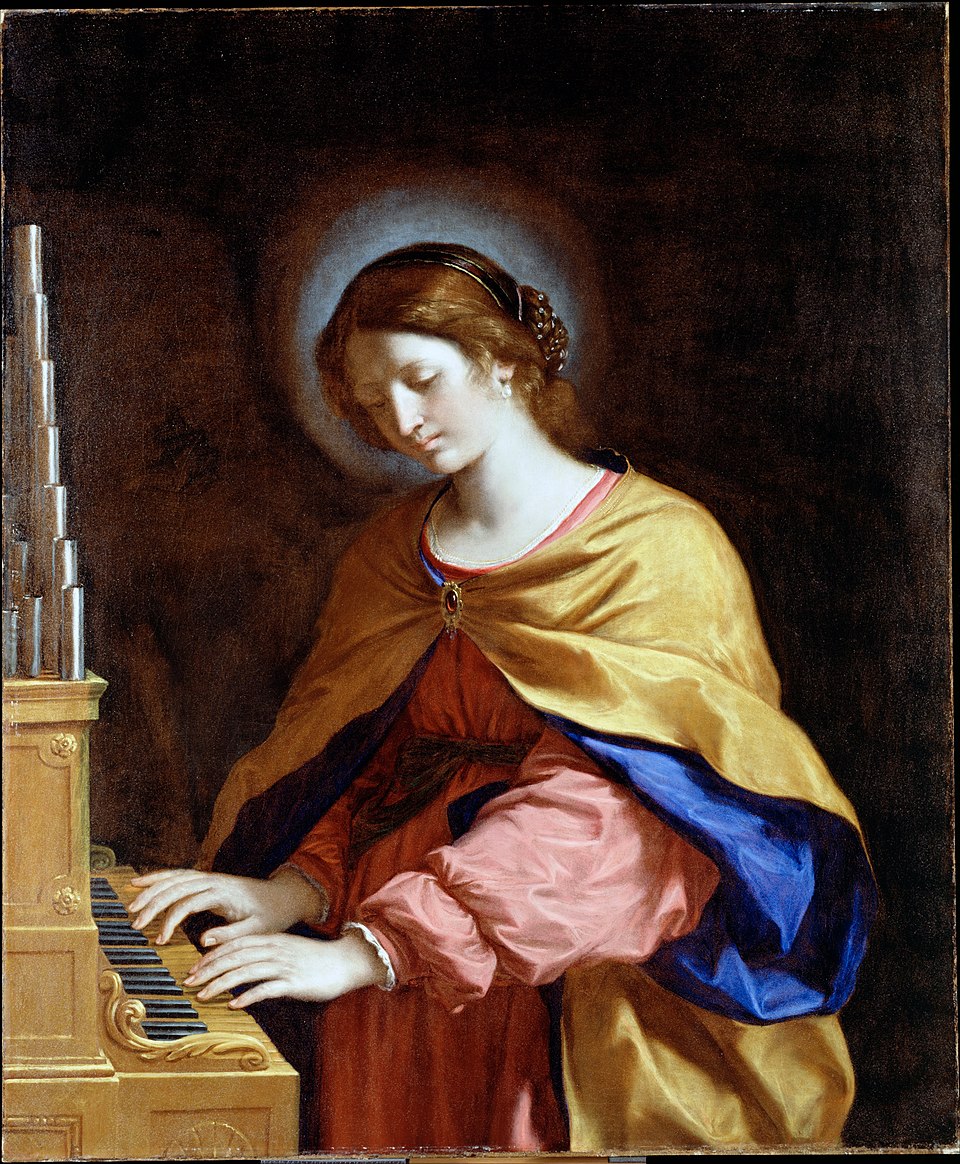
Her unwavering faith was put to the ultimate test when her parents, according to Roman custom, arranged her marriage to Valerian, a young pagan nobleman. On her wedding day, as the sounds of instruments filled the air, Cecilia, in her heart, sang only to God, imploring Him to preserve her purity. This profound inner melody, a testament to her spiritual devotion even amidst worldly celebration, is the beautiful genesis of her patronage of music and musicians. Through divine intercession and her eloquent persuasion, she not only converted Valerian but also his brother Tiburtius, and together they dedicated themselves to works of charity, burying the bodies of martyred Christians. Their courageous acts, however, did not go unnoticed, leading to their arrest and eventual martyrdom.
Cecilia herself was apprehended and condemned to death. First, she was placed in a heated bath, a common Roman method of execution, but miraculously, she remained unharmed. The executioner then attempted to decapitate her, striking her neck three times, yet failing to sever her head. She lingered for three days, preaching and distributing her possessions to the poor, before finally commending her soul to God around the year 230. Her body was reverently laid to rest in the Catacomb of San Callisto. Nearly 1,400 years later, in 1599, during the renovation of her basilica, her tomb was opened. To the astonishment of all present, her body was found perfectly preserved, lying on her side, seemingly asleep. Her right hand extended three fingers, and her left hand one, a silent, profound testimony to the Holy Trinity. The renowned sculptor Stefano Maderno was so moved by the sight that he immortalized her exact posture in a breathtaking marble statue, a poignant representation of her incorrupt state.
Saint Cecilia's incorruptibility, one of the earliest and most celebrated cases, stands as a powerful testament to divine favor and the sanctity of her life. While her body is now enclosed within a sarcophagus beneath the high altar of the Basilica of Santa Cecilia in Trastevere, pilgrims can still gaze upon Maderno's exquisite statue, which captures the very moment of her discovery. Her feast day on November 22nd is a cherished occasion for musicians and all who seek her intercession. Cecilia's enduring legacy as the patroness of music, her steadfast faith in the face of persecution, and the miraculous preservation of her body continue to inspire countless souls, reminding us of the profound mysteries of God's grace and the eternal triumph of faith over death.
Discovery
The story of Saint Cecilia's incorrupt body is one of profound significance in the annals of Catholic history, a testament to divine favor that has captivated believers and scholars alike for centuries. Her remarkable preservation came to light most strikingly in the year 1599, during a period of intense archaeological and spiritual renewal in Rome. Cardinal Paolo Emilio Sfondrati, nephew of Pope Gregory XIV, embarked upon a restoration project of the ancient Basilica of Santa Cecilia in Trastevere, which included a meticulous search for the saint's original burial place. Tradition held that Cecilia had been interred in the Catacomb of San Callisto, from which her relics were later translated to the basilica by Pope Paschal I in the 9th century. However, the precise location within the basilica had become obscured over time.
Upon opening her sarcophagus beneath the high altar, those present were met with an astonishing sight. There, lying peacefully within the marble tomb, was the body of Saint Cecilia, appearing as if she had only just fallen asleep. Her form was perfectly preserved, not merely a skeleton, but a complete human body, remarkably intact after more than thirteen centuries. She lay on her right side, her head slightly turned, her hands delicately positioned. Three fingers of her right hand were extended, a silent yet eloquent testimony to the Holy Trinity, while a single finger on her left hand pointed heavenward, signifying the one true God. The atmosphere in the crypt must have been one of awe and reverence, a palpable sense of the miraculous. Among those privileged to witness this extraordinary discovery was Cardinal Sfondrati himself, along with numerous clergy and skilled artisans. The sculptor Stefano Maderno, deeply moved by the pristine state and serene posture of the saint, was immediately commissioned to create a marble effigy. His masterpiece, still visible today beneath the altar, is a faithful and poignant rendition of Cecilia's body as it was found, capturing the exact position and the profound sense of peace that emanated from her incorrupt remains. This discovery served as a powerful affirmation of faith, particularly in an era marked by the challenges of the Protestant Reformation, reinforcing the Catholic belief in the sanctity of relics and the miraculous intervention of God.
While the 1599 exhumation remains the most celebrated and documented, it was not the first time Saint Cecilia's body had been encountered in a state of preservation. Pope Paschal I, in the year 821, had undertaken a search for her relics within the Catacomb of San Callisto. According to contemporary accounts, he too found her body incorrupt, clothed in a golden robe and covered with a veil, lying in a cypress wood coffin. He then translated her relics to the basilica in Trastevere, where they were reinterred. The consistency of these accounts, separated by nearly eight centuries, lends significant weight to the miraculous nature of her incorruption. After the 1599 discovery, the body was not subjected to extensive further examinations in the same manner as modern forensic studies. Instead, the focus shifted to its veneration and careful preservation. The decision was made to enclose the body within its original sarcophagus, maintaining its sacred dignity and protecting it from the effects of exposure. The profound reverence for her incorrupt state meant that direct, repeated handling or detailed scientific analysis was deemed inappropriate, preserving the sanctity of the relic.
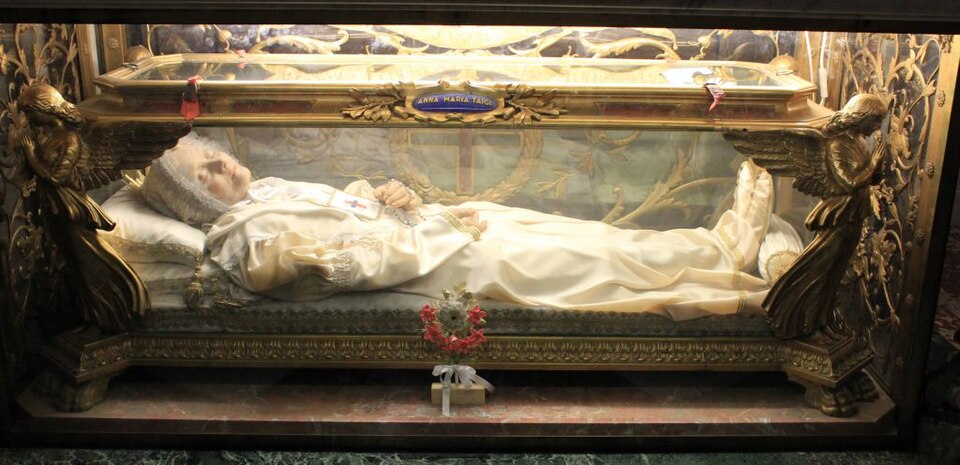
Today, the incorrupt body of Saint Cecilia rests beneath the high altar of the Basilica of Santa Cecilia in Trastevere, enshrined within its original sarcophagus. It is not displayed in a glass casket, nor is it openly visible to pilgrims. Instead, its presence is marked by the magnificent marble sculpture by Stefano Maderno, which serves as a perpetual visual representation of the miraculous discovery. This artistic rendition allows pilgrims to contemplate the saint's preserved form without directly disturbing her sacred repose. The decision to enclose the body within its tomb, rather than expose it, reflects a deep respect for the saint and a desire to protect the relic from deterioration. The basilica itself, built over the site of her martyrdom and home, serves as a perpetual reliquary, a sacred space dedicated to her memory and intercession. The enduring presence of her incorrupt body, even if unseen, remains a powerful spiritual magnet, drawing countless faithful to her shrine in Rome, a silent testament to her unwavering faith and God's extraordinary grace.
While the accounts of Saint Cecilia's incorruption primarily emphasize the remarkable preservation of her physical form, there are no widespread or consistently documented reports of other unusual phenomena such as sweet fragrances, flexibility, or bleeding associated with her body, unlike some other incorruptible saints. The miracle of Saint Cecilia lies primarily in the sheer endurance of her physical integrity over many centuries, defying the natural processes of decay. The most striking and consistently reported detail is the unchanging posture of her body, specifically the position of her hands, which has been noted in both the 9th-century translation and the 16th-century discovery. This consistent detail, observed across such vast spans of time, underscores the extraordinary nature of her incorruption. The very act of finding her body in such a pristine state, thirteen centuries after her death, without any embalming or special preservation techniques known to have been applied, is in itself the most profound and remarkable detail associated with her sacred remains. It stands as a powerful symbol of divine intervention, a silent sermon on the enduring power of faith and the promise of resurrection.
Preservation
Body enclosed beneath the altar of the Basilica of Santa Cecilia in Trastevere, Rome. Maderno's statue replicates her position.
Scientific Analysis
The reported preservation of a human body from the 3rd century, specifically that attributed to Saint Cecilia, presents a fascinating subject for scientific inquiry, particularly given its reported state upon rediscovery. The historical accounts suggest an extraordinary degree of preservation, defying typical post-mortem processes. When the tomb of Saint Cecilia was opened in 1599, nearly 1,400 years after her reported death, witnesses, including Cardinal Paolo Emilio Sfondrati and the sculptor Stefano Maderno, described her body as appearing intact, lying on her side, and even reportedly soft and flexible. Maderno’s famous sculpture, created shortly after this event, depicts her in this very posture, further cementing the visual narrative of her preservation. While no formal medical or scientific examinations in the modern sense were conducted at the time of the 1599 exhumation, the observations were meticulously documented by contemporary chroniclers. These accounts, though lacking in precise anatomical detail or chemical analysis, form the primary historical record of the body's condition. There are no records of a formal medical doctor, pathologist, or scientist performing an examination with the rigor expected today. The observations were largely visual and tactile, interpreted within the prevailing scientific and religious understanding of the late 16th century. The body was subsequently reinterred in a silver sarcophagus beneath the high altar of the Basilica di Santa Cecilia in Trastevere, where it remains enclosed, precluding direct modern examination.
The scientific remarkable nature of this case lies in the reported defiance of normal decomposition processes over such an extended period. Human decomposition typically involves a complex series of biochemical reactions initiated by autolysis (self-digestion by the body's own enzymes) and accelerated by bacterial putrefaction. Environmental factors such as temperature, humidity, oxygen availability, and soil composition profoundly influence the rate and extent of decay. In the warm, humid climate of Rome, and given the likely burial conditions of the 3rd century within a catacomb or early Christian burial ground, complete skeletalization would be the expected outcome within a few decades, if not sooner. The reported preservation of soft tissues, and especially the flexibility, challenges these expectations. There is no historical evidence suggesting any deliberate embalming or preservation treatments were applied to Saint Cecilia's body at the time of her death. Early Christian burial practices focused more on ritual and reverence than on sophisticated anatomical preservation techniques, which were largely associated with ancient Egyptian traditions or later medieval embalming for royalty. The absence of such interventions makes the reported state of preservation particularly enigmatic from a scientific standpoint.
Several natural explanations have been proposed for instances of extraordinary body preservation, including saponification and adipocere formation. Saponification, or the formation of adipocere, occurs when fatty tissues in a body are hydrolyzed into fatty acids, which then react with metal ions (like calcium or magnesium) in the surrounding environment to form a waxy, soap-like substance. This process typically requires specific conditions: a moist, anaerobic (low-oxygen) environment, often found in waterlogged soil or clay, and the presence of certain bacteria. Adipocere can preserve the external form of a body for centuries, giving it a waxy, firm texture. However, the historical accounts of Saint Cecilia describe the body as "soft and flexible," which is generally inconsistent with the hard, brittle nature of fully formed adipocere. While partial saponification might contribute to some degree of preservation, the reported pliability presents a challenge to this explanation as a sole factor. Skeptics often attribute such accounts to misinterpretations, wishful thinking, or the subjective nature of observation in the absence of scientific rigor. They might argue that the "softness" was relative to the expectation of finding only bones, or that the ambient conditions within the tomb, while not fully documented, might have created a microenvironment conducive to a unique form of preservation not entirely understood. However, the sheer duration of preservation, even if attributed to adipocere, remains a remarkable outlier in the study of human decomposition.
From a modern scientific perspective, the case of Saint Cecilia, while historically significant, is limited by the lack of direct contemporary examination. If the body were accessible today, a range of non-invasive and minimally invasive techniques could be applied to shed light on its condition. High-resolution CT scans could provide detailed anatomical information without disturbing the remains, revealing the state of internal organs and skeletal structure. Carbon dating of tissue samples could definitively establish the age of the remains, confirming their 3rd-century origin. Chemical analysis of any preserved tissues could identify the presence of adipocere, embalming agents, or other preservative compounds. Microbiological analysis could investigate the types of bacteria present in the burial environment and their potential role in inhibiting decomposition. Such studies, similar to those conducted on other ancient remains like the "Bog Bodies" or mummies, would offer invaluable insights into the complex interplay of environmental factors, microbial activity, and biochemical processes that can lead to exceptional preservation. Until such an examination is possible, the reported incorruption of Saint Cecilia remains a compelling historical account, situated at the intersection of faith, anecdotal evidence, and the enduring scientific mystery of human decomposition. The unanswered questions continue to fuel both scientific curiosity and religious reverence, highlighting the limits of our current understanding of post-mortem processes under extraordinary circumstances.
Spiritual Significance
The phenomenon of incorruption, particularly as exemplified by Saint Cecilia, offers a profound theological testament to the Catholic understanding of the human body and its ultimate destiny. Within Catholic theology, the body is not merely a vessel for the soul but is itself a temple of the Holy Spirit, destined for glorification at the resurrection. Saint Cecilia’s miraculously preserved form, discovered centuries after her martyrdom, serves as a tangible prefigurement of this eschatological hope. The Church interprets such preservation not as a mere biological anomaly, but as a divine affirmation of the sanctity of the individual and the power of God to transcend natural decay. Her incorruption underscores the doctrine of the communion of saints, reminding believers that those who have passed into glory remain intimately connected to the Church militant on earth, their physical remains, when divinely preserved, acting as powerful conduits of grace and reminders of eternal life. This particular manifestation of divine favor for Saint Cecilia emphasizes her extraordinary sanctity and her enduring presence within the mystical body of Christ, bridging the gap between the earthly and heavenly realms.
Saint Cecilia’s unique charism was rooted in an unwavering commitment to her consecrated virginity and an extraordinary devotion to Christ, even in the face of brutal persecution. Her biography reveals a soul deeply attuned to the spiritual melodies of faith, even before she became known as the patron of musicians. Her heroic virtues included profound courage, as she steadfastly refused to renounce her Christian faith despite threats and torture. Her charity extended to those around her, as she reportedly converted many through her witness and example, including her husband Valerian and his brother Tiburtius. Her obedience was not to earthly authorities when they conflicted with divine law, but to the higher calling of God, which she embraced with a pure heart. Her life was a testament to the power of inner conviction and the triumph of spiritual grace over worldly pressures, embodying a form of mystical union with God that transcended the physical realities of her time. This profound interior life, nurtured by prayer and unwavering faith, allowed her to face martyrdom with serene confidence, a testament to the strength found in Christ.
Devotion to Saint Cecilia has flourished over the centuries, solidifying her place as one of the most beloved early Christian martyrs. Her patronage of musicians, though not explicitly tied to her original legend, developed from a misinterpretation of her Passio, which describes her singing to God in her heart during her forced marriage. This imagery resonated deeply with the faithful, establishing her as an inspiration for all who use music to glorify God. Her feast day on November 22nd is celebrated with particular reverence, often featuring musical performances and special liturgies. Pilgrims from across the globe journey to the Basilica of Santa Cecilia in Trastevere, Rome, to venerate her relics. The experience of visiting her shrine is deeply moving, as pilgrims are invited to contemplate her preserved form, now enclosed, which once revealed her extended fingers, interpreted as a symbolic affirmation of the Trinity. This tangible connection to a saint who lived two millennia ago offers a powerful spiritual encounter, fostering a sense of continuity with the early Church and inspiring renewed faith.
Numerous miracles have been attributed to Saint Cecilia’s intercession throughout history, reflecting her powerful advocacy in heaven. Documented healings, conversions, and answered prayers have been reported by those who have sought her aid, particularly in matters related to music, purity, and steadfast faith in times of trial. The incorrupt body itself has been a perpetual source of spiritual consolation for the faithful, serving as a silent yet eloquent witness to the power of God and the sanctity of His saints. The very preservation of her body, defying natural processes, is seen as a continuous miracle, a divine sign that strengthens belief in the resurrection of the body and the enduring presence of the saints. For many, simply being in the presence of her relics evokes a profound sense of peace and closeness to the divine, reinforcing the Catholic belief in the efficacy of relics as channels of grace and reminders of the heavenly host.
Saint Cecilia’s enduring message for contemporary Catholics and seekers is one of unwavering fidelity to Christ, even in a world that often challenges spiritual values. Her life stands as a powerful counter-narrative to modern materialism and secularism, demonstrating that true fulfillment is found not in earthly possessions or fleeting pleasures, but in a radical commitment to God. Her example challenges people today to cultivate an interior life of prayer and virtue, to stand firm in their convictions, and to use their talents, whatever they may be, for the glory of God. Her incorruption serves as a tangible bridge between the visible and invisible worlds, a concrete reminder that eternity is real and that the saints are not distant figures of the past but active intercessors in the present. In an age often characterized by doubt and spiritual malaise, Saint Cecilia’s preserved body offers a beacon of hope, inviting all to contemplate the profound mysteries of faith and the ultimate triumph of divine love over death and decay.
AI summary
A plain-language overview generated from this page's source material. Always verify with primary sources.