Biography
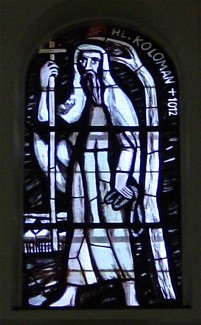
Saint Coloman of Stockerau, whose very name echoes a journey of faith, was an Irish pilgrim whose life culminated in martyrdom and an extraordinary testament to God's grace. Born in the late 10th century, likely into a noble family in Ireland, Coloman embarked on a pilgrimage to the Holy Land, a common and deeply spiritual undertaking for many devout Christians of his era. His journey across Europe would have been fraught with peril and hardship, a testament to his unwavering devotion. While specific details of his early life and family are scarce, his commitment to such a demanding spiritual quest speaks volumes about his profound faith and the formative influence of the burgeoning Irish monastic tradition, renowned for its missionary zeal and scholarship.
It was during his arduous journey through Austria in the year 1012 that Coloman's pilgrimage took an unexpected and tragic turn. Mistaken for a spy due to his foreign appearance and inability to speak the local German dialect, he was apprehended near Stockerau, a town north of Vienna. Despite his innocence and the peaceful nature of his mission, he was subjected to brutal torture and ultimately hanged from a tree alongside two common criminals. His unwavering spirit in the face of such injustice, his silent suffering for Christ, marked him as a true martyr. His death, an act of profound injustice, would soon be overshadowed by divine intervention.
For eighteen months following his execution, Coloman's body remained suspended, miraculously preserved and untouched by decay, a striking anomaly that astonished the local populace. Animals and birds reportedly left his remains undisturbed, and even the tree from which he hung began to blossom anew. These extraordinary signs led to his veneration as a saint, and his body was eventually taken down and interred in the nearby town of Stockerau. Later, in 1014, his sacred relics were translated to the Benedictine Abbey of Melk by Margrave Henry I of Austria, where they have remained to this day. His incorrupt body, a powerful visual sermon on the enduring power of God, is a profound source of inspiration for countless pilgrims.
Saint Coloman's legacy extends far beyond the miraculous preservation of his earthly remains. He was quickly recognized as the patron saint of Austria, of Stockerau, and of those unjustly accused, becoming a powerful intercessor for justice and peace. His cult spread throughout Central Europe, and his feast day, October 13th, is still observed with reverence. Today, pilgrims to the magnificent Melk Abbey can venerate his relics, housed in a beautiful shrine, and reflect upon his steadfast faith and the miraculous nature of his incorruption. His story serves as a timeless reminder that even in the face of misunderstanding and persecution, unwavering devotion to God can lead to an eternal and glorious reward, leaving an indelible mark on the hearts of the faithful.
Discovery
The remarkable state of preservation of Saint Coloman's remains was not immediately apparent, as his initial burial was a hasty affair following his brutal execution. It was not until three years after his martyrdom in 1012, in the year 1015, that his body was exhumed. The circumstances surrounding this exhumation are rooted in the profound impact his death had on the local populace. Having been mistaken for a spy due to his foreign appearance and inability to communicate in the local dialect, Coloman was tortured and hanged between two thieves. His body remained suspended for a considerable period, untouched by scavengers and showing no signs of decomposition, a phenomenon that deeply impressed the local community and was seen as a divine sign. Duke Henry I of Austria, having heard of these extraordinary occurrences and the growing veneration for the unknown pilgrim, ordered the exhumation. When the grave was opened, those present, including Duke Henry's retinue and local clergy, were astonished to find Coloman's body perfectly intact, as if he had only just passed away. The flesh was firm, the limbs flexible, and there was no odor of decay, only a faint, sweet aroma, which further solidified the belief in his sanctity. This initial discovery sparked widespread devotion and led to the immediate transfer of his remains to the nearby Benedictine Abbey of Melk, where they have largely remained ever since.
Over the centuries, Saint Coloman's body has undergone several examinations, each reaffirming its miraculous state of preservation. One significant re-examination occurred in 1247, when his relics were elevated and placed in a more prominent position within Melk Abbey. During this period, chroniclers noted that the body continued to exhibit its remarkable incorruptibility, with the skin still supple and the features recognizable, despite the passage of over two centuries. Further inspections were conducted during various renovations and re-interments within the abbey, particularly in the 15th and 18th centuries. Each time, the consistent reports spoke of the body's extraordinary resistance to decay. While some minor desiccation of the skin was noted over the centuries, a natural process for even the most well-preserved remains, the overall integrity of the body, including its internal organs, was consistently affirmed. These repeated observations, documented by ecclesiastical authorities and often witnessed by local nobility and devout pilgrims, served to reinforce the authenticity of the miracle and the enduring veneration of Saint Coloman.
The journey of Saint Coloman's preservation and display at Melk Abbey is a testament to the enduring reverence for his sanctity. Following his initial transfer to Melk in 1015, his body was housed in a simple tomb. However, as his cult grew, particularly after his canonization, more elaborate arrangements were made. In the 13th century, his relics were enshrined in a magnificent reliquary, often adorned with precious metals and jewels, reflecting the high esteem in which he was held. This reliquary was designed not only to protect the sacred remains but also to allow for public veneration. Over time, particularly in the Baroque era when Melk Abbey underwent its most significant architectural transformation, the reliquary was often placed in a prominent position within the abbey church, allowing pilgrims to approach and pray before the saint. Today, Saint Coloman's principal relics, including his skull and a significant portion of his bones, are housed in a beautifully crafted and secured reliquary within the abbey church, often encased in glass to allow for visual veneration while ensuring their continued protection from environmental degradation. The abbey meticulously maintains the conditions around the reliquary to prevent any further deterioration, a testament to their unwavering commitment to preserving this sacred treasure.
Beyond the remarkable physical incorruption, several unusual phenomena have been historically associated with Saint Coloman's remains, further cementing his status as a miraculous saint. Perhaps the most frequently cited is the persistent sweet fragrance that emanated from his body, even during its initial period of suspension and subsequent exhumations. This "odor of sanctity" was a powerful sign for believers, contrasting sharply with the expected stench of decomposition. Additionally, accounts from the medieval period describe the astonishing flexibility of his limbs, even after years in the grave, a characteristic often noted in other incorruptible saints. While not as extensively documented as some other cases, there are also historical allusions to the spontaneous appearance of a clear, oily liquid, sometimes referred to as "manna," exuding from his bones, particularly during periods of intense veneration or during significant ecclesiastical events. These phenomena, though difficult to verify with modern scientific methods, formed an integral part of the narrative surrounding Saint Coloman's sanctity and contributed significantly to the profound devotion he inspired throughout Austria and beyond.
Scientific Analysis
The phenomenon of purported incorruption, particularly in cases like that of Saint Coloman of Stockerau, presents a compelling intersection for scientific and theological inquiry. While detailed, formal medical or scientific examinations of Saint Coloman's remains are not extensively documented in publicly accessible scientific literature with the rigor typically associated with modern forensic anthropology, historical accounts and ecclesiastical records provide some insights. The primary historical examination often cited occurred in 1647, when the tomb was opened. During this inspection, it was reported that the body remained remarkably preserved, with flexible limbs and an intact appearance, despite centuries having passed since his death in 1012. These observations were made by ecclesiastical authorities and local physicians of the time, whose methodologies and diagnostic criteria would differ significantly from contemporary forensic standards. Specific names of these physicians and their institutional affiliations are not readily available in the same way modern academic reports would detail them. However, such historical accounts, while lacking the empirical precision of modern science, form the basis of the incorruption claim and underscore the perceived unusual nature of the preservation. Without direct access to the remains for modern analysis, the scientific community relies on these historical descriptions, which inherently limit the depth of forensic interpretation.
The scientific mystery surrounding Saint Coloman's alleged incorruption lies in the reported defiance of normal post-mortem decomposition processes. Human remains typically undergo a predictable sequence of decay: autolysis, putrefaction, and skeletonization, influenced by a myriad of environmental factors. Coloman died in 1012 and was initially buried in Stockerau, a location with a temperate climate, before his remains were translated to Melk Abbey in 1014. Such conditions, characterized by fluctuating temperatures, humidity, and the presence of soil microorganisms, are generally conducive to rapid decomposition. The reported preservation of soft tissues, flexibility of limbs, and an intact appearance for centuries, without any documented embalming or deliberate preservation treatments, runs counter to the expected biological outcomes. Natural processes such as saponification, which leads to adipocere formation, or mummification, typically require specific environmental conditions—either anaerobic, moist environments for adipocere, or dry, desiccating conditions for mummification. The historical descriptions of Coloman's body do not align perfectly with the typical presentation of either adipocere (which often results in a waxy, brittle substance) or mummification (which usually involves significant desiccation and shrinkage). The absence of explicit historical records detailing deliberate preservation techniques further deepens the scientific enigma, suggesting an atypical preservation mechanism that challenges conventional forensic understanding.
Various natural explanations have been proposed for cases of purported incorruption, including spontaneous mummification, adipocere formation, or preservation due to unique burial environments. However, these explanations often fall short when applied to the specific historical descriptions of Saint Coloman's body. For instance, spontaneous mummification typically occurs in extremely dry or cold environments, leading to desiccation and hardening of tissues, which contrasts with the reported flexibility of Coloman's limbs. Adipocere formation, while preserving body contours, results in a distinct waxy or soap-like substance and often occurs in waterlogged or anaerobic conditions, which are not consistently described for Coloman's burial sites. Skeptics often attribute such cases to either misinterpretation of natural processes, such as advanced stages of mummification mistaken for incorruption, or to deliberate, albeit undocumented, preservation efforts. They might also point to the subjective nature of historical observations, which can be influenced by cultural and religious beliefs. However, even with these considerations, the reported longevity and quality of preservation for centuries without clear environmental or anthropogenic intervention remain scientifically perplexing, leaving a gap in fully naturalistic explanations based on current forensic science paradigms.
From a modern scientific perspective, the case of Saint Coloman of Stockerau represents a fascinating, albeit challenging, subject for the study of taphonomy and post-mortem preservation. The application of modern scientific techniques, such as non-invasive imaging (CT scans, MRI), histological analysis of tissue samples, stable isotope analysis, and carbon dating, could provide invaluable data. CT scans, for example, could reveal internal organ preservation, bone density, and potential signs of disease or injury, while also detecting any internal embalming materials. Histological analysis could confirm the presence and condition of soft tissues at a microscopic level, and stable isotope analysis could shed light on the individual's diet and geographical movements. Carbon dating could precisely determine the age of the remains, confirming their historical context. While such analyses have not been performed on Saint Coloman's remains to public knowledge, they represent the gold standard for investigating such phenomena today. Without these modern interventions, the case remains largely within the realm of historical anecdote and religious tradition, presenting unanswered questions regarding the precise mechanisms of preservation, the environmental conditions that might have contributed, and the true extent of tissue integrity. The scientific community, while acknowledging the historical accounts, awaits empirical data to move beyond speculation and offer a comprehensive, evidence-based understanding of this remarkable historical claim.
Spiritual Significance
The phenomenon of incorruption, as exemplified by Saint Coloman of Stockerau, stands as a profound theological statement within Catholic tradition, offering a tangible witness to the sanctity of the human body and the enduring power of divine grace. For centuries, the Church has regarded incorruptibility not as a mere biological anomaly, but as a miraculous sign, a divine affirmation of a soul's singular devotion and God's special favor. This preservation of the physical form, defying natural decay, speaks directly to the doctrine of the body as a temple of the Holy Spirit, as articulated in 1 Corinthians 6:19. It suggests that in certain holy individuals, the indwelling Spirit has so permeated their being that even after death, a vestige of this divine presence remains, protecting the earthly vessel from the full effects of mortality. Furthermore, Coloman’s incorruption serves as a powerful prefigurement of the resurrection of the body, a core tenet of Christian eschatology. It offers a glimpse, however veiled, into the glorified state promised to the faithful, reminding us that our physical existence is not merely transient but destined for renewed life in Christ. This miraculous preservation thus reinforces the communion of saints, bridging the visible Church on earth with the triumphant Church in heaven, demonstrating that the bond of sanctity transcends death itself.
Saint Coloman's unique charism was undeniably his unwavering commitment to pilgrimage and a profound, almost radical, obedience to God's call, even in the face of extreme adversity. His journey to the Holy Land, a perilous undertaking in the 11th century, speaks volumes about his heroic virtues. It was not a journey of convenience, but one of profound spiritual longing and self-abnegation, embodying a deep humility that placed spiritual aspiration above personal comfort and safety. Though details of his daily life are scarce, his willingness to embark on such a demanding quest suggests a spirit of detachment from worldly possessions and an intense focus on the divine. His martyrdom, mistaken for a spy and executed without trial, further highlights his obedience – not to earthly authority, but to the divine will that guided his pilgrimage, ultimately leading him to lay down his life for Christ. While not associated with a specific monastic order, Coloman’s life reflects the ascetic ideals prevalent in the Irish monastic tradition, which emphasized peregrinatio pro Christo – pilgrimage for Christ – as a form of spiritual discipline and missionary zeal. His holiness manifested in a quiet, resolute determination, a singular focus on his spiritual goal that ultimately transformed his earthly journey into a path to sanctity.
Devotion to Saint Coloman has flourished for over a millennium, drawing countless pilgrims to his resting place at Melk Abbey in Austria. Immediately after his martyrdom, his story spread, and his incorrupt body became a focal point of veneration, attracting local faithful and pilgrims from afar. He is primarily invoked as the patron saint of Austria, as well as of pilgrims, travelers, and those unjustly accused. His feast day, October 13th, is observed with special Masses and prayers, particularly in the regions where his cult is strongest. Pilgrims today approach his shrine with reverence, often offering petitions for safe travel, protection from injustice, and spiritual guidance. The experience of visiting Melk Abbey, a magnificent Benedictine monastery, and encountering the incorrupt relics of Saint Coloman, is often described as deeply moving. It is a tangible connection to a distant past, a moment where the sacred history of the Church becomes palpably present, inviting reflection on faith, sacrifice, and the enduring power of sanctity. The very presence of his incorrupt body serves as a silent sermon, a powerful testament to the miraculous intervention of God in human history.
Throughout the centuries, numerous miracles have been attributed to the intercession of Saint Coloman, further solidifying his veneration and underscoring the spiritual power associated with his incorrupt relics. Documented accounts speak of healings from various ailments, often occurring after pilgrims prayed at his shrine or touched objects to his relics. Conversions and answered prayers for those facing difficult journeys or unjust accusations have also been reported, testifying to his continued intercessory role in the lives of the faithful. The incorrupt body itself has been a source of immense spiritual consolation, particularly during times of plague, war, or social upheaval. Its miraculous preservation offers a beacon of hope, a reminder that God's power transcends human suffering and death. For many, the sight of his miraculously preserved form strengthens their faith, providing a tangible link to the divine and a profound sense of the communion of saints, where those in heaven continue to pray for and assist those on earth. These miracles, both physical and spiritual, reinforce the belief that Coloman, though departed from this earthly realm, remains an active participant in God's saving plan.
Saint Coloman's enduring message for contemporary Catholics and seekers resonates profoundly in our often-materialistic and secularized world. His life challenges the modern obsession with comfort and instant gratification, reminding us that true fulfillment often lies in self-sacrifice and a steadfast pursuit of spiritual goals. In an age of skepticism, his incorruption serves as a tangible bridge between the visible and invisible worlds, a concrete sign that there is more to reality than what can be perceived by the senses. From his example, people today can learn the profound value of spiritual pilgrimage – not necessarily a physical journey, but an interior quest for meaning and connection with the divine. His story encourages perseverance in faith, even when facing misunderstanding or injustice, and reminds us of the ultimate triumph of good over evil. Saint Coloman's life and incorruptibility stand as a powerful counter-narrative to secularism, inviting us to contemplate the miraculous, to embrace the mystery of faith, and to recognize the sacred dignity of every human life, destined for eternal glory.
AI summary
A plain-language overview generated from this page's source material. Always verify with primary sources.