Biography
Saint Eustochia Smeralda Calafato, born Smeralda Calafato in Messina, Sicily, in 1430, was a child of noble lineage, her father being Bernardo Calafato and her mother Mascalda Romano. From a tender age, Smeralda exhibited a profound piety and a deep yearning for a life consecrated to God, a desire that often clashed with her family's expectations for a prestigious marriage. Despite their initial resistance and attempts to steer her towards a worldly life, Smeralda's unwavering resolve and fervent prayer eventually led her parents to acquiesce to her vocation. At the age of fifteen, she entered the convent of Santa Maria di Basicò in Messina, embracing the austere rule of the Poor Clares. Her early life was marked by rigorous asceticism, intense prayer, and a growing reputation for sanctity among her sisters.
Within the cloister, Sister Eustochia (as she was now known) quickly distinguished herself through her profound humility, unwavering obedience, and extraordinary mystical experiences. She was known to receive visions and locutions, particularly concerning the Passion of Christ, which fueled her desire for greater union with God and a life of penance. Driven by a desire for a stricter observance of the Rule of Saint Clare, she, along with a small group of like-minded sisters, sought permission to establish a new convent. After overcoming significant opposition and numerous trials, the Monastery of Montevergine in Messina was founded in 1464, becoming a beacon of fervent prayer and strict enclosure. Saint Eustochia served as its first abbess, guiding her community with wisdom, charity, and an unyielding commitment to evangelical poverty. Her leadership fostered a vibrant spiritual life within the monastery, attracting many vocations and inspiring widespread devotion.
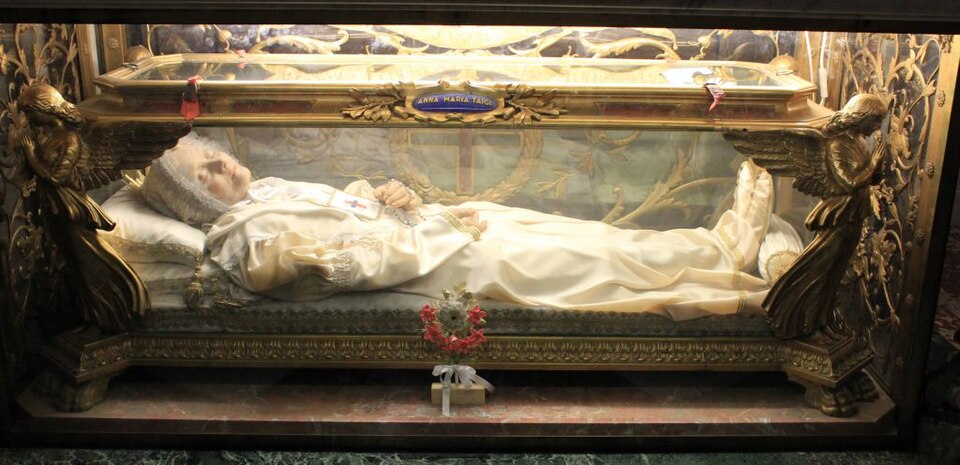
Saint Eustochia’s earthly journey concluded on January 20, 1485, at the age of 54, after a life spent in heroic virtue and profound union with God. Her death was met with deep sorrow by her community and the people of Messina, who already revered her as a saint. Just nine months after her burial, her tomb was opened due to a strong, sweet fragrance emanating from it. To the astonishment of all present, her body was found to be perfectly preserved, supple, and lifelike, defying the natural laws of decomposition. This miraculous incorruption was immediately recognized as a sign of God's favor. Today, her remarkably preserved body, still flexible and exhibiting a natural skin tone, rests in a glass reliquary in the Monastery of Montevergine, the very convent she founded, where pilgrims can venerate her.
The incorrupt body of Saint Eustochia Smeralda Calafato stands as a powerful testament to her sanctity and a continuous source of inspiration for the faithful. She was beatified in 1782 by Pope Pius VI and canonized by Pope John Paul II in 1988, formally recognizing her heroic virtues and the miracles attributed to her intercession. Her legacy endures not only through her incorrupt remains but also through the spiritual vitality of the Poor Clare order, particularly in Sicily, where her example continues to draw souls to a life of contemplation and service. Pilgrims visiting Messina can experience a profound sense of awe and reverence in the presence of her incorrupt body, a tangible link to a saint who lived a life of extraordinary devotion and mystical grace, reminding all of the enduring power of faith and the promise of eternal life.
Discovery
The remarkable story of Saint Eustochia Smeralda Calafato's incorruption began not long after her earthly life concluded in 1485. Her initial burial took place within the Monastery of Montevergine in Messina, an institution she herself had founded and nurtured. It was in 1490, a mere five years after her passing, that the first exhumation occurred. The nuns, driven by a profound veneration for their foundress and perhaps by an emerging sense of her sanctity, decided to transfer her remains to a more prominent location within the monastery church. As the earth was carefully removed and the simple wooden coffin opened, those present were met with an astonishing sight. The body of Smeralda, who had died at the age of 55, lay perfectly preserved. Her skin retained its natural color, her limbs were supple, and her features were recognizable, as if she were merely in a deep slumber. The air around the open coffin was reportedly filled with a sweet, floral fragrance, an unearthly perfume that further affirmed the miraculous nature of the discovery. The immediate reaction among the community was one of awe and profound reverence, a confirmation of the holiness they had witnessed in her life. This initial discovery cemented her reputation for sanctity and marked the beginning of a centuries-long veneration of her incorrupt remains.
Over the subsequent centuries, the body of Saint Eustochia underwent several examinations and transfers, each revealing the continued miraculous preservation. In 1590, a century after her death, her body was again examined and found to be in the same state of perfect incorruption. Documents from this period describe the flexibility of her joints and the natural appearance of her flesh, details that defied the natural laws of decomposition. A particularly significant examination occurred in 1632, when a more thorough canonical investigation was conducted. This examination, overseen by ecclesiastical authorities, confirmed the incorrupt state and noted the absence of any artificial preservation methods. The records from this period also mention the remarkable preservation of her habit, which, though old, showed no signs of significant decay. Subsequent inspections in the 18th and 19th centuries continued to attest to the body's enduring integrity, consistently noting the suppleness of her skin and the lifelike quality of her features, despite the passage of hundreds of years since her death. These repeated attestations by various witnesses and authorities underscore the consistent and enduring nature of her incorruption.
The journey of Saint Eustochia's preservation and display reflects the evolving practices of veneration within the Church. Following the initial discovery and subsequent examinations, her body was placed in a more accessible shrine within the Monastery of Montevergine. For many years, she rested in a simple, open coffin, allowing the faithful to gaze upon her miraculous form. As centuries passed and the monastery underwent renovations, her resting place was periodically updated to ensure both reverence and protection. Today, Saint Eustochia's incorrupt body is enshrined in a glass casket, allowing pilgrims to view her without direct contact, thus protecting her delicate remains from environmental factors and the effects of time. This casket is located within the monastery church in Messina, where she remains a central figure of devotion. The transparency of the casket allows for an unobstructed view of her remarkably preserved form, her face serene, her hands clasped in prayer, a testament to her enduring sanctity.
Beyond the mere physical preservation, several remarkable details have been associated with Saint Eustochia's incorrupt body throughout history. The sweet, floral fragrance, first noted at her exhumation in 1490, has been a recurring phenomenon, reported by many witnesses over the centuries. This "odor of sanctity" is a traditional sign of holiness in Catholic tradition, and its consistent presence around her remains has been a powerful affirmation of her sainthood. Furthermore, accounts from various periods describe the remarkable flexibility of her limbs, even centuries after death, a phenomenon that defies the rigor mortis and subsequent stiffening expected in a deceased body. There have also been reports of a subtle, almost imperceptible warmth emanating from her body, even in cooler temperatures, contributing to the sense that she is not truly dead but merely asleep. These extraordinary phenomena, coupled with the enduring visual evidence of her incorruption, contribute significantly to the profound veneration she receives from the faithful, serving as a powerful reminder of God's miraculous power and the sanctity of His saints.
Spiritual Significance
The phenomenon of incorruption, as exemplified by Saint Eustochia Smeralda Calafato, presents a profound theological statement within the Catholic tradition, speaking directly to the sanctity of the human body and the promise of resurrection. For centuries, the Church has viewed these extraordinary cases not as mere curiosities, but as divine affirmations of the spiritual integrity of those who have lived lives of exceptional holiness. Saint Paul’s teaching in 1 Corinthians 6:19, that our bodies are temples of the Holy Spirit, finds a tangible echo in the preserved remains of saints like Eustochia. Her incorrupt body, defying the natural processes of decay, serves as a powerful, albeit rare, prefigurement of the glorified body promised at the general resurrection. It is a visible sign that God honors those who honor Him, even in their physical being, and a testament to the enduring power of grace to permeate and transform every aspect of human existence. The Church interprets such incorruption as a sign of God's favor, a testament to the saint's heroic virtue, and a reminder of the ultimate destiny of the faithful: a bodily resurrection in Christ. It strengthens belief in the communion of saints, demonstrating that even in death, the holy ones remain connected to the Church militant, offering intercession and inspiration.
Saint Eustochia's unique charism was undeniably her profound and unwavering commitment to radical poverty and austere penance, coupled with a deep mystical union with Christ. Born into a noble family, her heroic virtue was most evident in her relentless pursuit of a consecrated life, directly opposing the worldly expectations of her parents. Her spiritual journey was marked by an intense asceticism, often involving severe fasting and self-mortification, not for their own sake, but as a means to achieve greater conformity with the suffering Christ. She embraced the rigorous Rule of Saint Clare with an exceptional fervor, contributing significantly to the Observant reform movement within the Poor Clares in Sicily. Her humility was legendary; despite her noble birth and growing reputation for sanctity, she always sought the lowest place, serving her sisters with profound charity and obedience. This specific way of holiness, rooted in the Franciscan tradition, emphasized contemplative prayer, evangelical poverty, and a joyful embrace of suffering, manifesting in her daily life through tireless labor, fervent prayer, and an unwavering focus on the crucified Savior. Her life stands as a testament to the transformative power of grace, shaping a soul to mirror Christ's own self-emptying love.
Devotion to Saint Eustochia has flourished over the centuries, particularly in her native Sicily, where she is revered as a patroness and a powerful intercessor. Her incorrupt body, enshrined in the Monastero di Montevergine in Messina, has been a focal point of pilgrimage since her death in 1485. Pilgrims from across Italy and beyond journey to her resting place, drawn by the tangible presence of holiness. The experience of visiting her shrine is often described as profoundly moving; to gaze upon a body preserved for over five centuries, defying the laws of nature, evokes a sense of awe and wonder, bridging the gap between the earthly and the divine. While specific prayers or novenas dedicated solely to her may vary regionally, her feast day on January 20th is celebrated with solemnity, often including special Masses and processions. The faithful often bring their petitions and offerings, seeking her intercession for various needs, particularly for those struggling with family opposition to religious vocations, for purity of heart, and for perseverance in spiritual discipline. The continuous stream of visitors to her monastery underscores the enduring power of her example and the deep spiritual solace her incorruption offers to those seeking a tangible connection to the saints.
Miracles attributed to Saint Eustochia's intercession are numerous and have been documented throughout the centuries, contributing significantly to her veneration and eventual canonization. Accounts include documented healings of the sick, often those suffering from chronic or seemingly incurable ailments, and conversions of heart, where individuals experienced profound spiritual transformations after seeking her prayers. Beyond these specific interventions, the incorrupt body itself has been a continuous source of spiritual consolation for the faithful. The mere sight of her preserved remains has inspired countless individuals to deepen their faith, to embrace a life of greater holiness, and to trust more fully in God's providential care. During times of plague or other calamities in Messina, the faithful would often process with relics or images of Saint Eustochia, seeking her protection and intercession, and numerous instances of relief were attributed to her powerful prayers. These documented miracles and the enduring spiritual comfort she provides underscore the Catholic belief in the active intercession of the saints, demonstrating that their communion with Christ continues to bear fruit in the lives of believers on earth.
For contemporary Catholics and seekers alike, Saint Eustochia's enduring message is a powerful challenge to the prevailing materialism and secularism of our age. Her life, marked by radical detachment from worldly possessions and honors, stands in stark contrast to a society obsessed with acquisition and fleeting pleasures. She reminds us that true fulfillment is found not in external achievements or material wealth, but in an interior life consecrated to God. Her unwavering pursuit of holiness, even in the face of familial opposition, inspires courage and perseverance in living out one's faith authentically. In a world often characterized by spiritual apathy, her incorruption serves as a tangible bridge between the visible and invisible worlds, a concrete reminder of the supernatural dimension of existence and the ultimate triumph of grace over decay. Her example encourages us to embrace asceticism, not as a grim burden, but as a path to spiritual freedom and deeper intimacy with Christ, demonstrating that a life dedicated to God, even in its most rigorous forms, can bear fruit that transcends time and space, offering a beacon of hope and a clear path to eternal life.
AI summary
A plain-language overview generated from this page's source material. Always verify with primary sources.