Biography
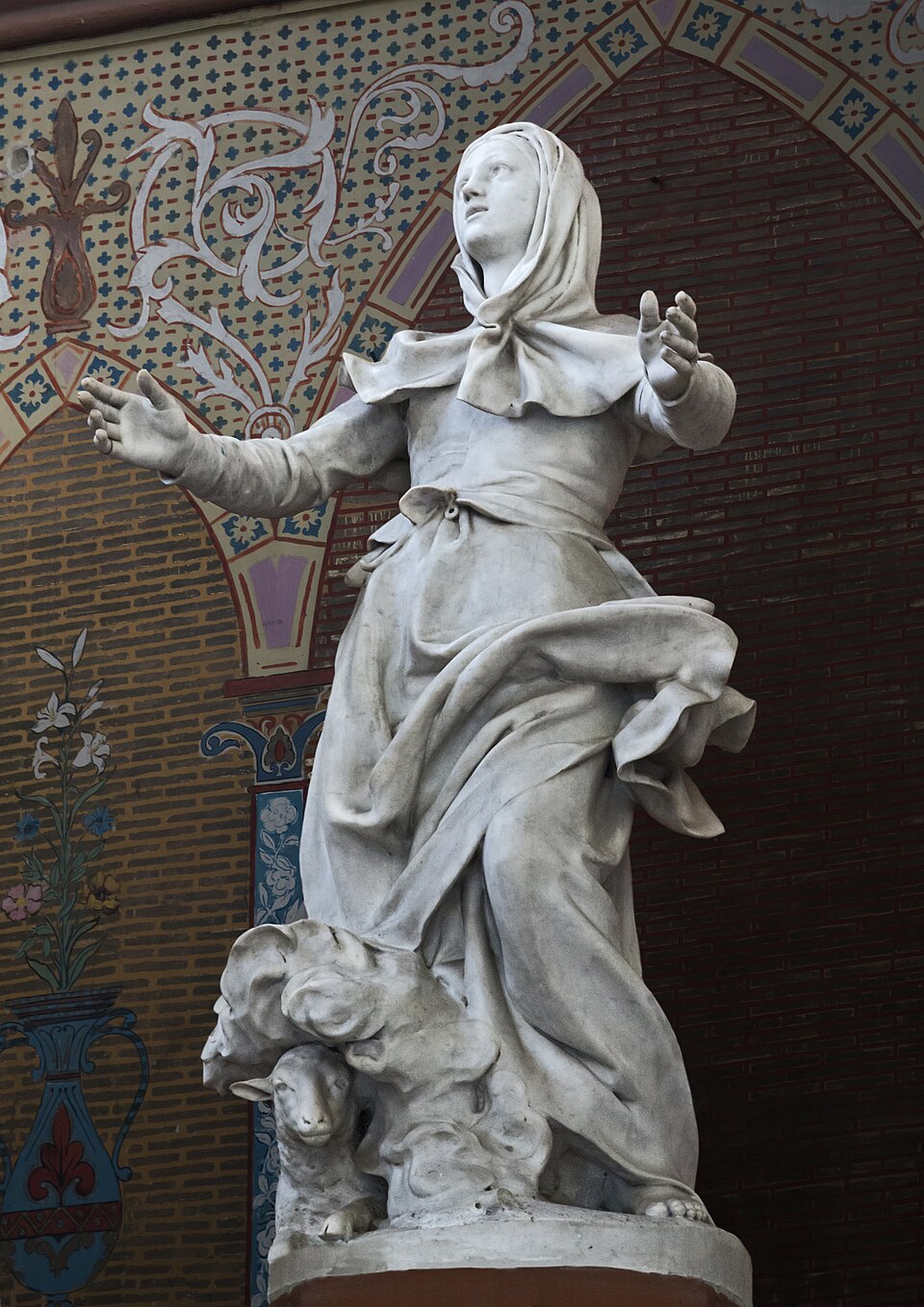
Saint Germaine Cousin, known affectionately as "The Shepherdess of Pibrac," entered this world in 1579 in the humble village of Pibrac, France, a child destined for both profound suffering and extraordinary sanctity. Born into a peasant family, Germaine's early life was marked by hardship. She suffered from scrofula, a form of tuberculosis that left her with a disfigured hand and a generally sickly constitution. To compound her physical ailments, her mother passed away when Germaine was very young, and her father remarried. Her stepmother, tragically, harbored a deep animosity towards Germaine, subjecting her to relentless abuse, neglect, and deprivation. While her stepsiblings were fed and cared for, Germaine was often forced to sleep in the stable, fed scraps, and given the most arduous tasks, her only companions the sheep she was sent to tend in the fields. Yet, amidst this profound cruelty, Germaine's spirit blossomed with an unwavering faith and an almost supernatural charity, her heart overflowing with love for God and all His creation.
Despite the incessant mistreatment, Germaine embraced her calling as a shepherdess with remarkable diligence and piety. Even while tending her flock, she would knit and spin, always with a rosary in her hand, her prayers ascending to heaven. She frequently attended daily Mass, often leaving her sheep unattended, yet miraculously, no animal was ever lost or harmed during her absence. Numerous stories attest to her profound holiness, including tales of her sharing her meager bread with beggars, despite her own hunger, and the miraculous parting of floodwaters to allow her to cross a stream to attend church. Her life was a testament to the power of enduring faith and boundless love, transforming her suffering into a crucible of sanctity that shone brightly even in the darkest of circumstances. She died in 1601, at the tender age of 22, her life seemingly unremarkable to the world, but profoundly significant in the eyes of God.
Forty-three years after her death, in 1644, Germaine's extraordinary sanctity was revealed to the world in a most unexpected manner. As a grave was being dug in the Church of St. Mary in Pibrac, the workers unearthed a perfectly preserved body. To their astonishment, it was Germaine Cousin, her remains completely incorrupt, a fragrant aroma emanating from the grave. Her withered hand, a lifelong mark of her suffering, was perfectly identifiable, confirming her identity. This miraculous discovery, occurring without any intentional embalming or special burial preparations, immediately drew attention and reverence. Though her body suffered some damage during the French Revolution when revolutionaries attempted to burn it, her remains were later recovered and continue to be venerated today, a powerful sign of God's favor.
Saint Germaine Cousin was canonized by Pope Pius IX in 1867, a testament to her enduring legacy of humility, perseverance, and unwavering faith in the face of immense suffering. Her incorrupt body, now enshrined in the Church of St. Mary in Pibrac, France, remains a powerful focal point for pilgrims from around the world. Her story resonates deeply, particularly with those who experience illness, neglect, or abuse, offering solace and inspiration. Saint Germaine's life serves as a poignant reminder that true greatness lies not in worldly acclaim or comfort, but in a heart wholly devoted to God, a spirit that can transform even the most desolate circumstances into a path to profound holiness and eternal glory.
Discovery
The remarkable story of Saint Germaine Cousin's incorruptibility began not with a deliberate search, but with the practical necessity of a new burial. It was the year 1644, a full forty-three years after her humble death in 1601, when workmen in Pibrac were engaged in the solemn task of digging a grave for a deceased parishioner within the hallowed grounds of the local church. As their spades delved into the earth, they unexpectedly struck an older coffin. Upon opening it, a gasp of astonishment rippled through the small gathering. There, lying within, was a body that defied the natural laws of decay. It was perfectly preserved, its features recognizable, its limbs supple. The identity of the deceased was immediately clear to those who remembered her: it was Germaine Cousin, "The Shepherdess of Pibrac," distinguished by the withered hand that had been a lifelong mark of her suffering. The discovery sent waves of awe and wonder through the village, confirming what many had already suspected about the sanctity of the young shepherdess. The parish priest, along with numerous villagers, bore witness to this extraordinary sight, recognizing in it a divine affirmation of Germaine's virtuous life.
Following this initial, astonishing discovery, Germaine's body was reverently reinterred, though its incorrupt state was now widely known and venerated locally. The first official examination occurred in 1661, seventeen years after the initial discovery, by order of the Archbishop of Toulouse. This formal inquiry confirmed the body's remarkable preservation, noting its flexibility and natural appearance, devoid of any signs of embalming or artificial preservation. Over the centuries, several more exhumations and canonical inspections took place, each time affirming the miraculous state of her remains. In 1700, another examination was conducted, further attesting to the body's continued incorruptibility. These inspections were crucial in the lengthy process of her canonization, providing compelling physical evidence of her sanctity. The body remained remarkably well-preserved, though it was noted that some natural desiccation occurred over time, a common phenomenon even among the incorrupt. Each successive viewing reinforced the profound respect and devotion that had grown around the memory of the humble shepherdess.
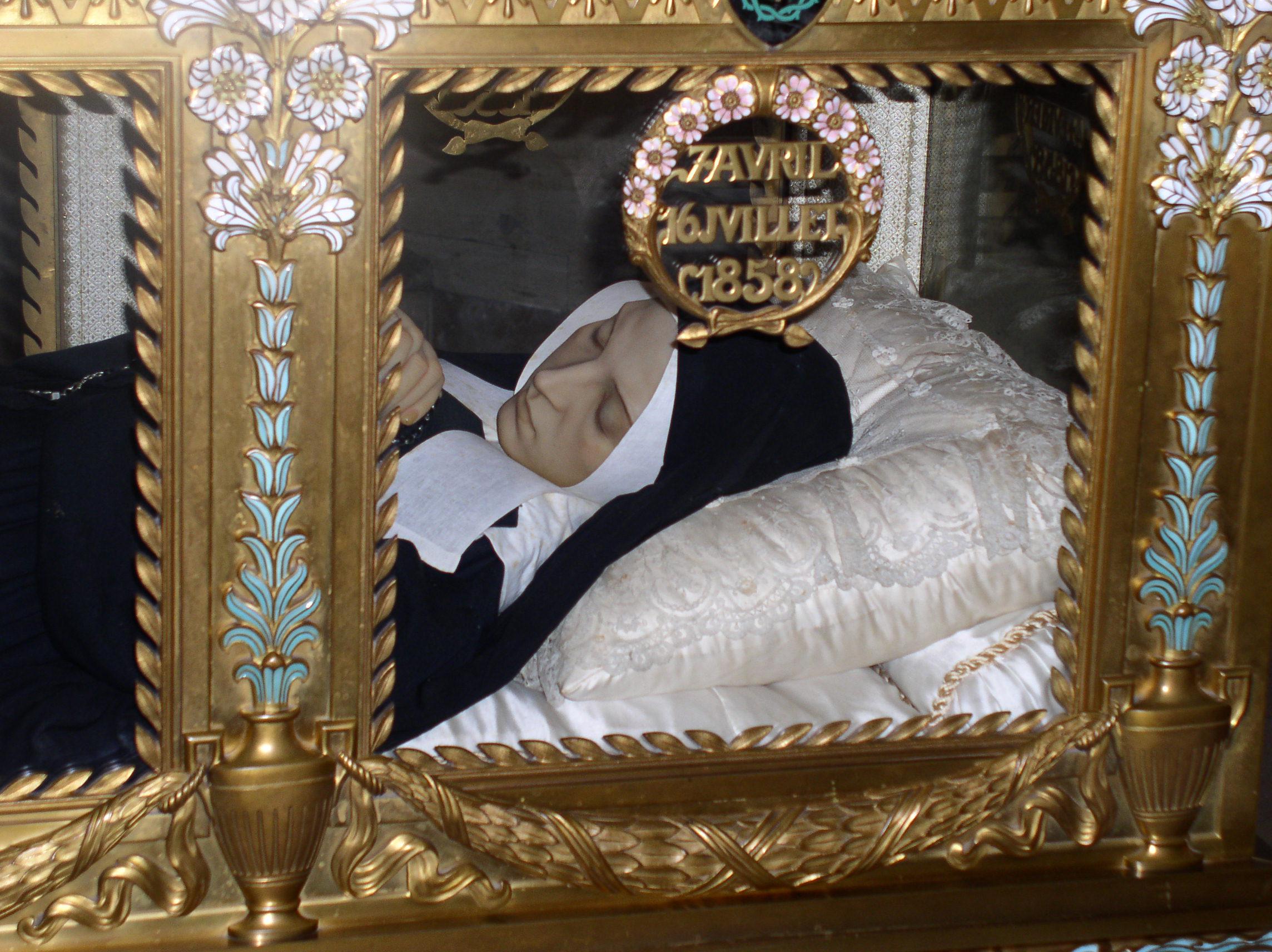
The journey of Saint Germaine's preservation has been one of both reverence and challenge. After its initial discovery and subsequent examinations, the body was placed in a lead coffin and enshrined within the Church of Pibrac, where it became a focal point of pilgrimage and devotion. However, the tumultuous period of the French Revolution brought immense destruction and sacrilege. In 1793, fanatical revolutionaries desecrated the church and exhumed Germaine's body, attempting to burn it. Miraculously, the body resisted the flames, though it suffered significant damage, particularly to the face and hands. Despite this brutal assault, the core of the incorruptibility remained. After the Revolution, what remained of her sacred relics was carefully collected and once again enshrined. Today, Saint Germaine Cousin’s body, though bearing the scars of revolutionary violence, is displayed in a glass reliquary within the Church of Pibrac. It rests beneath the main altar, allowing pilgrims to venerate the earthly remains of this extraordinary saint, a testament to both her enduring sanctity and the resilience of faith in the face of persecution.
Among the remarkable details associated with Saint Germaine's incorrupt body, beyond its sheer resistance to decay, was the consistent observation of its natural flexibility during early examinations. Witnesses and ecclesiastical examiners repeatedly noted that her limbs were not rigid, but rather pliable, as if she had only recently passed away. This unusual suppleness, decades after death, was a powerful indicator of a miraculous preservation. Furthermore, during the initial discovery and subsequent inspections, there were reports of a sweet, floral fragrance emanating from the body, a phenomenon often associated with incorrupt saints, known as the "odor of sanctity." While the French Revolution unfortunately marred the pristine state of her remains, the historical accounts from the centuries preceding this event consistently highlight these extraordinary attributes, painting a picture of a body miraculously preserved, not merely as a desiccated relic, but as a testament to the enduring power of divine grace.
Preservation
Body in the Church of Pibrac, though damaged during the French Revolution.
Scientific Analysis
The phenomenon of unusual bodily preservation, often termed incorruption within religious contexts, presents a fascinating intersection for scientific inquiry. In the case of Saint Germaine Cousin, born in 1579 and deceased in 1601, the circumstances surrounding the discovery and subsequent state of her remains have attracted considerable attention. Following her death at a young age, Germaine was interred in an unmarked grave within the local church. Her body was later exhumed in 1644, approximately 43 years after her burial, during the process of preparing a new grave. Witnesses at the time reported finding her body remarkably intact, appearing as though she had only recently passed away. This initial discovery prompted local ecclesiastical authorities to conduct preliminary examinations. While specific medical personnel and institutional affiliations from the mid-17th century are not extensively documented with modern precision, contemporary accounts describe observations of flexible limbs, intact skin, and discernible facial features, contrasting sharply with the expected skeletal remains after such a prolonged burial period. Further examinations were conducted in the lead-up to her beatification and canonization. For instance, in 1700, the body was again examined by medical professionals, though their names and detailed reports are not readily available in public scientific literature. These examinations consistently noted the absence of significant decomposition, despite the passage of decades. A more formalized medical review occurred in 1867, concurrent with her canonization. During this period, detailed reports were compiled by physicians, likely under the auspices of the Vatican's Congregation for the Causes of Saints. These reports, while not widely published in peer-reviewed scientific journals, form part of the historical record supporting the claims of incorruption. The consistent findings across these centuries, despite varying levels of scientific rigor, point to a state of preservation that defied the common understanding of post-mortem processes.
The scientific mystery surrounding Saint Germaine Cousin's incorruption lies in the apparent defiance of normal decomposition processes, particularly given the environmental factors of her burial. She was interred in an ordinary grave within a church, likely in unsealed ground, exposed to typical soil microorganisms, moisture, and temperature fluctuations. Under such conditions, a body is expected to undergo rapid putrefaction and decay, leading to skeletalization within a few years, certainly not decades. The reported preservation of soft tissues, skin, and even some internal organs, as described in historical accounts, is highly anomalous. There is no historical record or physical evidence suggesting any intentional embalming or preservation treatments were applied to her body. Such practices were not common for ordinary individuals in rural France during the late 16th and early 17th centuries, and certainly not for a peasant girl buried in an unmarked grave. The absence of embalming chemicals, desiccation techniques, or specialized burial containers further deepens the scientific puzzle. The climate of Pibrac, while not extreme, is temperate, with seasonal variations that would typically accelerate decomposition rather than inhibit it. The soil composition, while not precisely documented, would have contained the usual array of bacteria and fungi responsible for breaking down organic matter. The reported state of preservation, therefore, stands in stark contrast to the expected outcome based on established forensic taphonomy.
Several natural explanations are often proposed for cases of unusual post-mortem preservation, including saponification (adipocere formation), mummification, or bog body preservation. Saponification, the transformation of body fat into a waxy, soap-like substance (adipocere), can preserve soft tissues, particularly in moist, anaerobic environments. While adipocere formation can explain some degree of preservation, it typically results in a distinct waxy texture and often alters the body's appearance significantly, which does not fully align with descriptions of Saint Germaine's body as appearing "as though she had only recently passed away." Furthermore, extensive adipocere formation usually requires specific burial conditions, such as high moisture and an absence of oxygen, which are not explicitly documented for her grave. Mummification, either natural (desiccation in dry environments) or artificial (embalming), is also a common preservation mechanism. However, the climate of Pibrac is not conducive to natural mummification, and as previously noted, there is no evidence of artificial embalming. Bog body preservation, which involves highly acidic, anaerobic peat bog environments, is clearly not applicable here. Skeptics often attribute such cases to misidentification, exaggeration in historical accounts, or the limited scientific understanding of past eras. They might argue that the descriptions of "perfect preservation" were subjective and not based on rigorous scientific criteria. However, the consistent reporting of unusual preservation over multiple centuries and examinations, even if rudimentary by modern standards, suggests that something beyond typical decomposition occurred. The challenge for natural explanations is to account for the reported extent and quality of preservation in an ordinary burial environment without any known artificial intervention.
From a modern scientific perspective, the case of Saint Germaine Cousin presents an intriguing subject for advanced forensic taphonomic study. While historical accounts provide valuable qualitative data, the lack of modern scientific analysis leaves many questions unanswered. If her remains were subjected to contemporary techniques, CT scans could provide detailed insights into the internal state of her organs and skeletal structure, revealing any signs of adipocere, mummification, or other preservation mechanisms. Carbon dating could precisely determine the age of the tissues, confirming their origin. Tissue analysis, including histological examination and molecular analysis, could identify the specific biochemical changes that occurred, if any, and potentially reveal the presence of any natural or artificial preserving agents. For example, gas chromatography-mass spectrometry could detect residual embalming chemicals if they were used, even if undocumented. Furthermore, DNA analysis could confirm identity and rule out any possibility of misidentification over the centuries. The broader scientific study of body preservation benefits from examining such anomalous cases, as they can push the boundaries of our understanding of decomposition and taphonomic processes. While the Catholic tradition attributes such incorruption to divine intervention, a scientific approach seeks to understand the underlying physical and chemical mechanisms. The remaining unanswered questions revolve around the precise environmental conditions of her burial, the exact chemical and physical state of her tissues, and whether any unique, undocumented natural processes or environmental factors contributed to her extraordinary preservation. Without direct modern scientific examination, the case of Saint Germaine Cousin remains a compelling historical and religious phenomenon, awaiting the potential for empirical validation or explanation.
Spiritual Significance
The phenomenon of incorruption within the Catholic tradition stands as a profound testament to God's miraculous power and a vivid illustration of theological truths regarding the human body and its ultimate destiny. For Saint Germaine Cousin, "The Shepherdess of Pibrac," her preserved remains, discovered decades after her death, offer a particularly poignant example. Within Catholic theology, the body is not merely a vessel for the soul but is intrinsically linked to our identity, a temple of the Holy Spirit (1 Corinthians 6:19), destined for resurrection. The incorruption of saints like Germaine serves as a tangible prefiguration of this future glory, a divine seal upon a life lived in extraordinary sanctity. It affirms the Church's teaching on the communion of saints, demonstrating that those who have passed into eternity remain intimately connected to the living, their physical presence, however miraculous, a bridge between heaven and earth. For Germaine, whose earthly existence was marked by profound physical suffering and social ostracization, her incorruption is understood as God's ultimate vindication, a public declaration of her hidden holiness and a powerful counter-narrative to the neglect and abuse she endured. It underscores the belief that true worth is found not in worldly status or physical perfection, but in a heart wholly surrendered to God.
Germaine's unique charism was undoubtedly her unwavering perseverance in faith and charity amidst unimaginable adversity. Her life was a living testament to heroic humility, boundless patience, and a profound interior prayer life that flourished despite her external circumstances. Despite being disfigured by scrofula, neglected by her stepmother, and relegated to the lowest tasks, Germaine never harbored bitterness or resentment. Instead, she embraced her suffering as a path to holiness, finding solace and strength in constant prayer and devotion to the Eucharist. Her daily routine, tending sheep in the fields of Pibrac, became her cloister, a place where she communed deeply with God. Stories abound of her sharing her meager rations with the poor, even while she herself was starving, and of miraculous crossings of swollen rivers, her cloak miraculously spreading to allow her passage, preventing her from leaving her flock. Her spiritual tradition was one of simple, childlike faith, a profound trust in divine providence, and a radical embrace of the evangelical counsels in the most ordinary and challenging of circumstances. She exemplifies how sanctity is not exclusive to monasteries or grand deeds, but can be forged in the crucible of daily suffering and humble service.
Devotion to Saint Germaine Cousin blossomed organically after the discovery of her incorrupt body in 1644, decades after her death. Initially, local veneration grew rapidly, fueled by the miraculous preservation of her remains and the stories of her extraordinary life. Her formal canonization in 1867 solidified her place in the universal Church, leading to widespread devotion, particularly in France and among those suffering from illness or neglect. Her patronage extends to abandoned children, victims of abuse, the physically challenged, and shepherds, reflecting the poignant details of her life. Pilgrims today visit her shrine in the Church of Pibrac, where her incorrupt body rests, albeit damaged during the French Revolution when revolutionaries attempted to burn it. The sight of her preserved remains, even in their damaged state, evokes a powerful sense of awe and spiritual connection for many. Novenas and prayers dedicated to Saint Germaine often focus on themes of patience, perseverance in suffering, and intercession for the marginalized, inviting the faithful to draw strength from her example and seek her powerful intercession for their own trials.
Numerous miracles have been attributed to Saint Germaine's intercession both during her lifetime and after her death. Accounts speak of her miraculous ability to cross a swollen river without getting wet, her cloak serving as a bridge, to attend Mass, and of her sharing bread with the poor, the bread miraculously multiplying. Following the discovery of her incorrupt body, the shrine in Pibrac became a focal point for countless reported healings, conversions, and answered prayers. Documented cases include cures from various illnesses, the restoration of sight, and the resolution of seemingly insurmountable personal difficulties. The very existence of her incorrupt body has been a source of immense spiritual consolation for the faithful, serving as a tangible reminder of God's love for the humble and the suffering. It reassures believers that even in the face of profound hardship and injustice, God sees, God remembers, and God ultimately vindicates His faithful servants, offering a beacon of hope and a testament to the power of intercessory prayer.
Saint Germaine's enduring message for contemporary Catholics and seekers is profoundly relevant in a world often preoccupied with material success, physical perfection, and immediate gratification. Her life challenges modern materialism by demonstrating that true richness lies not in possessions but in a heart overflowing with divine love and compassion. In an age of secularism and skepticism, her incorruption serves as a powerful, tangible bridge between the visible and invisible worlds, a miraculous sign that transcends scientific explanation and points to the reality of the supernatural. From her example, people today can learn the transformative power of embracing suffering with faith, the profound dignity of the marginalized, and the boundless love of a God who elevates the humble. Her story encourages us to look beyond outward appearances and societal judgments, to recognize the sacred in every individual, and to cultivate an interior life of prayer and trust, even amidst the most trying circumstances. Germaine Cousin, the simple shepherdess, continues to inspire millions to pursue holiness not in grand gestures, but in the quiet, heroic fidelity of daily life.
AI summary
A plain-language overview generated from this page's source material. Always verify with primary sources.