Biography
Saint John Neumann, born Jan Nepomuk Neumann in Prachatice, Bohemia (now the Czech Republic), in 1811, entered a world steeped in Catholic tradition and intellectual fervor. From a young age, his brilliant mind and profound piety were evident. He pursued studies in philosophy and theology at the University of Prague, preparing for the priesthood. However, a deep longing to serve the burgeoning Catholic immigrant communities in America, who often lacked spiritual guidance, burned within him. Despite having completed his theological studies, there were too many priests in his native diocese, and ordination was delayed. Trusting in divine providence, he sailed for New York in 1836, leaving behind his family and homeland to answer a call he felt was from God.
Upon arrival, John Neumann was ordained a priest for the Diocese of New York and immediately plunged into missionary work. His tireless dedication led him to the Redemptorist order, known for its commitment to serving the poor and abandoned. As a Redemptorist, he ministered to German immigrants across vast and often challenging territories, learning several languages to better serve his flock. His exceptional administrative skills and profound holiness did not go unnoticed, and in 1852, he was consecrated the fourth Bishop of Philadelphia. It was in this role that he truly shone, establishing the first diocesan Catholic school system in the United States, a monumental achievement that laid the foundation for Catholic education in America. He also championed the Forty Hours Devotion and built numerous churches, hospitals, and orphanages, tirelessly working to strengthen the Church in his diocese.
Bishop Neumann’s earthly pilgrimage concluded on January 5, 1860, when he collapsed and died on a Philadelphia street at the age of 48, exhausted by his relentless labors. He was initially buried in the Redemptorist cemetery. When his body was exhumed in 1862 as part of the initial stages of his beatification process, a remarkable discovery was made: his remains were found in an extraordinary state of preservation, despite having been interred in a simple coffin without any embalming. Subsequent medical examinations confirmed this natural incorruption, a miraculous sign of God's favor. Today, his venerated body, encased in a glass reliquary, rests beneath the altar of St. Peter the Apostle Church in Philadelphia, a testament to his sanctity.
Saint John Neumann’s legacy is profound and enduring. Canonized in 1977 by Pope Paul VI, he holds the distinction of being the first male American citizen to be canonized, making him a powerful patron for the American Catholic Church. His feast day is celebrated on January 5. Pilgrims from around the world visit his shrine in Philadelphia, seeking his intercession and drawing inspiration from his life of unwavering faith, tireless service, and profound humility. His incorrupt body serves as a tangible reminder of the power of God and the sanctity to which all are called, a silent witness to a life lived entirely for Christ and His Church.
Discovery
The remarkable state of preservation of the holy Bishop's remains was first brought to light during the initial exhumation conducted on January 29, 1893. This solemn occasion was necessitated by the early stages of his beatification process, a meticulous investigation into his life and virtues. The Redemptorist Fathers, guardians of his legacy and the church where he was interred, St. Peter the Apostle in Philadelphia, oversaw the proceedings. When the coffin was opened, a profound silence fell over those gathered. Despite having been buried for thirty-three years in the humid conditions of a Philadelphia crypt, the body of Bishop Neumann was found to be largely intact. His vestments, though soiled, clung to a form that was recognizably human, not merely skeletal. The skin, while discolored and somewhat shrunken, had not completely disintegrated, and the facial features, though altered by the passage of time, were still discernible. This initial discovery, defying the natural laws of decomposition, immediately sparked a sense of awe and a renewed conviction in his sanctity among those present, including ecclesiastical authorities and medical professionals tasked with documenting the findings. The immediate reaction was one of profound reverence, recognizing in this extraordinary preservation a potential sign of divine favor.
Subsequent examinations further solidified the miraculous nature of this preservation. A more thorough exhumation took place on April 11, 1962, as the cause for beatification progressed. By this time, over a century had passed since his death. During this meticulous inspection, the body was found to have undergone some natural desiccation and darkening, yet the overall integrity remained astonishing. The skin, though leathery, still covered the bones, and the joints retained a degree of flexibility, defying the typical rigidity of a corpse of such age. Medical experts, including Dr. Joseph L. Holland, a pathologist, were present to document every detail. They noted the absence of significant putrefaction and the remarkable retention of the body's original contours. The internal organs, however, had naturally decomposed over the decades. Another significant examination occurred on October 1, 1975, in preparation for his canonization. At this point, the body had been exposed to air and various preservation efforts for many years, yet it continued to exhibit an unusual resistance to complete decay, a phenomenon that continued to baffle scientific explanation. Each examination, separated by decades, consistently revealed a body that had defied the expected course of decomposition, maintaining a state of preservation far beyond what could be attributed to natural processes or burial conditions alone.
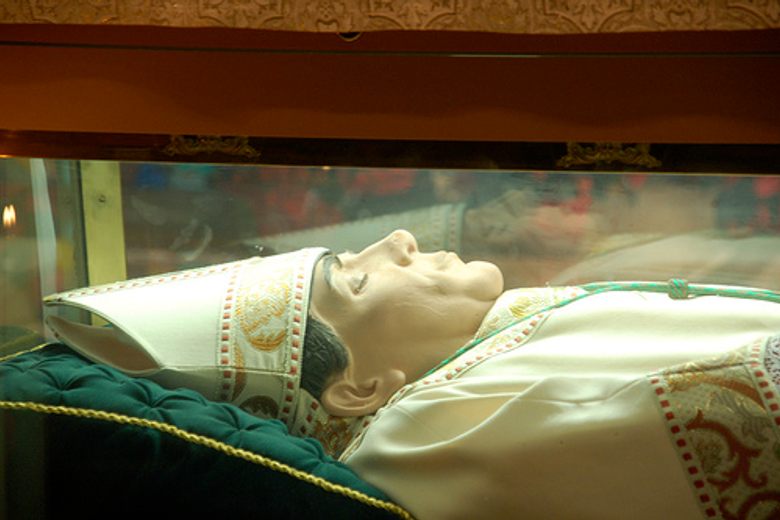
The journey of Saint John Neumann's preserved remains has been one of careful stewardship and reverent display. Following the initial exhumations, it became clear that special measures would be needed to protect and present this sacred relic. The body was treated with a wax coating and placed within a glass-sided casket, allowing the faithful to venerate him directly. This casket is now prominently displayed beneath the main altar of St. Peter the Apostle Church in Philadelphia, which has become the National Shrine of St. John Neumann. The environment within the shrine is carefully controlled to mitigate further deterioration, with temperature and humidity levels monitored to ensure the long-term preservation of the relic. The current display allows pilgrims to approach and view the saint's body through the protective glass, offering a powerful visual testament to his enduring presence and the mystery of incorruption. The decision to display him in this manner reflects the Catholic tradition of venerating the physical remains of saints as tangible connections to their holy lives and intercessory power.
While no reports of bleeding, oil exuding, or a sweet fragrance have been consistently associated with Saint John Neumann's incorrupt body, its primary remarkable detail lies in its sheer resistance to the natural processes of decay over such an extended period. The body's continued structural integrity, the discernible features, and the unusual flexibility noted in earlier examinations, particularly given the humid climate of Philadelphia and the conditions of his initial burial, stand as the most significant phenomena. The absence of extensive putrefaction and the retention of a human form for over a century, defying the typical decomposition into mere skeletal remains, are the hallmarks of his incorruption. This remarkable preservation, attested to by multiple medical and ecclesiastical witnesses over decades, serves as a profound and enduring testament to his sanctity, inspiring countless pilgrims who visit his shrine to seek his intercession and reflect upon the mysteries of faith and divine grace.
Preservation
Body displayed beneath the altar of St. Peter the Apostle Church, Philadelphia.
Scientific Analysis
The phenomenon of bodily incorruption, particularly as observed in figures like Saint John Neumann, presents a compelling subject for scientific inquiry, bridging historical accounts with modern forensic understanding. While many religious traditions document instances of seemingly miraculous preservation, scientific analysis seeks to understand the underlying biological and chemical processes involved. The case of Saint John Neumann, Bishop of Philadelphia, who died in 1860 and was canonized in 1977, has garnered particular attention due to the reported state of his remains.
Medical and scientific examinations of Saint John Neumann's remains have been a subject of considerable interest. Following his death in 1860, his body was interred in the crypt of St. Peter's Church in Philadelphia. Reports indicate that when his tomb was opened in 1962, in preparation for his beatification, his body was found to be remarkably well-preserved. While precise, detailed medical reports from that specific exhumation are not widely published in peer-reviewed scientific journals, anecdotal accounts and official church documentation suggest that medical professionals were present and confirmed the unusual state of preservation. These examinations reportedly noted the absence of significant putrefaction or skeletalization, which would be expected after over a century of burial. It is crucial to note that no embalming procedures were performed on Bishop Neumann's body at the time of his death, a fact confirmed by historical records and subsequent examinations. The initial findings, as reported by those present, indicated that the tissues, particularly the face and hands, retained a degree of pliability and recognizable form, defying typical post-mortem changes. Further examinations, though less formally documented in a scientific context, have occurred periodically during the process of veneration and display, consistently noting the unusual preservation.
The scientific mystery surrounding Saint John Neumann's incorruption lies in its defiance of typical decomposition processes. Normal human decomposition involves a complex series of biological and chemical changes, primarily driven by autolysis (self-digestion by cellular enzymes) and putrefaction (bacterial activity). These processes are significantly influenced by environmental factors such as temperature, humidity, oxygen availability, and the presence of microorganisms in the soil. Given his burial in a crypt in Philadelphia, a region with fluctuating temperatures and humidity, the expected outcome after over a century would be complete skeletalization or, at best, the formation of adipocere if specific anaerobic, moist conditions were met. Adipocere, or "grave wax," is a waxy substance formed from body fat in specific environments, but it typically results in a soap-like, brittle texture, not the reported pliable preservation. The absence of embalming further amplifies the scientific puzzle, as embalming fluids are specifically designed to denature proteins and inhibit microbial growth, thus delaying decomposition. The reported state of preservation, without such chemical intervention, challenges conventional understanding of post-mortem biology.
Various natural explanations have been proposed for instances of incorruption, including saponification (adipocere formation), mummification, or exceptional environmental conditions. However, these explanations often fall short in specific cases like Saint John Neumann's. While adipocere can preserve form, it alters tissue texture significantly, often resulting in a rigid, waxy appearance, which does not align with descriptions of his remains. Mummification, either natural (through extreme dryness or cold) or artificial, also results in a distinct, desiccated appearance. The conditions within a crypt in Philadelphia are unlikely to spontaneously induce natural mummification. Skeptics often attribute such preservation to a combination of factors: specific microclimates within the burial site, the formation of adipocere, or even the historical practice of applying waxes or other substances to remains for display purposes, which could be misconstrued as natural preservation. However, in Saint John Neumann's case, the consistent reports of preservation without prior embalming or overt artificial treatment, and the reported texture of the remains, continue to present a challenge to purely naturalistic explanations that fully account for the phenomenon.
From a modern scientific perspective, the case of Saint John Neumann, along with other reported instances of incorruption, offers a unique opportunity for interdisciplinary research. Advanced forensic techniques, such as computed tomography (CT) scans, magnetic resonance imaging (MRI), and detailed histological and biochemical analysis of tissue samples (if ethically and religiously permissible), could provide invaluable insights. These techniques could reveal the internal state of the tissues, identify any unusual chemical compounds present, and potentially shed light on the mechanisms that have inhibited decomposition. Carbon dating could confirm the age of the tissues, while microbial analysis could identify any unique microbial communities that might have played a role in preservation or inhibition of decay. The broader scientific study of body preservation, including taphonomy and forensic anthropology, could benefit immensely from a rigorous, objective examination of such cases. However, the sensitive nature of religious relics often limits the extent of invasive scientific investigation. Consequently, many questions remain unanswered, particularly regarding the precise chemical and biological processes that have maintained the integrity of Saint John Neumann's remains for over a century and a half without artificial intervention.
Spiritual Significance
The phenomenon of incorruption, as exemplified by Saint John Neumann, stands as a profound theological statement within Catholic tradition, offering a tangible witness to the sanctity of the human body and the promise of the resurrection. Within Catholic theology, the body is not merely a vessel for the soul but is itself a temple of the Holy Spirit, as articulated in 1 Corinthians 6:19. This doctrine underscores the inherent dignity and sacredness of human physicality, a dignity that is elevated and perfected through grace. The preservation of Saint John Neumann's body, defying natural processes of decay, is interpreted by the Church not as a mere biological anomaly, but as a divine affirmation of his exceptional holiness and his intimate union with Christ. It serves as a powerful prefigurement of the glorified body promised at the general resurrection, reminding believers that our earthly bodies, consecrated by baptism and sustained by the Eucharist, are destined for eternal life. Furthermore, it reinforces the doctrine of the communion of saints, demonstrating a continuing connection between the Church militant on earth and the Church triumphant in heaven, where the saints intercede for us and offer us models of virtue. For Saint John Neumann specifically, his incorruption is seen as a divine seal upon his tireless labors and profound spiritual dedication, a visible sign of God's favor and a testament to his heroic virtue.
Saint John Neumann’s life was characterized by a unique charism of pastoral zeal and an unwavering commitment to the spiritual welfare of immigrant communities. His heroic virtues were manifold, most notably his profound humility, which allowed him to embrace immense challenges without complaint, and his boundless charity, which drove him to tirelessly serve those most in need. He possessed an extraordinary obedience to the will of God, evident in his decision to leave his homeland and family to minister in a foreign land, and to accept the daunting responsibility of the episcopacy. As a Redemptorist, he was deeply rooted in a spiritual tradition emphasizing missionary work, devotion to the Eucharist, and a tender love for the Blessed Mother. His daily life was a testament to these virtues, marked by relentless travel, constant preaching, and an unwavering dedication to catechesis and Catholic education. He was a pioneer in establishing parochial schools, recognizing their vital role in preserving the faith of immigrant children. His spiritual legacy is one of self-sacrifice and an ardent desire to bring Christ to all, particularly the marginalized and the forgotten. He truly embodied the spirit of a shepherd who lays down his life for his flock, demonstrating a practical, hands-on holiness that resonated deeply with the struggles of his time.
Devotion to Saint John Neumann has grown steadily since his death, culminating in his canonization in 1977, a landmark event as he was the first male American citizen to be declared a saint. He is widely invoked as the patron of immigrants, educators, and those suffering from illness, reflecting the core concerns of his earthly ministry. Pilgrims from across the globe visit his shrine at the National Shrine of St. John Neumann in Philadelphia, drawn by his inspiring story and the profound spiritual atmosphere surrounding his incorrupt body. The experience of visiting the shrine is often deeply moving, offering a tangible connection to a holy life lived in service to God. Many faithful engage in novenas to Saint John Neumann, seeking his intercession for their needs, and his feast day on January 5th is celebrated with special Masses and devotions. The opportunity to view his preserved remains is a powerful catalyst for prayer and reflection, serving as a physical reminder of the eternal destiny of the faithful and the enduring power of God's grace. The solemnity and reverence surrounding his resting place create an environment conducive to contemplation and a deeper appreciation for the sanctity of life.
Numerous miracles have been attributed to the intercession of Saint John Neumann, both during his lifetime and after his death. Documented healings from various illnesses, conversions of heart, and countless answered prayers bear witness to his powerful intercession in heaven. These miracles, carefully scrutinized by the Church during his beatification and canonization processes, serve as concrete evidence of God's active presence in the lives of the faithful through the prayers of His saints. The incorrupt body itself has been a continuous source of spiritual consolation for the faithful, offering a visible sign of hope and a reminder of the supernatural realities that transcend our earthly existence. For many, standing before his preserved remains evokes a profound sense of awe and wonder, strengthening their faith and deepening their conviction in the communion of saints. It is a powerful reminder that death is not the end, and that those who have lived lives of heroic virtue continue to intercede for us from their place in glory. This tangible connection to a saintly life provides a unique spiritual anchor in a world often characterized by doubt and uncertainty.
Saint John Neumann's enduring message holds profound relevance for contemporary Catholics and seekers alike, offering a compelling antidote to the challenges of modern materialism and secularism. His life of radical self-giving, his unwavering commitment to the poor and marginalized, and his pioneering efforts in education stand in stark contrast to a culture often preoccupied with self-interest and fleeting pleasures. He challenges us to prioritize spiritual growth over worldly possessions, to embrace service over self-indulgence, and to find true fulfillment in a life dedicated to Christ. From his example, people today can learn the transformative power of humility, the enduring value of perseverance in the face of adversity, and the profound impact one person can have when wholly surrendered to God's will. His incorruption serves as a tangible bridge between the visible and invisible worlds, a physical manifestation of divine grace that reminds us of the reality of heaven and the eternal destiny of the human soul. It is a powerful symbol of hope, a testament to the sanctity attainable by ordinary individuals, and an invitation to embrace a life of deeper faith and more fervent love.
AI summary
A plain-language overview generated from this page's source material. Always verify with primary sources.