Biography
Saint John Southworth, born around 1592 into a prominent Lancashire Catholic family, was raised in a time of intense religious persecution in England. His early life was steeped in the steadfast Catholic faith of his ancestors, a faith that had to be practiced in secret and often at great personal risk. The Southworths, like many recusant families, provided refuge and support to priests, fostering young John's burgeoning vocation to the priesthood. He received his education at the English College in Douai, a vital seminary established on the continent to train priests for the perilous English mission. It was here that his resolve to serve God and his persecuted countrymen solidified, preparing him for a life of sacrifice and unwavering dedication.
Ordained a priest in 1618, Father Southworth returned to England in 1619, embarking on a dangerous but deeply spiritual ministry. He served primarily in Westminster and Clerkenwell, areas of London where poverty and disease were rampant. His priestly duties extended far beyond the sacraments; he became known for his tireless work among the poor and plague-stricken, often risking his own life to administer comfort, food, and spiritual solace to those abandoned by society. During the devastating plague of 1636, he distinguished himself through heroic charity, tending to the sick and dying without fear, embodying Christ's love in its purest form. This selfless devotion led to his arrest multiple times, yet each time, upon release, he returned to his flock with renewed fervor.
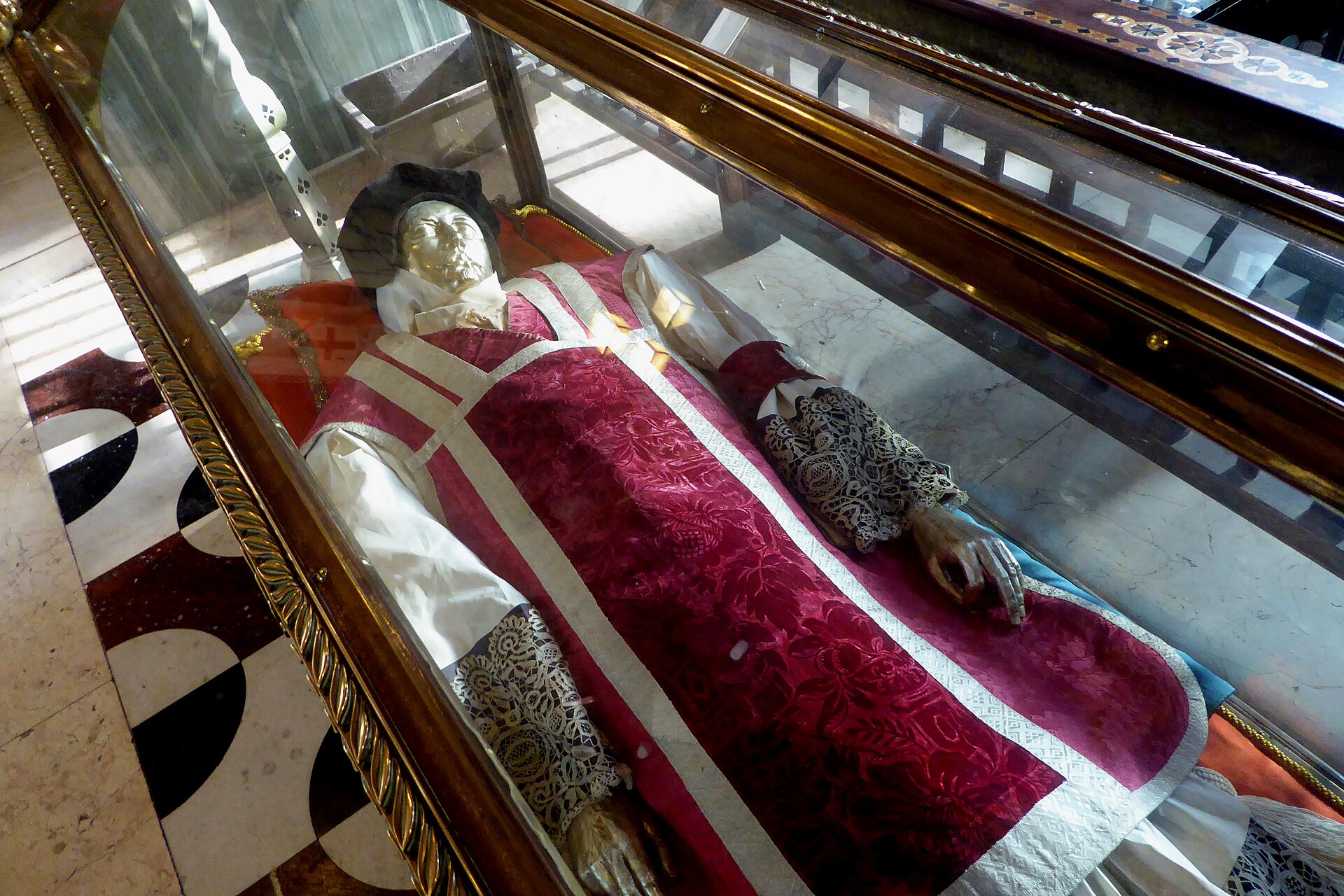
Father Southworth's unwavering commitment to his faith ultimately led to his martyrdom. On June 28, 1654, at the age of 62, he was arrested for the final time and condemned under the Elizabethan Act of Supremacy, which made it treason for a Catholic priest to be in England. He was hanged, drawn, and quartered at Tyburn, a common site for the execution of Catholic martyrs. Miraculously, his body was recovered by devoted Catholics and smuggled to the continent, eventually finding its resting place in the English College at Douai. Centuries later, in 1927, his tomb was opened, revealing his body to be remarkably preserved, a testament to God's favor. Today, his incorrupt body is enshrined in Westminster Cathedral in London, encased in a glass reliquary, allowing pilgrims to venerate his sacred remains.
Saint John Southworth's legacy endures as a powerful symbol of faith, charity, and perseverance in the face of persecution. He was canonized as one of the Forty Martyrs of England and Wales by Pope Paul VI in 1970, formally recognizing his heroic virtue and ultimate sacrifice. Pilgrims visiting Westminster Cathedral can witness the extraordinary preservation of his body, a tangible link to a saint who walked the streets of London ministering to the forgotten. His life serves as an inspiration for all Christians to live their faith boldly, to serve the poor and suffering with boundless compassion, and to remain steadfast in their convictions, even unto death.
Discovery
The remarkable journey of Saint John Southworth's incorrupt body began not at the moment of his martyrdom in 1654, but centuries later, in a testament to the enduring faith of the Catholic community in England and the mysterious ways in which divine providence can manifest. Following his execution by hanging, drawing, and quartering at Tyburn, his dismembered remains were, as was customary for executed traitors, displayed publicly as a deterrent. However, his Catholic admirers, undeterred by the risks, managed to recover his body parts. These were then secretly transported to Douai, France, a significant center for English Catholic exiles and the site of the English College where Southworth had studied. There, his remains were interred in the college chapel, a place of sanctuary and reverence for those who had suffered for their faith. For generations, his tomb remained a quiet, venerated spot, known to the college community but largely forgotten by the wider world, until the tumultuous events of the French Revolution forced another relocation. His remains were hastily reburied in an unmarked grave within the college grounds to protect them from desecration, their exact location becoming lost to memory as the college itself was disbanded and its property confiscated. It was not until 1927, during construction work on the former college site, that a coffin was unearthed. Inside lay a body, remarkably preserved, identified by a lead plate bearing the inscription "John Southworth, Priest, Martyr." The discovery sent ripples of awe and excitement through the Catholic world, particularly in England, where the cause for the canonization of the English Martyrs was actively progressing. The body, despite centuries of burial and the violence of its dismemberment, was found to be largely intact, a phenomenon immediately recognized as a potential sign of incorruption.
Upon its discovery, the body of Saint John Southworth underwent a series of meticulous examinations by ecclesiastical and medical authorities. The initial exhumation in 1927 revealed a body that had defied the natural processes of decay to an astonishing degree. Witnesses described the skin as supple, the features discernible, and the overall appearance remarkably lifelike, considering the passage of nearly three centuries since his death and his violent end. The remains were carefully documented, photographed, and studied by a team of medical experts, who, while unable to definitively explain the phenomenon through purely scientific means, attested to the extraordinary state of preservation. This initial examination confirmed the belief that a miraculous incorruption had occurred. In 1930, following his beatification, the body was exhumed again, this time with even greater solemnity and forensic rigor. Further medical assessments were conducted, reaffirming the earlier findings. The body, though showing some signs of desiccation over time, continued to exhibit remarkable flexibility in its limbs and a general lack of the decomposition typically expected. These repeated examinations served not only to verify the incorruption but also to gather crucial evidence for his eventual canonization, which occurred in 1970 as one of the Forty Martyrs of England and Wales. Each examination reinforced the conviction that this was not merely a natural preservation, but a divine sign.
The preservation journey of Saint John Southworth’s incorrupt body is a testament to both human reverence and divine mystery. After its rediscovery in Douai, and subsequent examinations, the decision was made to return the precious relic to England, the land for which he had given his life. In 1930, his body was solemnly translated to Westminster Cathedral in London, a fitting resting place for a martyr of England. Here, it was placed in a specially constructed glass casket, allowing the faithful to venerate the saint directly. This casket is itself a marvel of craftsmanship, designed to protect the body from environmental degradation while offering an unobstructed view. The body lies clothed in priestly vestments, a poignant reminder of his vocation and sacrifice. The air within the casket is carefully controlled for temperature and humidity to ensure optimal preservation, a modern scientific approach complementing the miraculous nature of its incorruption. The display at Westminster Cathedral is one of quiet dignity, located in the Chapel of St. George and the English Martyrs, where it serves as a powerful focal point for prayer and reflection. The continuous care and controlled environment are crucial in maintaining the body's current state, allowing generations of pilgrims to witness this extraordinary sign of faith.
Among the most remarkable details associated with Saint John Southworth’s incorrupt body is the sheer defiance of natural decay itself, particularly given the circumstances of his death. Unlike many incorruptibles who died peacefully and were buried in relatively undisturbed conditions, Southworth endured a brutal execution involving dismemberment and subsequent reassembly. Despite this violence and the passage of centuries, the body retained a surprising degree of integrity and flexibility, a phenomenon that has consistently baffled medical professionals. While there are no documented accounts of a sweet fragrance, bleeding, or oil exuding from his remains, as seen with some other incorrupt saints, the very fact of his preservation under such adverse conditions is considered a profound miracle. The absence of putrefaction, the retention of discernible features, and the relative suppleness of the tissues after nearly 300 years of burial, including a period in an unmarked grave, stand as the primary and most compelling attestations to his incorruption. This enduring state of preservation, against all natural expectations, is the central and most powerful detail, inspiring awe and strengthening the faith of those who come to venerate him at Westminster Cathedral.
Scientific Analysis
The phenomenon of exceptional post-mortem preservation, often termed incorruption within religious contexts, presents a compelling subject for scientific inquiry, particularly when examining cases such as that of Saint John Southworth. Born around 1592 and executed in 1655, his remains, interred at Westminster Cathedral in London, have been historically noted for their unusual state of preservation. While specific, detailed records of formal, modern medical or scientific examinations conducted with contemporary forensic standards are not widely publicized or readily available in the public domain for Saint John Southworth, historical accounts and anecdotal observations form the primary basis for claims of incorruption. It is understood that when his body was exhumed in 1927 from its original burial site in Douai, France, and subsequently transferred to Westminster Cathedral, medical professionals of that era would have observed and documented its condition. These observations, though not necessarily employing the rigorous methodologies of 21st-century forensic science, would have noted the remarkable retention of soft tissues and general anatomical integrity, defying the typical decomposition expected after centuries of burial. The precise names of the doctors and their institutional affiliations from that 1927 exhumation are not commonly cited in public records, but their findings would have contributed to the prevailing understanding of his preserved state. Further, during subsequent re-interments or public venerations, medical or anatomical experts may have been consulted to assess the body's condition, though again, detailed reports from such consultations are not widely disseminated.
The scientific mystery surrounding Saint John Southworth's preservation lies in its apparent defiance of normal decomposition processes, particularly given the historical context and burial conditions. Human decomposition is a complex biological process driven primarily by autolysis (self-digestion by endogenous enzymes) and putrefaction (bacterial activity). Factors such as temperature, humidity, oxygen availability, soil composition, and the presence of insects or scavengers typically dictate the rate and extent of decay. For a body interred in the 17th century, likely in a traditional coffin and burial plot, complete skeletalization would be the expected outcome after several centuries. The claim of incorruption suggests a significant retention of soft tissues, skin, and even internal organs, a state that is highly unusual without deliberate and sophisticated embalming or preservation techniques. While embalming was practiced in various forms throughout history, the methods available in 17th-century England and France, particularly for a condemned Catholic priest, were unlikely to produce such long-term preservation without significant degradation. The environmental factors of a typical European burial ground – varying soil pH, moisture, and microbial activity – should have facilitated rapid decay. The absence of extensive documentation regarding specific embalming procedures or unique burial conditions (e.g., extremely dry, anoxic environments, or highly acidic peat bogs known for natural mummification) makes the reported preservation scientifically remarkable.
Natural explanations for exceptional body preservation often include adipocere formation (saponification), mummification, or bog body preservation. Adipocere, or "grave wax," is a waxy substance formed from body fat when decomposition occurs in a cool, moist, anaerobic environment. While adipocere can preserve the general body shape and some anatomical features, it fundamentally alters the tissue structure and does not typically result in the lifelike appearance sometimes attributed to incorrupt bodies. Mummification, either natural (e.g., in arid conditions) or artificial (e.g., ancient Egyptian practices), involves the desiccation of tissues, preventing bacterial growth. Bog bodies are preserved in highly acidic, anoxic peat bogs, which tan the skin and preserve soft tissues. However, these specific environmental conditions are not typically associated with traditional Christian burials in 17th-century Europe. Skeptics often point to these natural processes as potential explanations, suggesting that incomplete or misinterpreted observations, or even deliberate alterations over time, might account for the perceived incorruption. They might also highlight the lack of rigorous, independent scientific examination to definitively rule out these natural phenomena. The challenge in cases like Saint John Southworth's is that without direct, modern forensic analysis, it is difficult to conclusively confirm or refute these natural explanations, leaving a significant portion of the phenomenon unexplained from a purely scientific standpoint.
From a modern scientific perspective, the case of Saint John Southworth, like other purported incorrupt bodies, offers a unique opportunity to study the complex processes of post-mortem preservation. While historical accounts are valuable, contemporary forensic science employs a suite of advanced techniques that could provide definitive answers. Non-invasive methods such as computed tomography (CT) scans and magnetic resonance imaging (MRI) could reveal the internal state of the body, identifying the presence and condition of internal organs, bone structure, and any evidence of embalming materials or natural preservation processes. Microscopic tissue analysis, if ethically permissible and minimally invasive, could differentiate between normal decomposed tissue, adipocere, mummified tissue, or potentially unique preservation states. Carbon dating could precisely determine the age of the remains, confirming their identity. Furthermore, DNA analysis could provide insights into the individual's genetic profile and potentially reveal any genetic predispositions to unusual decomposition patterns, though this is highly speculative. The absence of such comprehensive modern scientific investigations leaves many questions unanswered. For instance, what specific biochemical changes have occurred in the tissues to inhibit putrefaction? Are there unique microbial communities present that contribute to preservation rather than decay? What is the exact chemical composition of the preserved tissues? While respecting the religious significance of such relics, a thorough scientific examination, conducted with the highest ethical standards and transparency, could significantly advance our understanding of taphonomy and the extraordinary circumstances under which human remains can defy the natural course of decomposition, bridging the gap between historical observation and empirical evidence.
Spiritual Significance
The phenomenon of incorruption, as exemplified by Saint John Southworth, holds profound theological significance within Catholic doctrine, serving as a tangible testament to the sanctity of the human body and the promise of resurrection. In a world often prone to desacralizing the physical, the incorrupt body of a saint stands as a powerful reminder of 1 Corinthians 6:19, which declares our bodies to be temples of the Holy Spirit. This miraculous preservation, defying natural processes of decay, is understood not as a mere biological anomaly, but as a divine affirmation of a soul so intimately united with God that even after death, a special grace is bestowed upon their earthly remains. For Saint John Southworth, martyred for his unwavering fidelity to the Catholic faith during a period of intense persecution, his incorruption underscores the Church's belief in the ultimate triumph of grace over sin and death. It speaks directly to the doctrine of the resurrection of the body, offering a prefigurement, however partial, of the glorified bodies promised to the faithful at the end of time. The Church interprets such incorruption as a sign of God's favor, a visible manifestation of the saint's heroic virtue and their enduring participation in the communion of saints, bridging the temporal and eternal realms.
Saint John Southworth's unique charism was undoubtedly his unwavering fidelity to the priesthood and his profound charity towards the sick and the poor, particularly during the devastating plague that swept through London. His heroic virtues were manifest in his steadfast obedience to his priestly vows, even when it meant risking his life daily under the penal laws. Humility shone through his willingness to serve the most marginalized, ministering to plague victims without thought for his own safety, embodying Christ's command to love one's neighbor as oneself. His life was a testament to a deep, practical mysticism, where his spiritual fervor translated directly into compassionate action. He belonged to a spiritual tradition rooted in the Counter-Reformation zeal for the salvation of souls, particularly in mission territories like England, where the faith was under siege. His particular way of holiness was characterized by a courageous pastoral zeal, prioritizing the spiritual and physical well-being of his flock above all else. He did not seek earthly glory but rather the quiet fulfillment of his priestly duties, offering the sacraments and spiritual guidance to those who desperately sought them, often in clandestine settings. This selfless dedication, culminating in his martyrdom, underscores the depth of his commitment to Christ and His Church.
Devotion to Saint John Southworth has evolved over centuries, deeply rooted in the historical memory of English Catholicism and solidified by the remarkable preservation of his body. His patronage is primarily invoked for the sick, especially those suffering from infectious diseases, a direct reflection of his compassionate ministry during the plague. Pilgrims today visit his shrine in Westminster Cathedral, where his incorrupt body is reverently displayed, often finding profound spiritual consolation in his presence. The experience of standing before his preserved remains is often described as deeply moving, a tangible connection to a heroic figure who lived and died for his faith. While specific novenas or prayers directly attributed to him may be less widespread globally compared to some other saints, local devotion in England, particularly among those with a connection to recusant history, remains strong. His feast day, celebrated on June 27th, is a time for remembrance and prayer, particularly for persecuted Christians and for those who minister to the sick. The very act of venerating his incorrupt body serves as a powerful catechesis, reminding the faithful of the enduring power of grace and the sanctity of a life lived in Christ.
The incorrupt body of Saint John Southworth has itself been a source of spiritual consolation and a focal point for attributed miracles. While specific, widely documented miracles of healing or conversion directly attributed to his intercession might be less numerous in official records compared to some other saints, the very phenomenon of his incorruption is considered a continuous miracle, a sign of divine favor. For centuries, the faithful have found solace and renewed faith in the visible proof of God's special regard for His saints. Many pilgrims report a profound sense of peace and spiritual upliftment when visiting his shrine, experiencing a tangible connection to the heavenly communion. It is not uncommon for individuals to pray for his intercession for various intentions, particularly for strength in times of adversity, for healing, and for perseverance in faith. The ongoing preservation of his body serves as a quiet, yet powerful, testament to the enduring presence of God's grace in the world, fostering a deeper understanding of the communion of saints and their continued intercession for us.
Saint John Southworth's enduring message for contemporary Catholics and seekers resonates deeply in a world grappling with materialism and secularism. His life challenges the modern inclination to prioritize earthly comforts and fleeting pleasures, reminding us that true fulfillment lies in selfless service and unwavering fidelity to God. In an age often characterized by spiritual indifference, his example of courageous faith in the face of extreme persecution serves as a powerful antidote, urging believers to stand firm in their convictions. He teaches us the profound value of compassion and charity, particularly towards the most vulnerable, a lesson urgently needed in our often-individualistic society. His incorruption serves as a tangible bridge between the visible and invisible worlds, a physical reminder that there is more to existence than what meets the eye, pointing towards the eternal realities of heaven and the resurrection. From his life, we learn that genuine holiness is not an abstract concept but a lived reality, capable of transforming individuals and inspiring generations. His legacy encourages us to embrace our faith with courage, to serve others with love, and to trust in God's provident care, even amidst life's greatest challenges.
AI summary
A plain-language overview generated from this page's source material. Always verify with primary sources.