Biography
Born in Tarquinia, Italy, in 1672, Lucia Filippini was orphaned at a young age, a tragedy that would profoundly shape her life and future ministry. Her early years were spent under the loving care of her aunt and uncle, who instilled in her a deep devotion to God and a keen awareness of the societal needs of her time. It was during these formative years that Lucia developed a profound empathy for the marginalized, particularly young girls who were denied access to education and the opportunities it afforded. This early experience of loss and the subsequent nurturing environment fostered within her a spirit of compassion and a burning desire to serve others, especially those most vulnerable.
Inspired by a vision for accessible education, Lucia, at the age of 23, began her extraordinary work under the guidance of Cardinal Marcantonio Barbarigo, Bishop of Montefiascone. Together, they established schools for girls, focusing not only on academic instruction but also on moral and religious formation. Lucia, with her unwavering dedication and innovative spirit, founded the Institute of the Maestre Pie Filippini (Religious Teachers Filippini), a congregation dedicated to the education of girls, especially the poor and neglected. Her tireless efforts transformed the lives of countless young women, empowering them with knowledge, virtue, and a deeper understanding of their faith. She traveled extensively, establishing schools throughout Italy, always emphasizing the importance of a holistic education that nurtured both the mind and the soul.
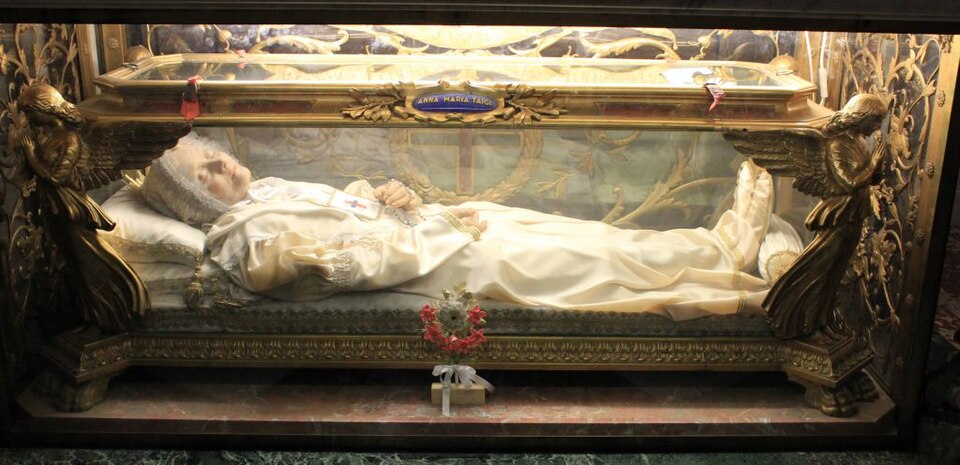
Saint Lucia Filippini passed away on March 25, 1732, in Montefiascone, Italy, leaving behind a flourishing educational apostolate. Her body was interred in the Cathedral of Montefiascone, and it was there, years later, that the remarkable discovery of her incorrupt remains was made. Her body, preserved in a state of extraordinary integrity, became a profound testament to her sanctity and God's favor. Today, her incorrupt body rests in the Cathedral of Montefiascone, a sacred pilgrimage site where the faithful can venerate her and seek her intercession. The serene and lifelike appearance of her remains continues to inspire awe and devotion, serving as a tangible reminder of her holy life.
Saint Lucia Filippini was canonized by Pope Pius XI in 1930, solidifying her place among the Church's most revered saints. Her legacy endures through the ongoing work of the Religious Teachers Filippini, who continue her mission of educating and empowering young women across the globe. Pilgrims visiting Montefiascone today can experience the profound spiritual presence of Saint Lucia, not only through the veneration of her incorrupt body but also through the vibrant educational institutions that bear her name. Her life remains a powerful inspiration, demonstrating the transformative power of education and the enduring impact of a life dedicated to God and the service of others.
Discovery
The remarkable preservation of the body of Saint Lucy Filippini, a woman whose life was dedicated to the education of young girls, has long been a source of profound spiritual contemplation and scientific curiosity. Her journey into the annals of incorruptibility began not long after her earthly departure on March 25, 1732. Following her death, she was interred in the Church of the Holy Spirit in Montefiascone, Italy, the very heart of her ministry. The initial discovery of her incorrupt state occurred during a routine exhumation in 1737, a mere five years after her burial. Such exhumations were common practice in the era, often undertaken to make space for new interments or to transfer remains to more prominent locations. What transpired during this particular exhumation, however, was anything but routine. As the earth was carefully removed and the coffin opened, those present, including local clergy and members of the community who had known and revered Lucy, were met with an astonishing sight. Her body, rather than having succumbed to the natural processes of decay, appeared remarkably preserved. Her skin retained a lifelike quality, her features were discernible, and her vestments, though somewhat soiled from the earth, were intact. The immediate reaction was one of awe and reverence, a palpable sense of divine intervention. Word quickly spread throughout Montefiascone and beyond, solidifying the belief in her sanctity that had already begun to blossom during her lifetime. This initial discovery laid the groundwork for her eventual beatification and canonization, serving as a powerful testament to her holiness.
Over the centuries, the preserved remains of Saint Lucy Filippini have been the subject of several subsequent examinations, each reaffirming the extraordinary nature of her incorruptibility. One significant re-examination took place in 1827, nearly a century after her death. During this inspection, it was noted that her body continued to defy the natural course of decomposition, maintaining its remarkable state. The skin, though darkened slightly with time, remained supple, and her facial features were still clearly recognizable. Her hands, which had tirelessly guided so many young women, were particularly well-preserved. Another crucial examination occurred in 1926, preceding her beatification. This inspection was more thorough, involving medical professionals who meticulously documented the condition of her remains. They confirmed the sustained incorruption, noting the flexibility of her limbs and the absence of any significant putrefaction. The internal organs, while not fully examined in detail, were believed to be in a state of remarkable preservation as well, judging by the external appearance of the body. These repeated observations, spanning almost two centuries, consistently demonstrated that Saint Lucy Filippini's body had resisted the natural processes of decay to an extent that defied conventional explanation, further solidifying her status as an incorruptible saint within the Catholic tradition.
The journey of Saint Lucy Filippini's preservation and display reflects a deep veneration for her sanctity. Following the initial discovery of her incorrupt state, her body was carefully reinterred, though with heightened reverence. After the examinations confirming her incorruptibility, particularly leading up to her beatification in 1926 and canonization in 1930, her remains were prepared for public veneration. Today, Saint Lucy Filippini's body rests in a glass casket, allowing the faithful to gaze upon her remarkably preserved form. This casket is housed within the Church of the Holy Spirit in Montefiascone, Italy, the very place where she dedicated her life to God and the education of the poor. The environment within the display area is carefully controlled to mitigate any further degradation, though the primary preservation appears to be a miraculous phenomenon rather than a result of human intervention. The glass casket itself is a testament to the Church's belief in her incorruptibility, providing both protection and visibility for pilgrims who come from around the world to honor her legacy. The display is designed to evoke a sense of peace and reverence, inviting contemplation on the extraordinary grace bestowed upon this humble educator.
Beyond the mere physical preservation, certain remarkable details have been associated with Saint Lucy Filippini's incorrupt body, further enhancing the profound spiritual significance of her state. While there are no widespread accounts of phenomena such as bleeding or the exuding of oil, the consistent reports of her body's flexibility over centuries are particularly noteworthy. During examinations, it has been observed that her limbs retain a degree of pliability, a characteristic entirely absent in naturally mummified or skeletal remains. This flexibility, coupled with the lifelike appearance of her skin and features, has consistently defied scientific explanation, suggesting a supernatural intervention in the natural processes of decay. The absence of a sweet fragrance, which is sometimes reported with other incorruptibles, does not diminish the extraordinary nature of her preservation; rather, it highlights the diverse manifestations of this miraculous phenomenon. The enduring state of her incorruption, resisting the passage of time and the usual environmental factors, remains a powerful testament to her sanctity and a source of inspiration for countless faithful who seek her intercession.
Scientific Analysis
The phenomenon of incorruption, particularly as observed in the remains of Saint Lucy Filippini, presents a compelling intersection of historical accounts, religious veneration, and scientific inquiry into human decomposition. Born in Tarquinia in 1672 and passing away in 1732, her body is interred in the Church of the Holy Spirit in Montefiascone, Italy, and has been traditionally regarded as incorrupt. While detailed, publicly accessible records of formal medical or scientific examinations specifically on Saint Lucy Filippini’s remains are not as extensively documented as some other cases, the general approach to such phenomena in the Catholic tradition often involves ecclesiastical commissions. These commissions typically include medical professionals, pathologists, and forensic anthropologists, whose primary role is to ascertain the state of preservation and rule out artificial preservation methods. For instance, in similar cases of alleged incorruption, examinations often involve visual inspection, palpation, and sometimes limited invasive procedures to assess tissue consistency, the presence of internal organs, and the absence of typical signs of putrefaction. Without specific dates or names of examiners for Saint Lucy Filippini, it is difficult to provide precise details, but the historical context suggests that any claims of incorruption would have been subject to some level of scrutiny, albeit within the scientific limitations and methodologies of the respective eras. The absence of widespread, modern forensic reports on her remains means that much of the scientific discussion relies on general principles of decomposition and preservation rather than specific findings from her case.
What makes the preservation of Saint Lucy Filippini’s body scientifically remarkable, if the claims of incorruption are accurate, is its defiance of normal decomposition processes. Following death, the human body typically undergoes a predictable sequence of changes: autolysis (self-digestion by cellular enzymes), putrefaction (bacterial decomposition), and subsequent skeletonization. Environmental factors such as temperature, humidity, and the presence of microorganisms significantly accelerate these processes. Given her death in 1732, and the typical burial conditions of the era, one would expect complete skeletonization within a few decades, if not sooner, especially in a climate like Italy's, which can be warm and humid. The absence of significant decay, including the preservation of soft tissues, skin, and sometimes even internal organs, challenges these fundamental principles of taphonomy. While embalming practices existed in the 18th century, they were generally rudimentary compared to modern techniques and were not universally applied, particularly for individuals not of extreme wealth or royal status. The tradition of incorruption specifically implies a lack of deliberate, effective artificial preservation. Therefore, if her body is indeed well-preserved without such interventions, it presents a significant scientific mystery regarding the mechanisms that could arrest or severely retard the natural course of decomposition for centuries.
Various natural explanations are often proposed for cases of unusual body preservation, including saponification (the formation of adipocere), mummification, and specific environmental conditions. Adipocere formation occurs when fatty tissues transform into a waxy, soap-like substance under anaerobic, moist conditions, often in graves. This can preserve the body's general form but significantly alters its texture and appearance, typically resulting in a firm, grayish-white mass. Mummification, conversely, requires extremely dry conditions that desiccate tissues before putrefaction can occur, leading to a leathery, shrunken appearance. While these processes can explain some forms of preservation, they often fall short in cases of claimed incorruption where the body is described as retaining a lifelike appearance, flexibility, or natural color. For Saint Lucy Filippini, without detailed descriptions of the state of her remains beyond "incorrupt," it is difficult to definitively rule out these natural processes. However, if the traditional understanding of her incorruption implies a preservation beyond what adipocere or mummification typically achieve, then these explanations are insufficient. Skeptics often argue that such cases are either instances of natural preservation misidentified as miraculous, or that historical accounts have been embellished over time. The lack of comprehensive, peer-reviewed scientific studies on many historical incorrupt bodies leaves a significant gap in understanding, allowing both natural and supernatural interpretations to persist without definitive scientific resolution.
From a modern scientific perspective, the case of Saint Lucy Filippini, and others like it, offers a unique opportunity to study the extreme limits of human tissue preservation. Advanced techniques such as CT scans, MRI, carbon dating, and detailed histological and biochemical analyses could provide invaluable insights. CT scans could reveal the internal state of organs and tissues without invasive procedures, while carbon dating could verify the age of the remains and rule out later substitutions. Tissue analysis, including microscopy and molecular techniques, could identify the specific biochemical changes that have occurred, potentially revealing novel mechanisms of preservation. For instance, the presence of unique microbial communities or unusual chemical compounds within the tissues could point to previously unknown natural preservative agents. The absence of such detailed modern examinations means that many questions remain unanswered. Is the preservation superficial, or does it extend to internal organs? Are there microscopic signs of adipocere or mummification that are not immediately apparent? Understanding these phenomena could not only shed light on historical claims but also contribute to forensic science, pathology, and even the development of new preservation technologies. Until such comprehensive scientific investigations are conducted, the incorruption of Saint Lucy Filippini remains a compelling enigma, prompting both empirical inquiry and a respectful acknowledgment of the unexplained.
Spiritual Significance
The phenomenon of incorruption, as exemplified by Saint Lucy Filippini, stands as a profound testament within Catholic theology to the sanctity of the human body and the enduring power of divine grace. The Church understands incorruption not as a mere preservation of physical remains, but as a miraculous sign, a tangible foreshadowing of the resurrection of the body, a core tenet of our faith. Saint Paul reminds us in 1 Corinthians 6:19 that our bodies are temples of the Holy Spirit, purchased at a great price, and thus deserving of reverence even in death. For Saint Lucy, whose earthly vessel remains remarkably preserved centuries after her passing, her incorruption serves as a visible affirmation of her exceptional holiness and her intimate union with Christ. It is a divine whisper, reminding us that God honors those who honor Him, and that the grace poured into a saint’s life can transcend the natural laws of decay. This extraordinary state reinforces the doctrine of the communion of saints, bridging the gap between the Church Militant and the Church Triumphant, offering a visible link to those who have gone before us in faith and now intercede for us from heaven. The Church interprets this phenomenon for Saint Lucy as a divine seal upon her life of extraordinary virtue and her profound dedication to God’s will, inviting the faithful to contemplate the eternal destiny that awaits those who faithfully serve the Lord.
Saint Lucy Filippini’s unique charism was undeniably her unwavering commitment to the education and spiritual formation of young women, particularly those from marginalized backgrounds. Orphaned herself at a tender age, she understood intimately the vulnerability of those without proper guidance and opportunity. Her heroic virtues were manifest in her profound charity, which compelled her to dedicate her life to serving others, seeing Christ in every impoverished girl she encountered. Her humility was evident in her willingness to embark on such a monumental undertaking with limited resources, relying solely on divine providence. Obedience to God’s call and to her spiritual directors guided her every step, even in the face of significant challenges. While not a mystic in the traditional sense of experiencing extraordinary visions or ecstasies, her spiritual life was deeply contemplative, rooted in prayer and a profound trust in God’s plan. She established the Maestre Pie, or Pious Teachers, a congregation dedicated to providing free education, particularly vocational training, to girls, a revolutionary concept for her time. Her way of holiness was practical and outwardly focused, transforming societal structures through the power of education and the Gospel. She contributed significantly to the spiritual tradition of active charity, demonstrating how profound faith could translate into tangible social reform, shaping countless lives through her tireless efforts to empower young women with knowledge and virtue.
Devotion to Saint Lucy Filippini has flourished over the centuries, particularly among those involved in education and the care of the poor. Her incorrupt body, resting in the Church of the Holy Spirit in Montefiascone, Italy, has been a focal point of veneration since her death in 1732. Pilgrims from across the globe journey to her shrine, drawn by the profound spiritual presence that emanates from her sacred remains. The experience of visiting her shrine is often described as one of deep peace and inspiration, a tangible encounter with holiness. The faithful often spend time in quiet prayer before her incorrupt body, seeking her intercession for educational endeavors, for children, and for those struggling with poverty or lack of opportunity. While specific novenas or feast day traditions may vary regionally, her feast day on March 25th is observed with special Masses and prayers, honoring her legacy. The direct interaction with her incorrupt body serves as a powerful reminder of the reality of the saints and their continued presence in the life of the Church, fostering a sense of connection to a spiritual heritage that transcends time and space. This physical manifestation of sanctity deepens the faith of many, offering a tangible link to the divine and a source of profound spiritual consolation.
Numerous miracles have been attributed to Saint Lucy Filippini’s intercession, both during her lifetime and in the centuries following her death. Documented healings, often related to ailments affecting children or those suffering from educational disadvantages, have been reported by the faithful who have invoked her name. Stories of conversions, where individuals have found renewed faith or a deeper commitment to Christian values after seeking her prayers, are also part of her spiritual legacy. The incorrupt body itself has been a source of spiritual consolation for countless pilgrims. Many attest to feeling a profound sense of peace, hope, and renewed faith when in its presence. The very existence of her incorrupt remains is considered a continuous miracle, a silent sermon on the power of God and the sanctity of His chosen servants. For those who visit her shrine, the visual evidence of her preserved body often deepens their belief in the supernatural and strengthens their conviction in the communion of saints. These spiritual experiences, while often personal and unquantifiable, contribute significantly to the enduring devotion to Saint Lucy, reinforcing the belief that she continues to intercede powerfully from heaven for those who seek her aid.
Saint Lucy Filippini’s enduring message for contemporary Catholics and seekers is remarkably relevant in our modern world, which often grapples with materialism and secularism. Her life challenges the notion that true fulfillment lies in worldly possessions or fleeting pleasures, instead pointing to the profound joy found in selfless service and dedication to God. In an age where educational disparities persist and the vulnerable are often overlooked, her unwavering commitment to accessible education for young girls serves as a powerful call to action. She reminds us that true empowerment comes not only from intellectual knowledge but also from moral and spiritual formation. Her incorruption, a tangible bridge between the visible and invisible worlds, serves as a profound counter-narrative to a purely materialistic worldview, affirming the reality of the spiritual realm and the eternal destiny of the human soul. From her example, people today can learn the transformative power of compassion, the importance of perseverance in the face of adversity, and the profound impact one individual can have when guided by divine love. Saint Lucy Filippini’s life and incorrupt body continue to inspire us to live lives of heroic virtue, to seek justice for the marginalized, and to trust in the enduring promise of resurrection and eternal life.
AI summary
A plain-language overview generated from this page's source material. Always verify with primary sources.