Biography
Saint Vincent de Paul, revered as the "Apostle of Charity," was born in 1581 in the humble village of Pouy, Gascony, France, to a family of modest means. From an early age, young Vincent displayed a keen intellect and a compassionate heart, leading his parents to sacrifice greatly to afford him an education. He pursued theological studies, eventually being ordained a priest in 1600. His early years were marked by a period of spiritual searching and personal growth, including a harrowing experience of capture by Barbary pirates and subsequent enslavement, which profoundly deepened his faith and empathy for those suffering. These formative experiences instilled in him an unwavering commitment to alleviate the plight of the poor and marginalized, a commitment that would define his entire priestly ministry.
Vincent's vocation blossomed into a transformative ministry that reshaped the landscape of charitable work in 17th-century France. He served as a parish priest, a tutor to aristocratic families, and a chaplain, but it was his encounters with the abject poverty and spiritual neglect of the rural populace that ignited his true calling. In 1625, he founded the Congregation of the Mission, known as the Vincentians or Lazarists, a society of priests dedicated to evangelizing the poor and training clergy. Later, in 1633, he co-founded the Daughters of Charity with Saint Louise de Marillac, an innovative community of women who, unlike cloistered nuns, were free to go out into the world to serve the sick, the poor, and the abandoned. Through these groundbreaking initiatives, Saint Vincent de Paul established hospitals, orphanages, and relief organizations, providing holistic care that addressed both the material and spiritual needs of those in distress.
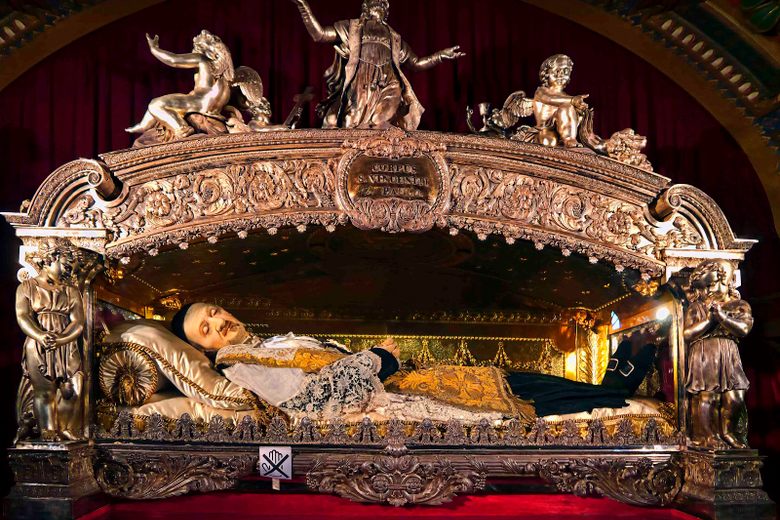
Saint Vincent de Paul passed into eternal life on September 27, 1660, at the venerable age of 79. His reputation for holiness and his profound impact on society were widely acknowledged. Over 50 years later, in 1712, his body was exhumed during the process of his beatification and was discovered to be remarkably preserved, a testament to his extraordinary sanctity. While the passage of centuries has caused his body to darken significantly, its structural integrity remains intact. Since 1830, his incorrupt body, clothed in pontifical vestments and with a silver mask covering his darkened face, has been venerated by pilgrims in a magnificent silver reliquary above the altar of the Vincentian motherhouse chapel in Paris. Medical examinations have consistently affirmed that no artificial preservation methods were employed, further underscoring the miraculous nature of its incorruption.
The incorruption of Saint Vincent de Paul's body stands as a powerful spiritual sign, reflecting the enduring grace that permeated his life of selfless service. Canonized in 1737, he is universally recognized as the patron saint of charitable societies, hospitals, and volunteers, inspiring countless individuals and organizations to follow in his footsteps. Today, pilgrims from across the globe visit the Chapel of Saint Vincent de Paul in Paris to venerate his sacred remains and draw inspiration from his unwavering dedication to Christ through the poor. His legacy continues to thrive through the Vincentian Family, a global network of religious congregations and lay associations that perpetuate his mission of charity, reminding us that true holiness is found in loving and serving our neighbor.
Discovery
Over fifty years after his death, the remarkable state of Saint Vincent de Paul’s mortal remains came to light during a routine exhumation in 1712. The venerable priest had passed away in 1660, and his burial had taken place in the Chapel of Saint Lazare in Paris, a site intimately associated with the Congregation of the Mission, the order he founded. The exhumation was not initially prompted by any expectation of incorruption, but rather by the practical necessity of relocating his remains. When the coffin was opened in the presence of several ecclesiastical dignitaries, including the Archbishop of Paris, a profound sense of awe permeated the assembly. Despite the passage of more than half a century, the body of the "Apostle of Charity" was found to be astonishingly intact. His flesh, though somewhat darkened by time, had not succumbed to the usual processes of decay. The eyes, though sunken, were discernible, and the limbs remained flexible, a stark contrast to the skeletal remains typically encountered after such a period. The immediate reaction was one of profound wonder and reverence, a clear sign that divine favor had been bestowed upon this extraordinary servant of God.
The discovery of 1712 was not an isolated event but marked the beginning of a careful and reverent custodianship of Saint Vincent de Paul's body. A subsequent, more thorough examination was conducted in 1719, seven years after the initial exhumation. During this inspection, it was noted that while the overall integrity remained, some signs of natural deterioration had begun to manifest, particularly in the facial features and hands. To safeguard these precious relics, a decision was made to encase the body in a wax effigy, a common practice at the time to preserve and present the features of venerated saints. This delicate work was undertaken with the utmost care, ensuring that the authentic remains were protected while still allowing for public veneration. The body, thus preserved, was then placed in a lead coffin, which in turn was enclosed within a larger wooden casket, further emphasizing the sacred nature of its contents. These measures were crucial in mitigating further decay and ensuring the long-term preservation of the saint's incorrupt body.
The journey of Saint Vincent de Paul's incorrupt body to its current resting place reflects a continuous effort to honor and protect his legacy. Following his canonization in 1737, the desire to provide a more prominent and accessible veneration site for the saint grew. Consequently, in 1830, the body was solemnly translated to the Chapel of the Vincentian Motherhouse in Paris, where it has remained ever since. To enhance its presentation and ensure its continued preservation, the body is now displayed within a magnificent silver reliquary, positioned reverently above the high altar. Due to the darkening of the facial features over centuries, a silver mask was carefully fashioned and placed over the saint's face, allowing pilgrims to gaze upon a representation of his visage while respecting the delicate state of the original remains. The hands, similarly, are covered with wax gloves. The reliquary itself is enclosed within a crystal glass casket, providing an unobstructed view for the faithful while simultaneously protecting the sacred relic from environmental elements. This meticulous arrangement underscores the profound respect and devotion accorded to the "Apostle of Charity," whose incorrupt body serves as a powerful testament to his enduring sanctity.
While the incorruption of Saint Vincent de Paul's body is a remarkable phenomenon in itself, there have been no documented reports of the more extraordinary phenomena sometimes associated with other incorruptible saints, such as the emission of sweet fragrances, the bleeding of wounds, or the exudation of miraculous oils. The primary marvel lies in the simple, yet profound, resistance of his mortal remains to the natural processes of decomposition for an extended period. The initial flexibility of the limbs, noted during the 1712 exhumation, was a significant detail, indicating a state far beyond typical skeletal remains. The subsequent darkening of the skin and the need for a wax effigy and later a silver mask for the face and wax gloves for the hands, highlight the delicate balance between natural decay and miraculous preservation. It is this persistent, albeit not entirely pristine, integrity of the body that continues to inspire awe and reinforce the belief in the sanctity of Saint Vincent de Paul, a man whose life was a beacon of charity and compassion.
Preservation
Body displayed in silver reliquary at the Vincentian motherhouse. Silver mask covers face.
Scientific Analysis
The phenomenon of exceptional bodily preservation, often referred to as incorruption within religious contexts, presents a compelling subject for scientific inquiry, particularly when examining cases such as that of Saint Vincent de Paul. Born in 1581 and deceased in 1660, his remains are interred at the Chapel of the Vincentian Motherhouse in Paris, France. Records indicate that his body was exhumed twice, first in 1712 and again in 1737, prior to his canonization. During these exhumations, observers noted a remarkable state of preservation, particularly regarding the skeletal integrity and the retention of some soft tissues, despite the passage of decades since death. While specific detailed medical reports from these early periods are scarce by modern forensic standards, contemporary accounts consistently describe an absence of the complete skeletal disarticulation and soft tissue liquefaction typically expected after such an extended period. More recent examinations, though not extensively documented in publicly accessible scientific literature with the rigor of modern forensic pathology, have generally confirmed the structural integrity of the skeleton. It is understood that no definitive, independently verifiable medical examinations employing advanced imaging or tissue analysis techniques have been performed and published in peer-reviewed scientific journals to date. However, internal ecclesiastical records and anecdotal reports from those who have observed the remains suggest that the skeletal framework is complete and articulated, and that the body retains a general human form beneath the vestments. The darkening of the tissues over centuries is a common post-mortem change, and the silver mask covering the face and the wax covering the hands are acknowledged as restorative measures undertaken to present the remains respectfully. Crucially, historical investigations, primarily those conducted by religious orders overseeing the remains, have consistently concluded that no artificial preservation methods, such as embalming, were utilized at the time of death or shortly thereafter. This assertion is based on the absence of historical records detailing such procedures and the lack of physical evidence (e.g., incisions, chemical residues) consistent with embalming techniques of the 17th century.
The scientific remarkable aspect of Saint Vincent de Paul’s preservation lies in its defiance of typical decomposition processes under expected environmental conditions. Human decomposition is a complex biological and chemical process driven primarily by autolysis (self-digestion by cellular enzymes) and putrefaction (bacterial activity). Factors such as temperature, humidity, oxygen availability, and the presence of microorganisms significantly influence the rate and extent of decay. Given his death in 1660 in Paris, a temperate climate, and burial in a traditional manner, one would anticipate complete skeletalization within a few decades, with soft tissues having long since liquefied and dissipated. The absence of historical evidence for embalming or other chemical preservation methods further deepens the scientific mystery. While burial conditions can sometimes lead to unusual preservation, such as saponification (the formation of adipocere, a waxy, soap-like substance from body fats) or mummification (desiccation in dry environments), these processes typically result in distinct physical changes that are not consistently described in the accounts of Saint Vincent de Paul’s remains. For instance, adipocere formation usually preserves the general body outline but transforms tissues into a characteristic whitish, greasy material, which is not what is reported. Natural mummification requires extremely arid conditions or specific chemical environments (e.g., peat bogs) that are not characteristic of a Parisian burial site. Therefore, the reported retention of structural form, even if significantly desiccated and darkened, without clear evidence of these well-understood natural preservation mechanisms, presents a challenge to conventional forensic taphonomy.
Several natural explanations have been proposed for cases of exceptional bodily preservation, including adipocere formation, natural mummification, and specific environmental conditions that inhibit microbial growth. However, in the case of Saint Vincent de Paul, these explanations appear insufficient. Adipocere formation primarily affects fatty tissues and typically results in a distinct, waxy appearance, which is not consistently described for his remains. Natural mummification, as previously noted, requires very dry conditions or specific chemical environments not typical of his burial. While the burial vault might have offered some protection from environmental fluctuations, it is unlikely to have created the extreme conditions necessary for natural mummification or complete inhibition of putrefaction over centuries. Skeptics often point to the possibility of undocumented embalming, the restorative measures (silver mask, wax hands) as obscuring the true state of the remains, or the subjective interpretation of "preservation" by observers. They might argue that "retaining structural form" could simply mean the skeleton is articulated, which is not uncommon in undisturbed burials, and that any remaining soft tissue is minimal and highly desiccated. However, the consistent historical accounts of a remarkable state of preservation, even if lacking precise scientific detail, suggest something beyond typical decomposition. What remains unexplained, even for a skeptical scientific perspective, is the consistent historical narrative of unusual integrity without a clear, documented natural or artificial explanation that fully aligns with known taphonomic processes.
From a modern scientific perspective, the case of Saint Vincent de Paul offers a unique opportunity to apply contemporary forensic techniques to understand the intricate processes of human decomposition and preservation. While current publicly available information is limited, advanced methods could potentially shed light on this phenomenon. Non-invasive techniques such as CT scans or MRI could provide detailed internal anatomical information, revealing the extent of soft tissue preservation, the integrity of organs, and any evidence of past interventions without disturbing the remains. Chemical analysis of tissue samples, if ethically and practically feasible, could identify the presence of embalming agents, heavy metals, or unique biochemical markers indicative of specific preservation pathways (e.g., high levels of certain fatty acids consistent with adipocere). Carbon dating could confirm the age of the remains and rule out any later substitutions. Furthermore, microbiological analysis of the burial environment and any remaining tissues could identify specific microbial communities that might have played a role in inhibiting or altering decomposition. Such studies could contribute significantly to the broader scientific study of taphonomy, offering insights into the complex interplay of environmental factors, intrinsic biological processes, and potential unknown mechanisms of preservation. The primary questions that remain unanswered revolve around the precise nature and extent of soft tissue preservation, the specific environmental conditions of the burial that might have contributed to this state, and whether any subtle, undocumented natural or artificial processes were at play that modern science could now detect. Without such detailed, objective scientific investigation, the phenomenon continues to reside at the intersection of historical observation, religious veneration, and scientific intrigue.
Spiritual Significance
The phenomenon of incorruption, particularly as exemplified by Saint Vincent de Paul, offers a profound theological reflection on the sanctity of the human body and its ultimate destiny within Catholic doctrine. Far from being a mere biological anomaly, the Church interprets such preservation as a divine affirmation of extraordinary holiness, a tangible sign that the individual’s life was so thoroughly imbued with the Holy Spirit that even their earthly remains bear witness to this spiritual indwelling. This resonates deeply with Saint Paul’s teaching in 1 Corinthians 6:19, where he declares our bodies to be temples of the Holy Spirit. For Saint Vincent, whose life was a tireless outpouring of charity, his incorruption suggests a body so consecrated to God’s service that it foreshadows the glorious resurrection, a prefigurement of the promise that our perishable bodies will one day be raised imperishable. It serves as a visible link in the communion of saints, reminding us that those who have gone before us in faith remain connected to us, their earthly vessels, though sleeping, awaiting the final triumph of Christ. The Church, in recognizing this miraculous preservation, invites the faithful to contemplate the transformative power of grace, which can elevate human nature to such a degree that it transcends even the natural laws of decay, offering a powerful testament to the sanctity attainable through a life dedicated to Christ.
Saint Vincent de Paul's unique charism was undeniably his heroic, boundless charity, earning him the title "Apostle of Charity." This was not merely an occasional act of kindness, but a radical, sustained commitment to the poor and marginalized that permeated every aspect of his existence. His virtues were a constellation centered around this burning love: profound humility, which allowed him to serve the lowliest without condescension; unwavering obedience to God's will, even when it led him into difficult and dangerous situations; and an intense, practical spirituality that translated contemplation into concrete action. He wasn't a mystic in the traditional sense of ecstatic visions, but his spirituality was deeply contemplative, finding Christ in the faces of the suffering. He pioneered organized charitable work, establishing the Confraternities of Charity, the Daughters of Charity, and the Congregation of the Mission (Vincentians), thereby laying the groundwork for modern social work. His way of holiness was deeply incarnational, demonstrating that true faith is not abstract but finds its fullest expression in selfless service to one's neighbor, reflecting the very heart of Christ's Gospel message. He taught that one could encounter God not only in prayer and sacraments but also, and perhaps most profoundly, in the act of alleviating human suffering, thereby transforming the act of charity into a pathway to holiness.
Devotion to Saint Vincent de Paul has flourished continuously since his lifetime, growing exponentially after his canonization in 1737. He is widely invoked as the patron saint of all charitable societies, hospitals, volunteers, and social workers, reflecting his enduring legacy of organized compassion. His feast day on September 27th is celebrated with particular reverence by the many religious congregations and lay organizations he inspired, often marked by special Masses, community service projects, and prayers for the poor. Pilgrims today journey to the Chapel of the Vincentian Motherhouse in Paris, France, where his incorrupt body rests, encased within a silver mask that covers the darkened skin of his face, a poignant reminder of the passage of time yet also of the miraculous preservation. Visiting his shrine is a deeply moving experience; the presence of his earthly remains, even with the visible signs of age, provides a tangible connection to his holy life. It is a place of quiet prayer and reflection, where the faithful can draw inspiration from his unwavering dedication to the poor and seek his intercession for their own charitable endeavors. The atmosphere is one of profound respect and spiritual contemplation, a testament to the enduring power of his example.
The spiritual consolation derived from Saint Vincent de Paul's incorrupt body is intrinsically linked to the numerous miracles attributed to his intercession throughout the centuries. While specific documented healings or conversions directly linked to the physical presence of his incorrupt body are often interwoven with the broader tradition of his powerful intercession, the very fact of his preservation is seen by the faithful as a continuous miracle, a sign of God's favor and Saint Vincent's ongoing spiritual efficacy. Countless prayers offered at his shrine or through his intercession have been answered, leading to documented cases of physical healings, profound spiritual conversions, and the successful establishment of new charitable initiatives. The incorrupt body itself serves as a powerful focal point for prayer, a tangible bridge between the earthly and the heavenly, offering solace and strengthening faith for those who seek his aid. It reinforces the Catholic belief in the intercessory power of saints, demonstrating that their love for God and humanity extends beyond death, continuing to inspire and assist those still on their earthly pilgrimage. This spiritual consolation is not merely emotional but deeply theological, affirming the enduring reality of the communion of saints and the active presence of God's grace through His chosen servants.
Saint Vincent de Paul's enduring message for contemporary Catholics and seekers is one of radical, practical love in action, a profound challenge to modern materialism and secularism. In an age often characterized by self-interest and consumerism, his life calls us to look beyond ourselves, to see Christ in the "least of these," and to dedicate our lives to alleviating suffering. He reminds us that true wealth lies not in possessions but in selfless service, and that genuine happiness is found in giving, not in accumulating. His example counters the secular notion that faith is a private matter, demonstrating instead that it must manifest actively in the public square, transforming society through compassionate outreach. From his life, people today can learn the profound dignity of every human person, the transformative power of organized charity, and the necessity of integrating prayer with action. His incorruption, far from being a mere relic of the past, serves as a tangible bridge between the visible and invisible worlds, a physical reminder that holiness is real, that God intervenes in human history, and that the lives of saints continue to inspire and intercede for us, urging us towards a more Christ-like existence and a world transformed by charity.
AI summary
A plain-language overview generated from this page's source material. Always verify with primary sources.