Biography
Saint Zita, born in 1218 in Monsagrati, a small village near Lucca, Italy, entered the world amidst the bustling life of the medieval Italian countryside. Her family, though humble, instilled in her deep Christian values from a young age. At the tender age of twelve, Zita was sent to serve as a domestic servant in the wealthy Fatinelli household in Lucca, a common practice for young girls of her social standing. For the next 48 years, until her death, she dedicated herself to this demanding role. Despite often enduring harsh treatment and ridicule from fellow servants and even her employers, Zita maintained an unwavering spirit of charity and piety. Her days were a testament to her profound faith, as she diligently performed her duties while secretly offering prayers and acts of penance. Her compassion for the poor was legendary; she frequently gave away her own meager portions of food and clothing, often facing accusations of theft, yet always trusting in divine providence.
Zita's life was marked by numerous extraordinary occurrences, attesting to her sanctity even during her lifetime. Stories abound of her bread miraculously multiplying when she was giving it to the hungry, or of her cloak being held aloft by angels when she was caught in a storm. These events, witnessed by many, began to shift the perception of her within the Fatinelli household, as even her employers came to recognize the divine grace that permeated her humble existence. She transformed the very atmosphere of the home through her quiet devotion and boundless charity, eventually earning the respect and admiration of those who once scorned her. Her ministry was not one of grand sermons or public pronouncements, but rather a profound living out of the Gospel in the ordinary tasks of daily life, demonstrating that true holiness can be found in the most unassuming of vocations.
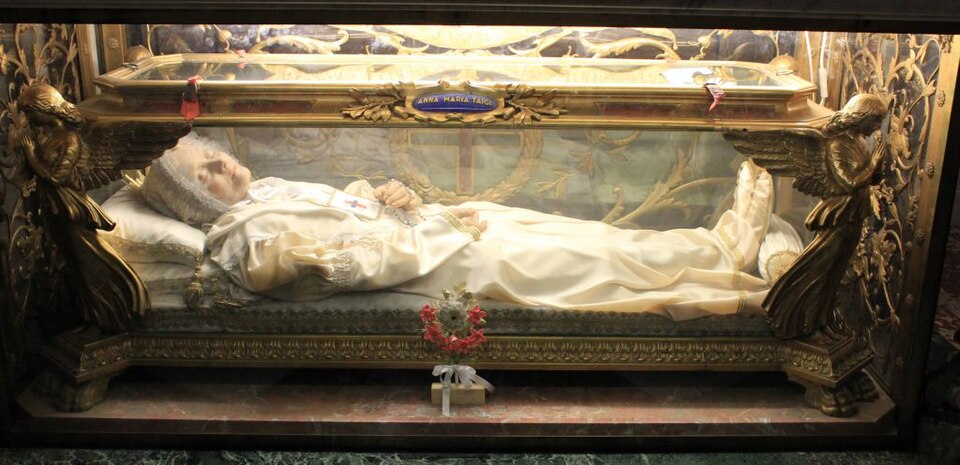
Saint Zita passed away peacefully in 1272, having lived a life entirely devoted to God and neighbor. She was buried in the church of San Frediano in Lucca, a place she had frequented for prayer throughout her life. Over three centuries later, in 1580, her tomb was opened, and her body was discovered to be remarkably incorrupt, a profound testament to her sanctity. The body, having naturally mummified, retained an astonishing degree of structural integrity and preservation, a phenomenon that continues to mystify scientists and inspire believers. Today, her incorrupt body rests in a glass reliquary within the Basilica of San Frediano in Lucca, where pilgrims can venerate her remains and reflect on her extraordinary life.
Her canonization in 1696 solidified her place among the saints, and she was fittingly named the patroness of domestic workers and servants, offering inspiration to all who labor in humble professions. Saint Zita's enduring legacy is a powerful reminder that sanctity is not reserved for the privileged or the powerful, but is attainable through steadfast faith, unwavering charity, and diligent service in any walk of life. Her incorrupt body serves as a tangible sign of God's favor and a beacon of hope, reminding us that even in the most ordinary of lives, extraordinary grace can flourish, transforming the mundane into the miraculous. Pilgrims visiting Lucca today continue to draw strength and inspiration from her story, finding in her a model of Christian virtue lived out in profound humility and love.
Discovery
The remarkable preservation of Saint Zita's earthly remains first came to light in the year 1580, a full 308 years after her passing. The impetus for this exhumation was not merely curiosity, but rather a growing devotion to the humble domestic servant, whose reputation for piety and miraculous intercession had steadily spread throughout Lucca and beyond. Accounts from the period describe a solemn occasion, likely attended by ecclesiastical authorities, members of the Fatinelli family (the household Zita had served for nearly five decades), and numerous faithful. When the grave was opened, what they beheld defied natural explanation. Instead of the skeletal remains expected after centuries of burial, Saint Zita's body was found to be largely intact, her features still discernible, her skin possessing a dry, mummified quality rather than the expected decomposition. This astonishing discovery immediately fueled further veneration, cementing her status as a true saint in the eyes of the people, long before her official canonization. The immediate reaction was one of profound awe and wonder, seen as undeniable proof of God's favor upon His faithful servant.
Following this initial discovery, Saint Zita's body underwent several examinations and re-interments over the centuries, each occasion confirming the extraordinary state of preservation. One significant re-examination occurred in 1652, prior to her beatification, when ecclesiastical officials once again inspected the remains, noting their continued incorruptibility. These inspections were not merely superficial; they involved careful observation of the body's condition, noting the dry, mummified state of the flesh and the preservation of her facial features. The consistency of these findings across multiple centuries served to strengthen the belief in the miraculous nature of her preservation. While the body has naturally undergone some desiccation over time, a characteristic of many mummified incorruptibles, its fundamental integrity has remained unchanged, defying the typical processes of decay. These repeated inspections, documented in various ecclesiastical records, provide a compelling historical record of her enduring preservation.
The journey of Saint Zita's remains from a humble grave to a place of public veneration reflects the evolving practices of relic display within the Catholic Church. After its discovery in 1580, the body was initially placed in a more accessible location within the Basilica of San Frediano, allowing the faithful to gaze upon the miraculously preserved form. Over time, as protective measures became more sophisticated, the body was enshrined within a specially constructed glass casket. This transparent sarcophagus, located within the Basilica of San Frediano in Lucca, Italy, allows pilgrims and visitors to view the saint's mummified remains directly, fostering a powerful connection to her life and sanctity. The glass enclosure serves not only for display but also as a protective barrier, shielding the delicate remains from environmental factors such as dust and humidity, thus contributing to their continued preservation. The current display is both reverent and practical, ensuring the longevity of this precious relic for future generations.
While Saint Zita's incorruptibility is primarily characterized by her mummified state, there have been no widely documented accounts of other extraordinary phenomena such as sweet fragrances, flexibility, or the exuding of oil or blood, which are sometimes associated with other incorruptible saints. Her case is remarkable for the sheer duration of her preservation in a dry, intact form, defying the natural course of decomposition for over four centuries before her body was enshrined in its current protective display. The absence of these more dramatic phenomena does not diminish the profound significance of her incorruption; rather, it highlights a different manifestation of God's power. Her enduring, mummified state is itself the miracle, a silent testament to her holiness and the divine favor bestowed upon her. This consistent, dry preservation, without additional miraculous attributes, underscores the unique nature of her incorruptibility within the pantheon of Catholic saints.
Preservation
Body displayed in a glass case in the Basilica of San Frediano, Lucca.
Scientific Analysis
The phenomenon of remarkably preserved human remains, particularly those attributed to religious figures, often prompts rigorous scientific inquiry. In the case of Saint Zita, whose body has been observed in a mummified state for over 750 years since her death in 1272, formal medical and scientific examinations have been somewhat limited by modern standards, yet historical accounts provide valuable insights. While comprehensive forensic analyses involving contemporary imaging and biochemical techniques have not been widely publicized, historical records indicate several inspections. One notable examination occurred during her canonization process in 1696, where ecclesiastical authorities and medical professionals of the time would have visually inspected the remains to attest to their condition. Subsequent viewings and lesser examinations have taken place over the centuries, often in conjunction with liturgical events or reliquary maintenance. For instance, in the early 20th century, during preparations for a public veneration, the body was again observed. While specific names of medical examiners from these earlier periods are often lost to history or not widely documented in secular scientific literature, the consistent reporting of her mummified state by various observers over centuries underscores the perceived unusual nature of her preservation. These historical observations, though lacking the quantitative rigor of modern forensic pathology, consistently describe a body that, while desiccated, retained remarkable structural integrity, a key characteristic distinguishing it from typical skeletal remains.
The scientific mystery surrounding the preservation of Saint Zita's body lies in its defiance of typical post-mortem decomposition processes. Under normal circumstances, after death, the human body undergoes a complex series of chemical and biological changes, including autolysis (self-digestion by cellular enzymes) and putrefaction (bacterial decomposition), leading to the breakdown of soft tissues and eventual skeletonization. The environmental factors in Lucca, Italy, where Saint Zita was interred in the Basilica of San Frediano, are generally not conducive to natural mummification. The climate is Mediterranean, characterized by moderate temperatures and humidity, which typically accelerate decomposition rather than inhibit it. There is no historical evidence suggesting any deliberate embalming or artificial preservation treatments were applied to Zita's body at the time of her death or shortly thereafter. Medieval embalming practices, when they occurred, were rudimentary compared to modern techniques and primarily involved evisceration and the packing of cavities with aromatic herbs or spices, which would not typically result in such long-term, intact mummification. The absence of such interventions, coupled with an environment not inherently desiccating or anoxic, makes the sustained preservation of soft tissues for over seven centuries a significant scientific anomaly.
Several natural explanations have been proposed for instances of extraordinary body preservation, such as saponification (the formation of adipocere, a waxy, soap-like substance from body fats in moist, anaerobic environments) or natural mummification (desiccation in extremely dry conditions). However, these explanations often fall short in fully accounting for Saint Zita's case. Adipocere formation typically results in a distinct, waxy appearance and can preserve body contours, but it usually occurs in damp, oxygen-deprived conditions, which do not entirely align with the historical burial environment within a basilica. Natural mummification, as seen in desert climates or high-altitude, cold, dry environments, relies on rapid dehydration to inhibit microbial growth. While some degree of desiccation has clearly occurred in Zita's body, the prevailing climate of Lucca does not present the extreme dryness typically required for natural mummification to this extent. Skeptics often point to the possibility of unique microclimates within the tomb, or perhaps the cumulative effect of centuries of gradual desiccation, as contributing factors. However, the remarkable integrity of facial features and other soft tissues, as consistently reported, remains difficult to fully explain by these mechanisms alone, particularly without evidence of deliberate intervention or unusually favorable environmental conditions. The precise combination of factors that led to her mummified state continues to be a subject of scientific curiosity and debate.
From a modern scientific perspective, the case of Saint Zita offers a fascinating opportunity for the application of advanced forensic and anthropological techniques. While historical accounts provide a narrative of her preservation, contemporary methods could yield unprecedented insights. Non-invasive techniques such as computed tomography (CT) scans could provide detailed three-dimensional internal imaging, revealing the state of internal organs, bone structure, and any potential evidence of historical trauma or disease, as well as definitively ruling out any internal embalming materials. Carbon dating of tissue samples, if ethically permissible and minimally invasive, could precisely confirm the age of the remains, corroborating historical dates. Furthermore, advanced tissue analysis, including histological examination and molecular studies (e.g., DNA analysis, proteomics), could identify the specific biochemical alterations that have occurred in the tissues, potentially shedding light on the precise mechanisms of preservation. Such analyses could determine if unique microbial communities played a role, or if specific environmental factors, perhaps previously unconsidered, contributed to the mummification. The broader scientific study of body preservation, encompassing both natural mummification and forensic taphonomy, would greatly benefit from a thorough investigation of such historically significant cases. The unanswered questions surrounding Saint Zita's incorruption—the exact environmental conditions within her tomb over centuries, the precise biochemical changes in her tissues, and the absence of typical decomposition—underscore the ongoing mystery and the potential for new scientific discoveries in the field of post-mortem preservation.
Spiritual Significance
The phenomenon of incorruption, as exemplified by Saint Zita, stands as a profound theological statement within Catholic tradition, offering a tangible glimpse into the eschatological hope of the Church. This miraculous preservation of the body, defying natural processes of decay, is understood not merely as a biological anomaly but as a divine affirmation of sanctity and a prefigurement of the resurrection of the body. For Saint Zita, whose humble life was dedicated to service, her incorruption powerfully underscores the doctrine of the body as a temple of the Holy Spirit, as articulated in 1 Corinthians 6:19. Her earthly vessel, though engaged in the most menial of tasks, was consecrated by a life lived in constant communion with God, rendering it a sacred dwelling worthy of divine preservation. The Church interprets such incorruption as a sign of God's special favor, a testament to the soul's profound union with Christ, and a comforting reminder of the ultimate triumph over death promised to all who believe. It reinforces the communion of saints, demonstrating that even in death, the holy remain intimately connected to the living, their physical remains serving as a sacred touchstone between heaven and earth.
Saint Zita's unique charism was undoubtedly her extraordinary humility and unwavering charity, practiced amidst the demanding and often unappreciated life of a domestic servant. Her heroic virtues shone brightest in the crucible of daily toil and occasional mistreatment. She embodied a profound obedience, not merely to her earthly masters, but to the divine will, seeing every chore as an opportunity for prayer and service to God. Her spirituality was not one of grand theological treatises or monastic seclusion, but a radical mysticism of the ordinary, transforming mundane tasks into acts of profound devotion. She practiced a form of poverty of spirit, detached from worldly comforts and ambitions, finding her riches in spiritual devotion. Her life contributed to the rich tradition of lay sanctity, demonstrating that holiness is not exclusive to the clergy or religious orders, but attainable in any state of life, even the most unassuming. Her quiet perseverance, her readiness to forgive, and her secret acts of penance reveal a soul deeply attuned to the divine presence in every moment.
Devotion to Saint Zita blossomed organically, initially among the people of Lucca who witnessed her extraordinary life and the immediate miracles attributed to her after death. Her canonization in 1696 formalized a veneration that had already been deeply ingrained in popular piety for centuries. As the patron saint of domestic workers, servants, and even lost keys, her intercession is sought by countless individuals facing similar challenges. Her feast day on April 27th is marked by special Masses and prayers, particularly in Italy, where her cult remains strong. Pilgrims today journey to the Basilica of San Frediano in Lucca, where her remarkably preserved body rests in a glass reliquary, offering a powerful visual testament to her sanctity. The experience of visiting her shrine is often described as one of profound peace and inspiration. To stand before her incorrupt body is to encounter a tangible bridge between the earthly and the divine, a silent sermon on the power of faith lived out in the most ordinary circumstances. Many visitors report a deep sense of connection to her spirit, feeling her gentle encouragement to embrace their own daily duties with renewed purpose and love.
Miracles attributed to Saint Zita's intercession began even before her death, with accounts of her providing food for the poor by miraculously multiplying provisions, and protecting those in her care. After her passing, a multitude of healings were reported at her tomb, including the curing of illnesses and the restoration of sight. Her incorrupt body itself has been a continuous source of spiritual consolation for the faithful, serving as a constant reminder of God's power and the rewards of a virtuous life. The very preservation of her remains, defying the natural order, is considered a perpetual miracle, strengthening the faith of those who witness it. Countless answered prayers, both large and small, have been attributed to her intercession, solidifying her reputation as a powerful advocate in heaven. These miracles, documented over centuries, testify to her continued active participation in the communion of saints, demonstrating that her care for the humble and suffering did not cease with her earthly life but continues from her place in glory.
Saint Zita's enduring message for contemporary Catholics and seekers is one of profound relevance, challenging the prevailing materialism and secularism of our age. Her life reminds us that true dignity and holiness are not found in wealth, power, or social status, but in humble service and unwavering faith. In a world obsessed with outward achievement, Zita's example champions the sanctity of the ordinary, demonstrating that every task, no matter how menial, can be sanctified through love and intention. She teaches us to find God in the everyday, to transform our work into prayer, and to practice charity even when faced with adversity. Her incorruption serves as a tangible bridge between the visible and invisible worlds, a powerful reminder that our earthly lives have eternal consequences and that God truly rewards those who serve Him faithfully. Her legacy calls us to embrace our own vocations, however humble, with the same dedication and love that characterized her remarkable life, reminding us that true greatness lies in the quiet heroism of a soul devoted to God.
AI summary
A plain-language overview generated from this page's source material. Always verify with primary sources.