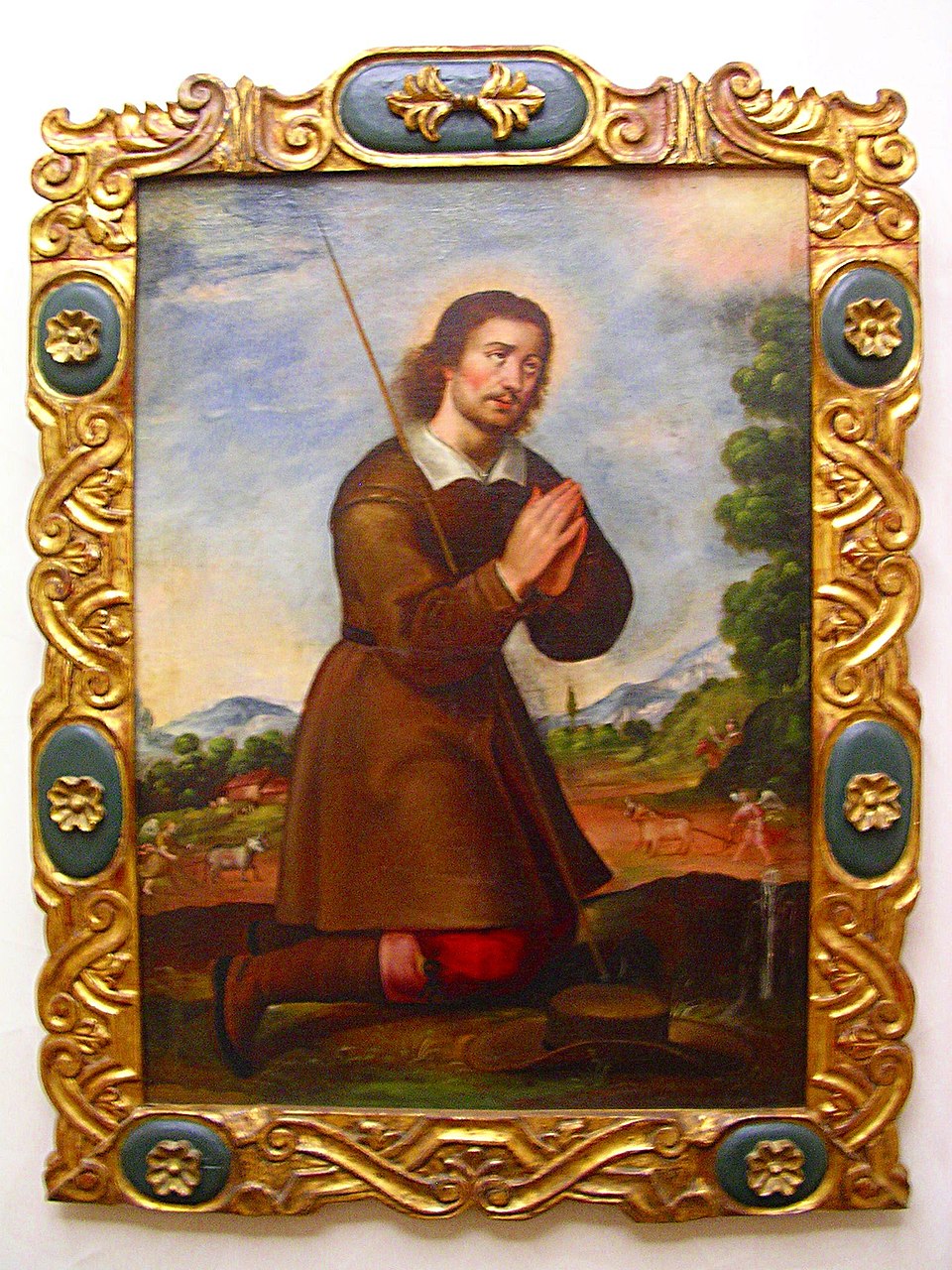
Biography
Saint Isidore the Laborer, born Isidro de Merlo y Quintana around 1070, lived a life of profound simplicity and unwavering faith in the rural landscapes surrounding Madrid, Spain. From a young age, he embraced the arduous yet honest toil of farming, a vocation he pursued with steadfast dedication for the same landowner throughout his entire life. His parents, devout and humble peasants, instilled in him a deep love for God and a spirit of generosity that would define his earthly journey. Despite the demanding nature of his work and the meager means afforded to a farm laborer of his era, Isidore was renowned for his extraordinary charity, always sharing his limited provisions with the poor and hungry, often leaving his own family with little. His days began with prayer, attending Mass before dawn, a practice that sometimes drew the ire of his fellow laborers who accused him of neglecting his duties. Yet, it was precisely in these moments of prayer that Isidore found the strength and grace to perform his tasks with diligence and joy.
Isidore's vocation was not one of grand sermons or theological treatises, but rather a ministry of humble service and profound devotion lived out in the fields. The accusations of his tardiness were often met with wonder when his employer would find the fields already plowed, sometimes even witnessing angels guiding the oxen, a miraculous intervention attributed to Isidore's fervent prayers. He was a man of deep contemplation, finding God in the rhythms of nature and the simple acts of daily labor. His life was a testament to the sanctity achievable in the most ordinary circumstances, demonstrating that true holiness lies not in worldly status but in a heart wholly given to God and neighbor. He was known to possess a special gift for finding water, a crucial skill in the arid regions of Castile, and many miracles of provision and healing were attributed to his intercession during his lifetime.
Saint Isidore passed away around 1130, and his earthly remains were interred in the local cemetery. However, forty years after his death, his body was exhumed and found to be remarkably preserved, a state of incorruption that has endured for over nine centuries. This extraordinary preservation, defying the natural processes of decay without any artificial means, stands as a powerful testament to his sanctity. His body, venerated by countless pilgrims, was eventually translated to the Collegiate Church of San Isidro in Madrid, where it rests today, housed in an ornate reliquary. Scientific analysis has only underscored the miraculous nature of his incorruption, a phenomenon that continues to inspire awe and devotion.
Canonized in 1622 alongside other great Spanish saints like Teresa of Ávila and Ignatius of Loyola, Saint Isidore the Laborer's legacy endures as the beloved patron of farmers, agricultural workers, and Madrid itself. His life teaches us that holiness is not reserved for the cloister or the pulpit, but can be found in the honest sweat of one's brow and the generous spirit of a humble heart. Pilgrims to Madrid can visit the Collegiate Church of San Isidro, where his incorrupt body is occasionally displayed for public veneration, offering a tangible link to a saint whose simple life continues to inspire profound faith and charity in a world often seeking grandeur. His story reminds us that God often chooses the humble to manifest His greatest wonders, proving that sanctity flourishes in the most unexpected places.
Discovery
Forty years after his earthly pilgrimage concluded in 1130, the humble farmer Isidore, whose life was a testament to unwavering faith and diligent labor, was to receive an extraordinary posthumous honor. It was in the year 1170, amidst the fervent devotion of the people of Madrid, that the first exhumation of his remains took place. The initial impetus for this solemn undertaking stemmed from the growing veneration for Isidore, whose reputation for sanctity had blossomed in the decades following his death. Miracles attributed to his intercession were becoming increasingly numerous, prompting a desire to translate his body to a more fitting resting place within the Church of San Andrés, where he had been initially interred in the churchyard. The exhumation was a public event, attended by local clergy, civic leaders, and a multitude of the faithful, all eager to witness the transfer of their beloved patron. As the earth was carefully removed from his grave, a collective gasp rippled through the assembled crowd. Instead of the expected skeletal remains, the body of Isidore lay before them, miraculously preserved, appearing as if he had only recently fallen into a peaceful slumber. His flesh, though somewhat darkened by time, was intact, and his features were still recognizable. This astonishing discovery, defying the natural laws of decomposition, was immediately recognized as a sign of divine favor, confirming the sanctity of the man who had lived such an unassuming life. The immediate reaction was one of profound awe and reverence, solidifying the nascent cult of Saint Isidore and marking the beginning of his journey towards formal recognition by the Church.
The remarkable state of preservation witnessed at the initial exhumation was not an isolated incident, but rather a consistent marvel observed over centuries of subsequent examinations. The body of Saint Isidore has undergone numerous inspections and translations throughout its long history, each occasion reaffirming its incorrupt status. In 1212, during the reign of Alfonso VIII, the body was once again examined, and its integrity was found to be undiminished, further cementing the belief in his sanctity. Perhaps one of the most significant examinations occurred in 1504, when Queen Isabella I of Castile, a fervent devotee of Saint Isidore, ordered a thorough inspection. Witnesses at this time recorded that his body remained flexible, a characteristic often associated with incorruptibility, and that a sweet, earthy fragrance emanated from his remains. This examination was meticulously documented, providing invaluable historical evidence of his enduring preservation. Later, in 1622, the very year of his canonization, another detailed inspection was conducted. The accounts from this period describe the body as still possessing its flesh and skin, albeit with a dark, almost mummified appearance, yet unmistakably preserved from the natural processes of decay. These repeated examinations, spanning centuries and involving various ecclesiastical and secular authorities, consistently attested to the extraordinary condition of Saint Isidore’s body, a testament to a phenomenon that continues to defy scientific explanation.
The preservation journey of Saint Isidore's incorrupt body is a narrative interwoven with the history of Madrid itself, reflecting both profound veneration and meticulous care. After its initial discovery, the body was reverently placed in a wooden coffin within the Church of San Andrés. However, with his growing fame and the eventual construction of a new, grander church dedicated to him, his remains were translated to the Royal Collegiate Church of San Isidro, where they reside to this day. Throughout the centuries, the body has been housed in various reliquaries, each designed to protect and honor its sacred contents. Currently, Saint Isidore's body is displayed within a magnificent silver and crystal urn, a reliquary of exquisite craftsmanship that allows the faithful to view his preserved form. This transparent casing provides both protection from environmental factors and an unobstructed view for pilgrims who come from across the globe to venerate him. The reliquary itself is situated within the main altar of the Royal Collegiate Church, a place of prominence befitting the patron saint of Madrid. The environment within the reliquary is carefully controlled, though the exact methods of preservation beyond the inherent incorruptibility are not publicly detailed, maintaining a sense of mystery around this miraculous phenomenon. The consistent display in a transparent, protective enclosure underscores the Church's belief in the body's authenticity and its desire to make this extraordinary relic accessible for public veneration, a continuous source of inspiration and spiritual solace.
Beyond the remarkable physical preservation, several extraordinary phenomena have been associated with Saint Isidore's incorrupt body, adding to the mystique surrounding his sanctity. As mentioned, during the 1504 examination, witnesses reported a distinct, sweet fragrance emanating from his remains, a phenomenon often described as the "odor of sanctity" in the lives of other incorrupt saints. This ethereal perfume, defying the expected stench of decay, was taken as a clear sign of divine favor. Furthermore, accounts from various periods describe the body as retaining a degree of flexibility, particularly in the limbs, an astonishing characteristic for remains that have been deceased for centuries. This pliability, observed during translations and examinations, further distinguishes his incorruptibility from mere mummification. While there are no widespread accounts of bleeding or oil exuding from his body, the sheer resistance to decay in an unsealed environment for such an extended period is a miracle in itself. The body has survived countless centuries, including periods of war and social upheaval, without succumbing to the natural processes of decomposition. These remarkable details, attested to by numerous historical accounts and witnesses, elevate Saint Isidore's incorruptibility beyond a mere curiosity, positioning it as a profound and enduring testament to the power of God and the sanctity of a humble farmer from Madrid.
Preservation
Body displayed in the Royal Collegiate Church of San Isidro, Madrid.
Scientific Analysis
The preservation of Saint Isidore the Laborer's body for nearly a millennium without artificial intervention presents a profound scientific enigma. Formal medical and scientific examinations, though not as extensive or publicly detailed as some more recent cases of purported incorruption, have nonetheless been conducted over centuries. Early accounts from the time of his exhumation in the 12th century, and subsequent transfers, describe a body that appeared remarkably intact, with skin, hair, and even clothing reportedly well-preserved. More specific examinations were documented during the 16th and 17th centuries, particularly in the lead-up to his canonization in 1622. During these periods, ecclesiastical commissions, often including physicians and surgeons of the time, were tasked with verifying the state of the remains. While precise names and institutional affiliations from these early examinations are often lost to detailed historical records or remain within restricted archival documents, the consistent reports from multiple independent witnesses over centuries attest to an unusual state of preservation. These examinations typically involved visual inspection and tactile assessment, noting the flexibility of the skin, the presence of internal organs, and the absence of the expected signs of advanced decomposition. Later, during the 20th century, particularly in the context of various relic venerations and transfers, further informal medical observations were made, reiterating the extraordinary state of the remains, though comprehensive modern forensic analysis has not been widely publicized.
The scientific remarkable nature of this case lies in its defiance of the normal decomposition processes. Following death, the human body typically undergoes a predictable sequence of changes: autolysis, putrefaction driven by microbial activity, insect activity, and eventually skeletonization. These processes are accelerated by environmental factors such as warmth, humidity, and exposure to oxygen. Saint Isidore, having died in 1130 and interred in the earth, should have undergone complete skeletonization within a few decades, if not sooner, especially given the historical burial practices which often lacked sophisticated embalming or protective measures. The climate of Madrid, characterized by hot, dry summers and cold winters, while potentially slowing some aspects of decomposition, does not typically lead to such long-term preservation without specific environmental conditions like extreme aridity or anoxic environments. There is no historical record or scientific evidence suggesting deliberate embalming or sophisticated preservation treatments were applied at the time of his death or initial burial. The consistent accounts of a remarkably intact body, including soft tissues, for over 800 years, without any known artificial intervention, fundamentally challenges the established understanding of post-mortem human decay.
Various natural explanations have been proposed to account for instances of unusual body preservation, such as saponification (adipocere formation) or mummification. Saponification, the conversion of body fats into a waxy, soap-like substance, occurs in specific environments, typically cool, moist, and anoxic conditions, which are not consistently described for Saint Isidore's burial environment. While adipocere can preserve body contours, it often results in a brittle or waxy texture, which does not fully align with historical descriptions of a more pliable state. Mummification, either natural (due to extreme dryness or cold) or artificial, also does not fit the historical narrative for Saint Isidore. The burial conditions in Madrid, while varying, are not inherently conducive to natural mummification on such a scale. Skeptics often point to the possibility of misinterpretation of historical accounts, the effects of subsequent interventions (even if not full embalming), or the natural variability in decomposition rates. However, the sheer duration of preservation and the consistent reports from multiple independent witnesses over centuries make it difficult to dismiss the phenomenon entirely as mere anecdotal exaggeration. The absence of clear evidence for specific environmental factors or deliberate preservation techniques that could explain this degree of preservation remains a significant scientific puzzle.
From a modern scientific perspective, the case of Saint Isidore the Laborer presents an intriguing opportunity for advanced forensic investigation. While historical accounts provide valuable qualitative data, the application of contemporary techniques could offer definitive insights. Non-invasive methods such as CT scans or MRI could provide detailed internal imaging without disturbing the remains, revealing the state of internal organs and bone structures. Carbon dating could precisely determine the age of the remains and any associated materials. Furthermore, microscopic tissue analysis, if ethically permissible and minimally invasive, could identify the specific cellular and molecular changes that have occurred, potentially revealing unique biochemical processes or environmental interactions that contributed to the preservation. Analysis of the burial environment, including soil composition, humidity levels, and microbial presence, could also shed light on potential factors. Such comprehensive studies, conducted with the highest scientific rigor and ethical considerations, could either confirm existing hypotheses of natural preservation mechanisms or, conversely, highlight truly anomalous biological phenomena that challenge current scientific understanding of human decomposition. Many questions remain unanswered, particularly regarding the precise biochemical mechanisms that have inhibited putrefaction and maintained tissue integrity for so long, making this case a compelling subject for continued scientific inquiry.
Spiritual Significance
The enduring incorruption of Saint Isidore the Laborer stands as a profound theological testament within the Catholic tradition, a visible sign of God's extraordinary grace working through His saints. This remarkable phenomenon, where the physical body resists the natural process of decay long after death, speaks directly to the doctrine of the body as a temple of the Holy Spirit, as articulated in 1 Corinthians 6:19. For Isidore, whose life was characterized by profound humility and unwavering devotion, his preserved remains suggest a special sanctity that permeated even his physical being. The Church interprets such incorruption not as a mere biological anomaly, but as a divine affirmation of the saint's heroic virtue and a foretaste of the resurrection of the body. It serves as a tangible reminder that our earthly bodies, consecrated through baptism and lived in holiness, are destined for glorification. Furthermore, Isidore's incorruption reinforces the communion of saints, bridging the gap between the Church Militant and the Church Triumphant, offering a visible link to those who have gone before us in faith and now intercede for us from heaven. It is a powerful catechesis in itself, teaching that true holiness can imbue even the physical with an enduring spiritual significance.
Saint Isidore's unique charism was undoubtedly his profound simplicity and unwavering faith, lived out in the most ordinary of circumstances. His heroic virtues were not displayed on grand stages but in the humble fields of rural Spain. Humility was his constant companion, as he labored tirelessly for the same landowner his entire life, never seeking personal gain or recognition. His charity was legendary, often sharing his meager provisions with the poor and hungry, even at the expense of his own family's comfort, embodying a radical detachment from worldly possessions. Obedience marked his daily routine, submitting to the demands of his work and the will of God with serene acceptance. While not a mystic in the traditional sense of ecstatic visions, his deep prayer life and constant awareness of God's presence in creation reveal a profound interior spirituality, a mysticism of the everyday. He contributed to no formal theological school but rather exemplified the "little way" of holiness, demonstrating that sanctity is attainable through faithful perseverance in one's vocation, no matter how mundane it may seem. His life was a living sermon on the dignity of labor and the sanctification of daily toil, proving that the sacred can be found in the secular.
Devotion to Saint Isidore the Laborer has flourished over centuries, particularly among agricultural communities and those who labor with their hands. He is widely revered as the Patron of Farmers, agricultural workers, and Madrid itself. His feast day on May 15th is celebrated with particular fervor in many parts of the world, often involving processions, blessings of crops, and special Masses. Numerous prayers and novenas have been composed seeking his intercession for bountiful harvests, protection from natural disasters, and the sanctification of work. Pilgrims today journey to the Royal Collegiate Church of San Isidro in Madrid, where his incorrupt body rests, to pay homage and seek his powerful intercession. The experience of visiting his shrine is often described as deeply moving, a profound encounter with a tangible manifestation of holiness. To stand before his preserved remains is to be confronted with a life lived entirely for God, a silent yet eloquent testimony to the transformative power of faith and the enduring presence of the divine in the human story. The reverence shown to his incorrupt body is not idolatry, but a profound respect for the vessel that housed such a holy soul.
Miracles attributed to Saint Isidore's intercession are numerous and span centuries, often focusing on themes related to agriculture, sustenance, and healing. Documented accounts speak of miraculous springs appearing in times of drought, ensuring crops and providing water for communities. There are also reports of extraordinary harvests following prayers to Isidore, and instances of livestock being protected from disease or harm. Beyond agricultural miracles, many personal healings and conversions have been attributed to his powerful intercession, demonstrating his compassionate responsiveness to the needs of the faithful. The incorrupt body itself has been a source of immense spiritual consolation, particularly during times of plague or hardship. In Madrid, during outbreaks of disease, his body was often carried in procession, and many believed that its presence brought an end to the epidemics. This tangible relic serves as a constant reminder of God's power working through His saints, offering hope and reassurance that heaven is intimately connected to earth, and that our prayers are heard and answered through the intercession of those who dwell in glory.
Saint Isidore's enduring message for contemporary Catholics and seekers is remarkably relevant in our often-materialistic and secularized world. His life challenges the modern obsession with wealth, status, and instant gratification, demonstrating that true fulfillment and holiness are found not in worldly success, but in faithful service and humble dedication to one's vocation. In an age where work is often seen as a necessary evil or merely a means to an end, Isidore elevates labor to a sacred act, showing that even the most mundane tasks can be sanctified when offered to God with a loving heart. He teaches us the dignity of manual labor and the profound spiritual rewards of a simple, virtuous life. His incorruption serves as a tangible bridge between the visible and invisible worlds, a concrete reminder that eternity is real and that our earthly actions have eternal consequences. For those grappling with the complexities of modern life, Isidore offers a refreshing example of profound peace found in surrender to divine providence, a beacon of hope that holiness is accessible to everyone, regardless of their station in life, and that God truly blesses those who labor in love.
AI summary
A plain-language overview generated from this page's source material. Always verify with primary sources.