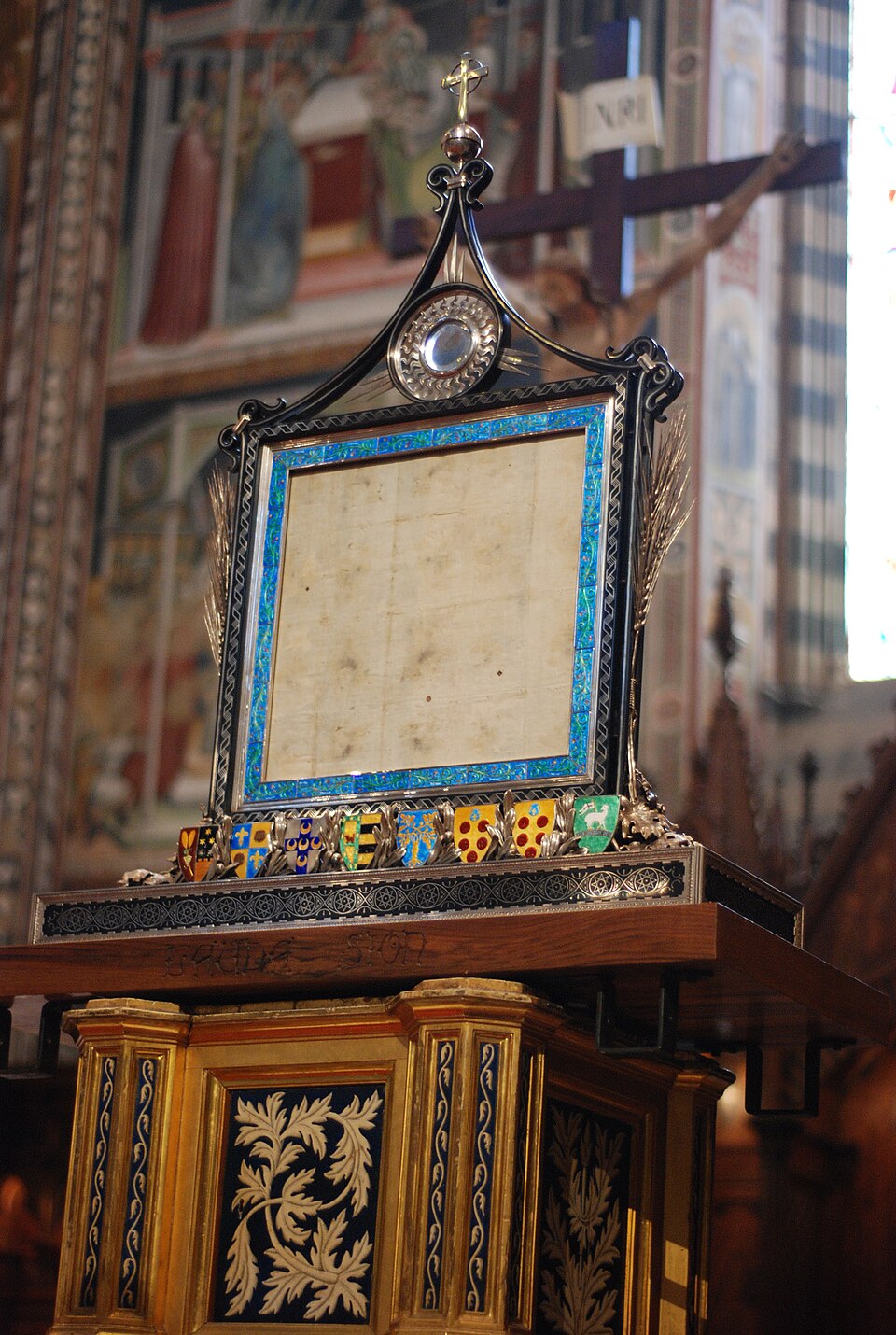
A priest who had forgotten to clean the chalice after Mass found the remaining consecrated wine had transformed into blood, which then coagulated into visible clots. The blood was preserved and a second miracle occurred in 1595 when the blood was found to be still fresh after 365 years.
History
On December 30, 1230, a priest named Uguccione at the Church of Sant'Ambrogio in Florence forgot to clean the chalice after Mass. The next morning, he found that the remaining drops of consecrated wine had transformed into coagulated blood. The miracle was investigated by the Bishop of Florence and declared authentic. The blood was carefully preserved in a crystal ampulla. In 1595 — 365 years later — when the reliquary was opened for inspection, the blood was found to be still fresh and liquid, constituting a second miracle. The Church of Sant'Ambrogio became an important pilgrimage site, and the double miracle of Florence is considered one of the most remarkable Eucharistic miracles in Italian history.
Scientific Findings
The blood has been preserved for nearly 800 years. The 1595 examination found the blood to be still fresh after 365 years, which is considered scientifically inexplicable. The double miracle — the initial transformation and the subsequent preservation — provides two distinct phenomena for investigation.
AI summary
A plain-language overview generated from this page's source material. Always verify with primary sources.