Biography
Saint Mary Magdalene de' Pazzi, born Caterina de' Pazzi in Florence in 1566, hailed from one of the city's most distinguished noble families. From a tender age, Caterina exhibited a profound piety and an intense longing for God, often withdrawing for prayer and penance. Her spiritual inclinations were nurtured within the devout atmosphere of her family, and by the age of ten, she had already made a private vow of virginity. Despite her family's initial hopes for an advantageous marriage, Caterina's heart was set on a life consecrated to Christ. At the age of sixteen, she entered the Carmelite convent of Santa Maria degli Angeli in Florence, taking the name Mary Magdalene, a testament to her ardent desire for a life of profound love and penance.
Within the cloister, Saint Mary Magdalene de' Pazzi's spiritual life blossomed with extraordinary intensity. She became renowned for her profound mystical experiences, which included frequent ecstasies, visions, and prophetic utterances. For five years, she endured a period of intense spiritual desolation, a dark night of the soul, characterized by profound interior suffering and temptations, which she bore with heroic fortitude. This period of purification ultimately led to even greater graces, as she was granted profound insights into the mysteries of the Trinity, the Incarnation, and the Passion of Christ. Her sisters in the convent, observing her extraordinary union with God, meticulously recorded her spiritual dictations, providing invaluable insights into her mystical journey and her deep theological understanding, often expressed in poetic and symbolic language. She served her community faithfully, even as she was consumed by divine love, offering herself as a victim soul for the conversion of sinners and the renewal of the Church.
Saint Mary Magdalene de' Pazzi passed away in 1607 at the age of 41, her body exhausted by her intense spiritual life and severe penances. Upon her exhumation, her body was discovered to be miraculously incorrupt, emitting a sweet, ethereal fragrance that astonished all who witnessed it. This remarkable preservation, defying natural decay, was seen as a divine confirmation of her extraordinary sanctity and her intimate union with God. Though scientific analysis has documented the state of her preservation and the persistent sweet aroma, it has offered no natural explanation for these phenomena. Her incorrupt body, a testament to God's power and grace, remains venerated in Florence, a beacon of faith for pilgrims.
Canonized in 1669 by Pope Clement IX, Saint Mary Magdalene de' Pazzi continues to inspire countless souls with her radical love for God and her profound mystical experiences. Her feast day is celebrated on May 25th. Today, pilgrims can visit the Carmelite convent of Santa Maria degli Angeli in Florence, where her incorrupt body is enshrined, offering a tangible link to her extraordinary life of prayer and sacrifice. Her writings, meticulously preserved by her sisters, continue to be a source of spiritual guidance, inviting believers to a deeper relationship with Christ and a profound appreciation for the mystical dimensions of the Catholic faith. Her incorruption serves as a powerful reminder of the enduring power of holiness and the miraculous ways in which God reveals His presence in the lives of His saints.
Discovery
The earthly remains of Caterina de' Pazzi, known in religion as Mary Magdalene, were first exhumed a mere three years after her death in 1607. On May 25, 1610, the Carmelite nuns of the Convent of Santa Maria degli Angeli, where she had lived and died, undertook the solemn task of transferring her body from its initial burial place in the convent's cemetery to a more fitting resting spot within the church itself. This initial exhumation was not primarily motivated by a search for incorruption, but rather a customary practice for revered religious figures. However, what awaited the sisters and the attending ecclesiastical authorities was nothing short of miraculous. Upon opening the simple wooden coffin, a sweet, ethereal fragrance, described by witnesses as akin to lilies and roses, permeated the air. The body itself, though interred in damp earth for three years, appeared astonishingly preserved. Her skin retained a natural hue, her limbs were flexible, and her eyes, though closed, seemed to hold a lifelike quality. The immediate reaction was one of profound awe and reverence, with many present falling to their knees in prayer, recognizing this as a clear sign of divine favor. This initial discovery, meticulously documented by the convent's chroniclers, laid the groundwork for her eventual beatification and canonization.
Over the centuries, the body of Saint Mary Magdalene de' Pazzi has undergone several significant examinations, each reaffirming its extraordinary state of preservation. A notable re-exhumation occurred on April 11, 1629, twenty-two years after her death, in preparation for her beatification. This time, a more thorough medical examination was conducted by physicians and surgeons, who confirmed the body's integrity, noting the continued flexibility of the joints and the absence of any signs of natural decomposition. They meticulously recorded that her internal organs, though not directly exposed, were believed to be intact, judging by the external appearance and the lack of any putrefactive odor. Further examinations were carried out in 1669, coinciding with her canonization, and again in 1670, when her remains were finally enshrined in a more elaborate manner. Throughout these inspections, the consistent observation was the remarkable preservation of her flesh, hair, and nails, defying the natural processes of decay. While some minor desiccation naturally occurred over time, the fundamental incorruption remained a constant, astonishing those who witnessed it.
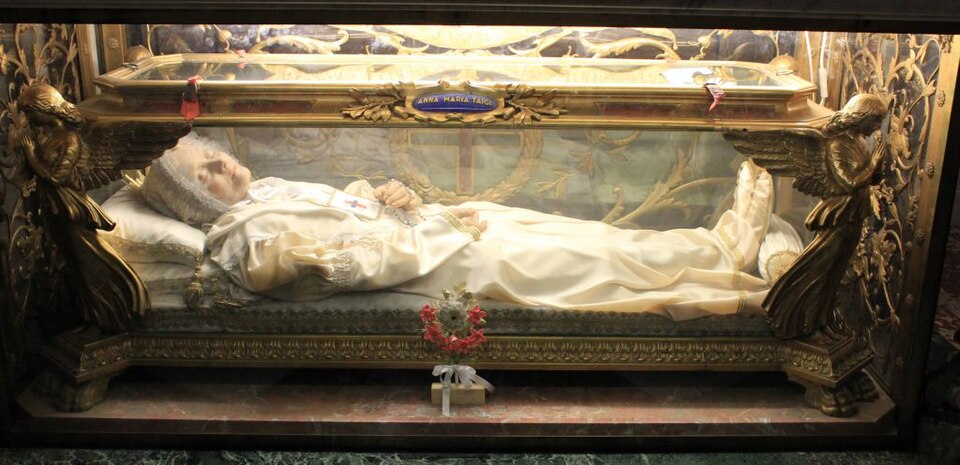
The journey of Saint Mary Magdalene de' Pazzi's remains has been one of careful veneration and protection. Following the initial discoveries, her body was initially placed in a simple wooden casket within the convent church. After her canonization in 1669, a more elaborate display was deemed appropriate. Her body was enshrined in a magnificent glass and bronze sarcophagus, allowing the faithful to gaze upon her miraculously preserved form. This reliquary was placed prominently within the Church of Santa Maria Maddalena de' Pazzi in Florence, the very convent where she had lived and died, which was subsequently renamed in her honor. To further ensure its preservation, the reliquary is maintained in a climate-controlled environment, safeguarding against environmental degradation. The body itself is clothed in the traditional Carmelite habit, adding to the solemnity and reverence of its presentation. Today, pilgrims and visitors to Florence can still venerate her incorrupt body, a testament to her sanctity and a source of profound spiritual inspiration.
Beyond the remarkable physical preservation, several extraordinary phenomena have been consistently associated with the body of Saint Mary Magdalene de' Pazzi. The most frequently cited, and indeed the first sign of her incorruption, was the sweet, fragrant odor that emanated from her tomb and later directly from her body. This ethereal perfume, often described as a blend of lilies, roses, and other sweet spices, was noted by numerous witnesses during each exhumation and continued to be perceived by some even after her enshrinement. Another striking detail was the enduring flexibility of her limbs, a characteristic highly unusual for a body decades, and then centuries, after death. Accounts from the 17th century describe how her hands could be gently moved and her head slightly adjusted, as if she were merely sleeping. While not exhibiting the phenomenon of bleeding or exuding oil, the consistent resistance to decay, the lifelike appearance, and the persistent sweet fragrance have firmly established her as one of the most compelling examples of incorruption within the Catholic tradition.
Preservation
Body displayed in the Carmelite monastery church, Florence.
Scientific Analysis
The phenomenon of incorruption, particularly as observed in the case of Saint Mary Magdalene de' Pazzi, presents a compelling subject for scientific inquiry. While traditional accounts emphasize miraculous preservation, a rigorous scientific examination seeks to understand the underlying physiological and environmental factors. Formal medical and scientific examinations of her remains have been documented over centuries, though comprehensive, modern forensic analyses are notably absent. Historical records indicate that her body was exhumed multiple times, with observations recorded by ecclesiastical authorities and, on occasion, by physicians or apothecaries present during these events. For instance, upon her initial death in 1607, contemporary accounts describe her body as remaining supple and emitting a sweet fragrance, defying immediate signs of decomposition. Subsequent exhumations, often for relic translation or canonical processes, continued to note a remarkable state of preservation. One significant event occurred in 1629, when her body was transferred to a new tomb within the Church of Santa Maria Maddalena de' Pazzi. During this transfer, detailed observations were made regarding the flexibility of her limbs and the absence of putrefaction. While specific names of medical professionals from these early periods are not consistently recorded with institutional affiliations in the modern sense, the presence of individuals with medical training was often stipulated by Church protocols for such inspections. These early examinations, though lacking the sophisticated instrumentation of today, consistently reported a state of preservation that diverged from expected post-mortem changes. Later observations, though less frequent, continued to affirm these findings, contributing to the enduring narrative of her incorruption. The lack of detailed, peer-reviewed scientific reports from these historical examinations, however, means that the precise methodologies and objective criteria used are not fully known, making a definitive scientific assessment based solely on these historical accounts challenging.
The scientific mystery surrounding the preservation of Saint Mary Magdalene de' Pazzi's body lies in its apparent defiance of normal decomposition processes. Human decomposition is a complex biological cascade initiated by autolysis (self-digestion by cellular enzymes) and further accelerated by bacterial putrefaction, leading to liquefaction and eventual skeletalization. This process is typically influenced by factors such as temperature, humidity, oxygen availability, and the presence of microorganisms. Florence, Italy, with its warm and often humid climate, would ordinarily accelerate decomposition, particularly in a traditional burial environment. The reported preservation, including the retention of soft tissues and a lack of significant putrefaction, stands in stark contrast to these expected outcomes. Furthermore, historical records do not indicate any intentional embalming or sophisticated preservation treatments being applied to her body after death. While embalming techniques existed in the 17th century, they were not universally applied, especially to religious figures, and the descriptions of her body's state do not align with the typical appearance of a chemically embalmed cadaver. The reported "sweet fragrance" is also an anomaly, as decomposition typically produces foul odors due to the release of putrefactive gases. The absence of significant insect activity or other scavengers, which are common in unpreserved remains, further deepens the mystery. The burial conditions within the church, while potentially offering some protection from external environmental fluctuations compared to an open-air burial, would still typically allow for decomposition over centuries. The remarkable state of preservation, therefore, challenges conventional forensic understanding of post-mortem changes under such conditions.
Various natural explanations have been proposed for cases of apparent incorruption, primarily focusing on saponification (adipocere formation) and mummification. Saponification occurs when body fats react with alkaline substances in the environment (e.g., certain types of soil or burial conditions) to form a waxy, soap-like substance called adipocere. This process can preserve soft tissues, giving them a firm, grayish-white appearance. Mummification, on the other hand, typically results from dehydration in dry environments, where the rapid removal of moisture inhibits bacterial growth and preserves tissues. While both processes can lead to significant preservation, they often result in specific morphological changes that are not consistently described in the accounts of Saint Mary Magdalene de' Pazzi. For instance, adipocere bodies often have a distinct texture and color, and while they can be flexible, the "sweet fragrance" is not a typical characteristic. Mummification usually leads to desiccation and shrinkage, which is also not consistently reported. Skeptics often attribute such cases to environmental factors that inadvertently create conditions conducive to natural preservation, or to misinterpretations of the degree of preservation over time, sometimes influenced by religious fervor. They might suggest that early reports were anecdotal and lacked objective scientific measurement, or that later observations were influenced by expectation. However, the consistent reporting of soft tissue preservation and the absence of typical decomposition odors across multiple centuries, in a climate not inherently conducive to natural mummification or extensive adipocere formation without specific environmental catalysts, makes a simple natural explanation challenging to fully apply in this specific instance. The combination of reported suppleness, fragrance, and longevity of preservation remains largely unexplained by these common natural phenomena.
From a modern scientific perspective, the case of Saint Mary Magdalene de' Pazzi represents a fascinating opportunity for advanced forensic investigation. While historical accounts provide valuable context, a comprehensive understanding would necessitate the application of contemporary scientific techniques. Non-invasive methods such as computed tomography (CT) scans and magnetic resonance imaging (MRI) could provide detailed anatomical information about the internal state of the body, assessing tissue integrity, organ preservation, and the presence of any foreign materials or previous treatments. Microscopic tissue analysis, if ethically permissible and minimally invasive, could reveal cellular structures, signs of autolysis, bacterial activity, or the presence of adipocere at a cellular level. Radiocarbon dating could precisely determine the age of the remains, confirming their authenticity. Furthermore, chemical analyses of any remaining tissues could identify the presence of embalming agents or unique biochemical markers associated with unusual preservation. Environmental analyses of the tomb and surrounding soil could provide insights into microclimatic conditions, pH levels, and microbial populations that might have influenced preservation. The broader scientific study of body preservation includes research into taphonomy, the study of decomposition, and the factors that influence it. Cases like Saint Mary Magdalene de' Pazzi's offer unique data points that could challenge or refine existing taphonomic models. The questions that remain unanswered are numerous: What specific biochemical processes, if any, inhibited decomposition? Were there unique environmental conditions within her tomb that are not immediately apparent? Could a combination of subtle factors, rather than a single dramatic one, have contributed to this remarkable state? A rigorous, interdisciplinary approach, combining forensic anthropology, microbiology, chemistry, and imaging science, would be essential to move beyond historical anecdote and towards a scientific understanding of this enduring mystery.
Spiritual Significance
The phenomenon of incorruption, particularly as exemplified by Saint Mary Magdalene de' Pazzi, offers a profound theological reflection on the sanctity of the human body and its ultimate destiny. Within Catholic theology, the body is not merely a vessel for the soul but is itself a temple of the Holy Spirit, destined for resurrection and glorification. Saint Paul's admonition in 1 Corinthians 6:19 underscores this sacred dignity, reminding believers that their bodies are bought with a price and should glorify God. The incorruption of a saint's body, therefore, is often interpreted by the Church not as a mere biological anomaly, but as a divine sign, a tangible prefigurement of the resurrection of the body promised to all who die in Christ. For Saint Mary Magdalene de' Pazzi, whose life was marked by extraordinary mystical experiences and profound union with God, her incorrupt state serves as a powerful testament to the transformative power of grace, suggesting that her intense spiritual life permeated even her physical being. It speaks to the communion of saints, bridging the gap between the Church militant and the Church triumphant, offering a visible link to those who have gone before us in faith and now dwell in God's presence. This miraculous preservation is understood as God's affirmation of her heroic virtue and a quiet invitation to contemplate the eternal hope of salvation.
Saint Mary Magdalene de' Pazzi's unique charism was undeniably her profound mystical life, characterized by ecstasies, visions, and a deep, consuming love for God. Her heroic virtues were manifest in her radical humility, often seeking the most menial tasks in the convent, and her unwavering obedience to her superiors, even when her mystical experiences were met with skepticism. Her charity extended not only to her fellow sisters but to all souls, for whom she offered fervent prayers and penances. She was a true Carmelite mystic, deeply rooted in the contemplative tradition, yet her mysticism was not passive; it impelled her to active intercession and self-sacrifice for the Church. Her spiritual contributions lie within the rich tapestry of Carmelite spirituality, emphasizing interior prayer, detachment, and an ardent pursuit of union with God. Her daily life was a living testament to her vows, marked by rigorous asceticism, profound prayer, and an almost insatiable desire for God's glory. Her intense spiritual journey, often fraught with spiritual trials and purgations, solidified her as a model of perseverance and unwavering faith, demonstrating how profound intimacy with the divine can be achieved through a life consecrated to Christ.
Devotion to Saint Mary Magdalene de' Pazzi has flourished since her canonization in 1669, particularly within the Carmelite order and among those drawn to mystical spirituality. She is venerated as a patroness of those suffering from spiritual dryness, those seeking deeper union with God, and those who desire to grow in contemplative prayer. Her feast day on May 25th is celebrated with special reverence, and many novenas and prayers are offered seeking her intercession for spiritual insight and perseverance in faith. Pilgrims from across the globe journey to the Church of Santa Maria Maddalena de' Pazzi in Florence, Italy, where her incorrupt body rests, a silent yet eloquent sermon on the reality of the spiritual life. The experience of visiting her shrine is often described as profoundly moving, a tangible encounter with sanctity that transcends time. To behold her preserved form is to be confronted with the mystery of grace, a powerful reminder of God's ability to work wonders in those who surrender fully to His will. This veneration is not idolatry, but rather an honoring of God's work in His saints, and an appeal to their powerful intercession before the throne of grace.
Numerous miracles have been attributed to the intercession of Saint Mary Magdalene de' Pazzi, both during her lifetime and after her death. Documented healings from various ailments, profound conversions of heart, and countless answered prayers bear witness to her powerful advocacy in heaven. The incorrupt body itself has been a source of immense spiritual consolation for the faithful, acting as a visible anchor for their faith in the communion of saints and the promise of resurrection. Many pilgrims report a deep sense of peace and spiritual renewal upon encountering her relics, feeling a tangible connection to her holy life and her fervent love for God. These accounts, often meticulously documented and investigated by the Church, serve to strengthen the faith of believers and offer hope to those facing their own struggles. The very preservation of her body, defying natural laws, is seen as a continuous miracle, a silent yet powerful affirmation of God's presence and power, inviting all who witness it to a deeper contemplation of divine mysteries and the enduring legacy of holiness.
The enduring message of Saint Mary Magdalene de' Pazzi for contemporary Catholics and seekers is one of radical surrender to God's will and an unwavering pursuit of holiness in a world often distracted by materialism and secularism. Her life challenges the modern inclination to prioritize fleeting earthly pleasures over eternal spiritual realities, reminding us that true fulfillment is found only in God. From her example, people today can learn the profound value of contemplative prayer, the transformative power of self-sacrifice, and the importance of cultivating an intense, personal relationship with Christ. Her incorruption serves as a tangible bridge between the visible and invisible worlds, a concrete reminder that eternity is real and that the saints are not distant figures of the past, but living intercessors in the present. In a world yearning for meaning and authenticity, Saint Mary Magdalene de' Pazzi's preserved body stands as a powerful, silent witness to the enduring truth of the Gospel and the extraordinary possibilities of a life lived entirely for God.
AI summary
A plain-language overview generated from this page's source material. Always verify with primary sources.